Tuesday, December 4, 2012

Savior of the Universe...

Like most of my reviews, this one comes well after the release date.  But if you think about some of the movies I've been reviewing, I'm decades late.  And let's not ponder just how I'd zip back to a time before my birth to have caught some of them on opening night.  Or ponder it. Heck, I'm game.


I finally got my hands on the first volume of IDW's new reproduction of Alex Raymond's Flash Gordon and Jungle Jim.  And whoa nelly, it's a beautiful book that was well worth waiting for. Over the years, I've picked up and/or flipped through a number of the reprints of Raymond's seminal space hero only to be let down by one facet of them or another. Now, while we'd all love to see someone track down all the original b&w artwork penned by Raymond for the series, until I'm a bazillionaire who can pull of such a feat, this might be one of the better collections we're going to get.

Alex Raymond (1909-1956) is legendary in the field of comics, not merely for creating Flash (who was originally meant to be competition for the popular Buck Rogers strip) but for creating an elegant, thinly lined realistic style of cartooning. Tragically, his life was cut short in an automobile accident with fellow comic artist Stan Drake (Drake survived.). His professional life and this accident were the intense focus of Dave Sim's otherwise satirical comic Glamourpuss.  Flash, however, continues to thrive and survive and Raymond's other creation, Rip Kirby, outlived its creator by another 40 years.


The introduction does a wonderful job of introducing new readers to Raymond and his work. It also attempts to tackle the controversy regarding long time Flash editor and contributor, Don Moore.  Moore took over writing Flash Gordon after Raymond left the strip to enlist for World War II, but it's often been argued whether he was writing Flash while Raymond drew it, writing additional material, or merely editing Raymond's work. The answer will likely continue to be unknown, but at least that Moore was definitely a part of the Flash and Jungle Jim families receives acknowledgement.


As to the content itself, Flash gets off to a bit of both an abrupt and slightly rough start. Anyone familiar with Raymond's prowess might be surprised just how clunky the earliest of both strips kick off, then how simplistic they become before finally settling into all the flowing line work. I've gone over a number of strip collections and seen the work grow over many years. Raymond, however, moves by leaps and bounds in developing his style...then takes a few steps back...then leaps forward again. If you wanna see an artist grow, you'd be hard-pressed to do better than this book.  The writing too takes a fair bit of time to finally find its legs, but there's never a dull moment as the story rushes headlong forward from the first strip. The only strange part is the weird obsession with characters wanting to marry one another, but you'll have to read them to find out.

I was surprised that the book also featured a warning concerning the racial stereotyping featured in the stories. I'm going to have to say that Jungle Jim, with it's jungle natives and treacherous local guides is far more likely to ruffle feathers.  It certainly doesn't go out of it's way to be offensive like many other works of the time, but it's still offensive. In Flash, on the other hand, it's always surprised me that Ming the Merciless managed to reach a far more neutral place despite his obvious "Yellow Peril" roots. He and his men start as an almost caricature of Sax Rohmer's Fu Manchu. I suppose his escape from stereotype hell has something to do with his being from another planet, and that other than the occasional outfit, there's nothing terribly Asian about him.  In any event, you've been warned.

The book's a good 16" x 12", which might not quite match the newspapers of the day, it's quite generous for a polo-playing space jockey that's nearly eighty years old now. While there's clearly limitations in the source material from one strip to the next, the line work is generally clear and detailed. The colors are well-reproduced, (but...ok, back to my dream project up there...I'd love to see a side by side of the b&w originals paired with the colored version that went to print), but occasionally mask some of the inking beneath. While a few strips looked like they'd had a good washing out, most are probably as crisp if not far crisper than when they saw print in the 1930's. In all, it's a most happy edition to my shelves and a font of inspiration.
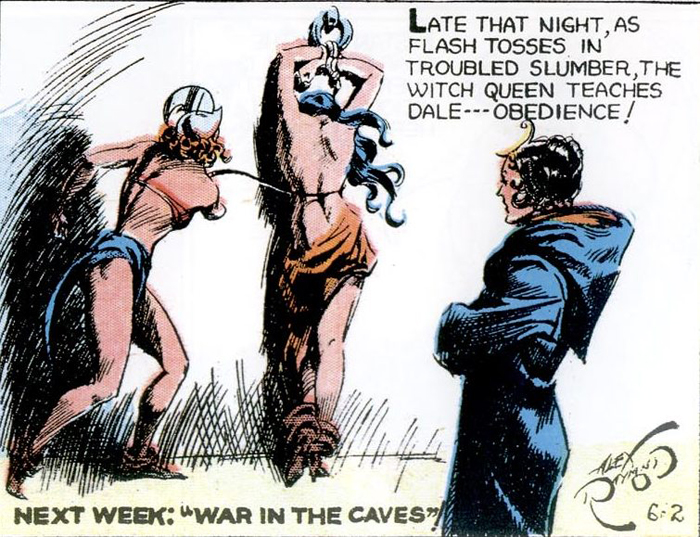
(Note: This reproduction's not from this wonderfully printed book...but is hilarious nonetheless.)


Thursday, November 29, 2012

Al cinema!

Subtlety, thy name is "giallo"...
For this review, I felt the need to return to both my and the internet's roots with some cinematic esoterica. Like so many of my fellow cinephiles, I too would roam from video store to video store collecting both the classics and the dregs of the cinematic experience.  As the internet first began to develop it saw not only the development of community around the motion picture arcane, but rapidly became a valued source for building up a lengthy checklist of sought after obscurity. Naturally, Italian genre films of the 60's and 70's were one of the most well-mined of these, and so it was to Italia that I ventured.

How many killers were merely attempting bad tracheotomies?
I kicked things off with the 1971 giallo The Iguana with the Tongue of Fire (L'inguana dalla lingua di fuoco). The story concerns a series of murders surrounding a Swiss diplomat stationed in Dublin. The rather bizarre title (and what great giallo doesn't have a bizarre title?) refers to the killer's enjoyment of throwing acid in the face of victims before slitting their throats. The Inspector in charge of the case calls in disgraced Inspector Norton with the playful nickname "The Brute", played by Euro-genre movie favorite Luigi Pistilli, to get in close to the family to solve the murders despite the difficulties of diplomatic immunity.

The "Brute"..."Groggy"...was Luigi's character ever called "Friendly"?
Like most giallos, as the bodies pile up, everyone becomes a suspect at some point or another, although usually it's mostly the male cast. However, in Iguana the ladies get a fair few visual clue nods. Blending in intrigue with the diplomat's family and the gloomy settings around Dublin gives the film a Gothic feel; however, like too many gialli, atmosphere and a steadily mounting body count take precedence over a coherent story.  Pistilli, who I always revert back to thinking of as Indio's trusted man Groggy in For a Few Dollars More, plays a good part...but it's especially disconcerting to hear an Irish brogue coming out of this Italian character actor.

This poster should have Spoiler Alert stamped on it...and maybe this caption should too.
For my second feature I switched to the Wild European West with 1972's Fast Hand is Still My Name ( Mi chiamavano 'Requiescat'...ma avevano sbagliato which actually translates to something more like They called me "Rest In Peace"...But They Were Wrong). After the American Civil War, Union soldiers scour the West for a band of terrorizing southern rebels led by Machedo. When soldier Jeff Madison returns to the Union fort, Machedo's men capture him, and after massacring the other soldiers, they torture Madison before shooting holes in his gun hand and leaving him for dead. Madison returns to foil a bank heist pulled by Machedo in order to exact his revenge as they look for their ill-gotten loot.  


Alan Steel stars in Tom of Finland's Zorro!
Fast Hand is a late entry and I wasn't expecting much...and, well, it didn't deliver much. It had the opposite problem of Iguana, in that, it was pretty straight forward but kept throwing in moments and plot elements to make it seem more complex.  William Berger, who is a particular favorite spaghetti staple of mine, lapses well into Klaus Kinski level histrionics as Machedo. Alan Steel, far better known for playing in a number of Hercules films (including my favorite, Hercules Versus The Moon Men), makes for one of spaghetti's blandest heroes. Not too mention, he frequently looks like he over did it with the eye make-up. Equally out of place was the movie's oddly moody, jazzy score.

I can't bring myself to mock William Berger...Sorry.
Now, would I recommend either of these movies? Well, that depends. To the general movie-going public...no. To those who love the good and the gloriously bad...a bit more.  There's far worse things to waste your time on than this aged genre detritus...like most of the awful, expensive new trash opening at the cinema each week.


Tuesday, November 27, 2012

"First time she ever handles a gun, she gets shot!"

Not affiliated with the Kinsey Report...
Time for another relative quickie.

During the art house movie boon in the 90's, a weird revival came around in the form of Russ Meyer's 1965 trashy epic Faster Pussycat! Kill! Kill!  Naturally, I took a front row seat for the first showing and was summarily blown out of the theater. Every line was loaded with a hardboiled style of innuendo, as three go-go dancers hunt after the fortune of a crazy old man in the desert.  I still remember my dad chuckling when I told him what I'd seen, and he explained that back when it had originally been released, everyone knew Russ as the "guy who made nudie flicks with the girls with big boobs." (On a side note, I got to meet Meyer a few years later at a midnight screening. Though in his mid-70's at the time, he was slightly drunk and ready to party it up with a bunch of college film nerds.)

Russ Meyer and...say...who's that dapper young film critic on the right?
Over the years, I managed to see all but one of Russ's piece of handiwork...and he indeed made lots of nudies with girls with big boobs.  But what was odd was how much analytic attention, including a fair amount of praise, Russ received from not only mainstream film critics but also feminist critics. Furthermore, Russ had had a wild life having worked as a cameraman in World War II and as one of Hef's photographers for the early days of Playboy before delving into filmmaking. But despite his leanings toward the lurid and titillating (pun fully intended...come on, you can't resist putting that word in a review of Russ somewhere), he quietly bowed out when some full frontal and a heavy heaping of innuendo had to make way for hardcore pornography.

In Russ's catalogue under "nature" photography...
Which brings us to his 1967 effort Common Law Cabin (aka. How Much Loving Does a Normal Couple Need?), which was written by (and, oddly enough, starred) Jack Moran, who'd written Faster Pussycat.  And it is truly an old trashy paperback come to life as multiple couplings amongst a strange disparate group of strangers devolves into violence at a strange backwater resort in the deserts of Arizona. Now, I could take the time to write up a long paragraph trying to give you a better idea of the plotting, but like any salty old paperback, it'd result in a lot of minor random plot twists that led to either sex or death and little else.

The movie's short, falling just shy of a 70 minute runtime. The pacing's a little up and down, making it still feel well around feature length or more. The acting's reasonable (The highlight being Alaina Capri, who excels at being the vampy bitch). The plot, as I mentioned, is fairly absurd, eventually involving stolen diamonds and a runaway millionaire kid. But boy, the dialogue flies fast and funny. It's a colorful and brightly lit version of something you'd expect coming from dark alleyways and flophouses.  I could cite some of it, but let's face it, innuendo lies pretty dead on the page until some buxom raven-haired vamp slices your ears with it.

Not, I repeat, not from a 60's sitcom...
In any event, it's not one of Russ's better efforts, but certainly a must for aficionados of Meyer's work. It's got the aforementioned oversexed "girls with big boobs," though they keep them pretty much under wraps. It's got the men who are impotent in more ways than one. And after all the fun, it's got the usual moralistic wrap-up, which is something I always found hilarious. Much like the writings of de Sade, who sought depths of depravity well below the lowest of where Meyer plumbs, the stories still manage to reward the virtuous and punish the evildoers.


Friday, November 23, 2012

Many Thanks...

Sorry. Meant to put this up yesterday.

No review for yesterday as it was a holiday here. Unless you want to hear how my meal was? No? I thought not.

We'll return next week with more general culture-based nonsense.  In the meantime, accept this three year old sketch I did of Groucho Marx.
"Well, art is art, isn't it? Still, on the other hand, water is water. And east is east and west is west and if you take cranberries and stew them like apple sause they taste much more like prunes than rhubarb does. Now, you tell me what you know." - Groucho Marx, Animal Crackers (1930)

Tuesday, November 20, 2012

"This is a seven shot six-shooter..."

Let's kick this review off with the acknowledgement of the power of cliché.


When I came across a listing for The Villain (aka. Cactus Jack, 1979), I was amazed that there was a comedy western, starring Kirk Douglas and Arnold Schwarzenegger no less, that I had never heard of. The clichéd response is one of two: a)...and now I know why, or b) ...and I wish I hadn't!  Or something like that.

Now, I remember cracking up watching Mel Brooks' glorious Blazing Saddles (1974) with my dad as a kid, and I have often tried to plug the wildly underrated Rustlers' Rhapsody (1985).  (I must state here, however, that as much as I am a fan of Spaghetti Westerns, I'm no fan of the comedy Spaghettis.) In fact, as bad as The Villain flopped, I'll have to admit that I'm amazed Rustlers' ever got made...though director Hugh Wilson was coming off the success of the first Police Academy at the time.  Which also makes this one confusing as famed stuntman turned director, Hal Needham, also made two of the biggest hits of the era with Smokey and the Bandit (1977) and Cannonball Run (1981).   Not that either one of those were plot-heavy masterpieces...but whoa nelly...

This photo looks like the opening to a pretty good joke...
Here's the plot: Charming Jones (the always lovely Ann-Margret) comes into town to pick up her father's money for his mining endeavor from the crooked banker, Avery Jones (Jack Elam), who has hired the outlaw Cactus Jack (Kirk Douglas) to steal the money back, which will garner Avery both the investment and control of the mine; however, Charming's father has hired Handsome Stranger (Schwarzenegger) to escort her safely home. Fair enough, right?

The movie starts off well enough in the town with a series of gags that has Cactus Jack failing to rob the bank from the drunken comedian Foster Brooks, and a hilarious sequence between Handsome Stranger and the telegraph operator played by the stuttering country singer Mel Tillis.  In fact, the first half-hour is pretty consistently good, but once Charming and Handsome hit the trail, the movie becomes one Looney Tunes-esque failed robbery attempt after another.  They start off somewhat fun, but by another twenty minutes in, I was liberally employing the fast forward button.  And it all leads to a wildly unsatisfactory ending...not that I was expecting much by then...but it still managed to evoke a feeling of "What the hell was that?"

Like me, Mel Tillis is not amused...
Now apparently Kirk had regretted passing on two other western comedies: Cat Ballou (1965) which garned Lee Marvin an Oscar, and the aforementioned Blazing Saddles.  Watching the movie, you can tell Kirk got into the work of being funny with zeal, and for a while his commitment keeps it entertaining.  (Sadly, he would follow this up with the equally awkward failure Saturn 3 (1980).) In fact, it's one of those movies where it seems like everyone involved was having a good time, it just came to nothing. Ann-Margret is one note as Charming, as all she's given to do for an hour is to luridly hit on the embarrassed and/or oblivious Handsome Stranger. Likewise, Schwarzenegger, as the hero, is given almost nothing to do after the first 30 minutes apart from look hunky. Now, he may not have fully developed them yet, but Arnie does have comedic chops, and either way he's always had considerable presence on screen. But, with nothing to do, he's just sort of...well...there.

Whatever was going on here was likely funnier than what was getting filmed...
I already mentioned the highlights of the supporting cast above: Jack Elam, Foster Brooks, and Mel Tillis. Strother Martin, who was in the previously reviewed Hannie Caulder, is a fantastic character actor whose wasted in his brief appearance as Charming's father. And strangely, he's not even brought back once they arrive back at his mining outpost. Most painful of all is Paul Lynde's final screen performance as the "Indian" chief Nervous Elk.  Now Brooks' turn as the Jewish chief in Saddles has a strange but relatively funny air to it. Lynde's, however, is so drab as to barely register as racist as it is. Lynde was a great purveyor of innuendo and wordplay in his day, and this was not the note to go out on.

The happy face but heavy heart of a man that could have blazed a saddle...
Well now I've seen it, and now I know.  I was due for a reminder in this internet age of rediscovery that more often than not when one finds a film with stars that seem to big to be forgotten, there's usually a reason.


Thursday, November 15, 2012

M. Diamant

Today's entry is to be a quickie of sorts.

As I've mentioned before, family and friends come across random books and colorful paperbacks in their various travels, which they often forward on to me. Usually, I enjoy these little oddities, the stranger the better.


This time around, it was a copy of a non-fiction book by James Bond creator Ian Fleming about the illegal diamond trade that centered around the mines of Africa, which was related to him by a man who helped bust up a great many of the smuggling rings.  The book for the most part is an interesting if not terribly compelling affair.  If you're looking for lurid, Scarface-like chainsaw massacres in the bush, you'll be in for quite a disappointment.  However, it is amazing the lengths of creativity some smugglers went to to get stones out, that amount of stones that were just lying around different parts of Africa, and just how many nations were in on the steals.

At the same time, it's a strong reminder of just how colonialism ravaged much of the world while injecting European values into various cultures.  Naturally, one of the first results was the introduction of new disease, such as those that wiped out the Native North Americans. However, at least disease was a two-way street.  Of course new and usually more destructive weapons entered scenes with already strained tribal relationships. Slavery was often an aspect of it.  The rule of the privileged few over the many.  And then there's the one perhaps least spoken of: Drug Trade.  You don't often here much about the Opium Wars started between British colonialists from India and the Chinese, but I've been thinking of them due to the similarities between then and now (ie. The Chinese only exporting goods, but not buying from the rest of the world.) that led to mass trade and popularization of opiates as recreational drugs.

Lastly, there was the element of greed given to groups who often didn't know what the fuss was all about, such as the Inca who freely offered their precious metals and jewels to the Spanish.  To them, it's only value was as decoration...until the Spanish taught them a cruel lesson in economics.  This was given a similar mirror with diamond mining, where not only the workers but also the very countries receive little comparative reward for the precious resources drawn out of the their soil.  Diamond conglomerates reap the rewards and take them out of impoverished countries whose inhabitants, with riches so near at hand, quickly set up illegal ways and means to try and benefit either off their labor or these valuable gemstones. And naturally, over time, corruption becomes an all-encompassing top-to-bottom phenomenon as long as such large amounts of money and such abject poverty live so close together.

This pic of Fleming is about as bad ass as this review's gonna get.
I, however, am moralizing in a way that Fleming's book does not.  Like I said, an interesting if slightly dry account of the policing that had to be established by the various colonial governments to help stop illegal diamond trafficking after World War II. It's just that one can't help but ponder the bigger historical picture of how such interference changes the course of things...it makes me think of Afghanistan...

Tuesday, November 13, 2012

"But I'm Gonnna Shock Her Out of Her Miniskirt..."

And so today, we'll wrap up the world of Matt Helm with The Wrecking Crew (1968).

If you're waiting for a final poster joke about "balls", you're gonna be waiting a long time.
As I mentioned in my review of the third installment in the franchise, The Wrecking Crew would experience something of a change in tone.  Oddly enough, I thought of an apt Bond metaphor.  Though each of the films kept ratcheting up the amount of gadgets and crazy situations, it was during Roger's stint that the movies moved into full blown cartoon territory.  Moonraker (1979) was the pinnacle of silliness as it not only knocked the over-the-top qualities of The Spy Who Loved Me up another notch, but also made a half-assed stab at the Star Wars boom.  So when Bond returned in 1981 with For Your Eyes Only, it was not only the most serious and subdued of Roger's stint as 007, but perhaps of the entire franchise up to that point.

Now, positing The Wrecking Crew as the most serious of the Helm movies...well, they only toned it down to somewhere around Our Man Flint level.  Most of the endless innuendo is gone from much of the banter, though Dino still gets in a regular flow of zingers.  There's still plenty of lovely ladies, but each has a part to play in the plot. The gadgets are nothing too wacky, and most of the scenarios are remarkably plausible if comically performed (I would suggest looking up the term "haymaker" with regards to fighting and consider how useful it is in life and death combat between trained professionals).

I prefer to believe this was the life of spies...
The story concerns $1 billion of US gold being stolen from a train traveling through Europe, though why all that gold would be travelling via train through Europe's never really made clear, when it's high-jacked by wealthy industrialist Count Massimo Contini and his deadly fiancée Linka Karesky.  Matt Helm's sent to Denmark to covertly locate the gold and wrest it back from Contini before it plunges the world money markets into chaos. (This is what happens when you're on the gold standard, folks!)  Since Matt more or less knows who stole it and roughly where it is, the movie's more or less a string of set pieces trying to bump Matt and his helper Freya Carlson off or trying to seduce Matt into stealing the gold for himself. I'm pretty sure without having seen it, you can guess what happens.

If you guessed alien invasion...that's cool...but wrong.

No joke. Just something lovely.
Dean eases into this more relaxed version of Helm with just the amount of cool you would expect.  While the part hasn't exactly moved into firm dramatic territory, Dino seems more comfortable not having to race to spit out double entendres with every retort. His only problem comes with Freya, played by Sharon Tate.  (Without dragging the tragic events of the Manson Family murders into this, let's just say that there's a certain sad air that will likely only bother you if you're familiar with the exuberant Tate's sorrowful fate. The same thing happened the first time I saw what should've been another comic romp with Tate in The Fearless Vampire Killers (1967).) Freya's the most bumbling thing Matt's had to deal with since Stella Stevens played Gail Hendricks in the first Helm adventure, and to be honest, considering the shift in tone, she's the one element that seems to belong in an earlier Helm-er. She's the first thing to really break Matt's cool, and robbing Dino of cool is cinematic suicide in terms of the fun.

Those of you waiting for a "Hello, little buddy!" joke...you just got one.
The rest of the cast is a lot of fun. Nigel Green, who plays Contini, is perhaps the most convincing foe since Karl Malden in Murderer's Row.  Elke Sommers is her usual lovely ice queen self.  Tina Louise of Gilligan's Island fame makes an appearance as a double-crossing Gypsy dancer.  But perhaps most interesting is Nancy Kwan as the Hong Kong assassin, Yu-Rang, who, apart from the goofy name (which I assume was some sort of nod to the colorful super-villain henchmen monikers of Bond), is far less offensive an Asian character than one would expect from a movie from this time period.  I'm not going to say fully positive as there's a number of gongs and "Chinese" music stings throughout the film.  I suspect the better portrayal might be due, at least in part, to the movies fight choreographer. You may have heard of him...fella by the name of Bruce Lee.  Oh, and as I forgot to mention it the last time around, like its predecessors, the last two films also features another movie score heavy-hitter with the wonderful sounds of Hugo Montenegro.

Considering the era, is it ok that I hear Pete Sellers saying "Kaaaaay-tooooo?" when I look at this? I mean, I know that's the Pink Panther and not Green Hornet and all...
So to wrap it all up: if The Ambushers makes you look at The Wrecking Crew as "Criminey, here we go again...", let me assure you that it's not that.  But at the same time, if you wanted more of the same old same old, it's not that either. If anything, it's a fairly familiar and mostly enjoyable ride that makes you wonder where it would have gone if, as promised in the end credits, they had made The Ravagers next.