Showing posts with label book review. Show all posts

Thursday, March 21, 2013

"You Know Much About Guns, Mr. Bond?" "No, but I Know a Little About Women."


James Bond's nemesis, Ernst Stavro Blofeld, leader of SPECTRE (SPecial Executive for Counter-intelligence, Terrorism, Revenge and Extortion) is often cited as the prototype for the master-villain, the faceless brain behind mass conspiracies of villainy. For his first two appearances in Bond films, he was more or less depicted solely as an arm before finally being revealed in You Only Live Twice (1967) played by the bald, scarred-eye, Nehru-collared form of Donald Pleasance...an image used and reused both seriously and for parody in countless movies and TV programs since. Though he's in six of the canon Bond films, he's only in three of Fleming's original novels: Thunderball, On Her Majesty's Secret Service, and You Only Live Twice, otherwise known as the Blofeld trilogy. Having been given a copy of Majesty's, I found myself having to track down Thunderball to get started.

 After all, it seems strange when he's revealed if you haven't seen the movies in order...so I figured it'd be just as strange if not stranger to read the books out of order.

The book opens with James Bond in sorry shape. He's been drinking and smoking a little too much after having been beaten up a bit too much by his work. So M, on a health kick, sends him to a spa in the English countryside. There, a brusque brush-up with one of the other spa visitors ends up tying into a conspiracy that involves the theft of an RAF plane and it's payload of two nuclear weapons, which are then used to try and blackmail $100, 000, 000 ransom from the world governments.

Naturally, this is the work of Blofeld and SPECTRE. Blofeld, who came up through government bureaucracy was immersed in the world of espionage during the second World War and has since used his ability to buy and sell information to form a dangerous network of spies and criminals into a global conspiracy. No one knows where the plane went. No one knows where the bombs are. And Bond is dispatched into the field to try and stop this plot. So...on M's hunch, Bond is sent to Nassau in the Bahamas where he meets the "treasure-hunter" Emilio Largo and his kept woman, the lovely Domino. With the help of Felix Leiter, Bond begins to assemble clues that point to Largo as the man behind hi-jacking the plane and stealing the bombs.


In all, Fleming's novel moves at a pretty good clip and Blofeld is introduced in grand style with a well-built background for evil. Largo, too, is an enjoyable antagonist: the rich playboy, who is, in fact, a total scumbag who knows how to torture with a cigar and some ice. Bond is, well Bond, and benefits from the presence of the ever plucky Leiter (who is always whole in the movies, but after events in the book Live and Let Die, is missing an arm).  And Domino, for the books, is one of Bond's more remarkable conquests, although she leads Fleming into one of the most hilarious sexist rants about women-drivers I've ever read. Domino, of course, is a great driver, and the sole exception to the diatribe.

I did, however, have a couple of problems with how the book played out. For one, though the events and resutls of the time at the health spa are amusing, they meander for a bit too long, and are tied into the main plot by only the flimsiest of threads. So inevitably they end up eating up a fair bit of time, as does many of Fleming's various asides about a variety of topics from technology to a dinner menu.  Detail often brings a world to life, but in several cases in this book (and in other Bond novels I've read) it just seems like an oddly placed editorial. It's not as off-putting as some of the pages and pages of technical jargon in modern spy/military thrillers, but it does throw off the plotting. And finally, too much of the initial part of the main plot rely on hunches and coincidences (ie. With no idea who or where SPECTRE is, Bond just happens to end up in the right place at the right time for no real good reason but happenstance.)  Still and all, these aren't documentaries on spying but meant as entertainment, and on that score, Thunderball was largely successful despite these distractions.

Of course, one can't address Thunderball without addressing the controversy over the book that lead to a decades long legal dispute. Before Albert Broccoli and Sean Connery made a little movie called Dr. No (1962), Fleming and his friend Ivar Bryce teamed up with an Irish filmmaker, Kevin McClory, to form a production company to produce a Bond film, whose plot elements eventually became Thunderball. While that movie was never made, Fleming adapted certain characters and elements from what had been fleshed out for the film project into the novel which later became its own movie and so on without McClory receiving any credit. While I don't seek to settle what all transpired between these men, suffice it to say that McClory's legal pursuit of restitution from Fleming and his estate led to the loophole that allowed for a remake of Thunderball, which saw the return of Connery to the role that he made famous and that made him a star in this here...


Tuesday, January 22, 2013

More Fun Than a Pack of Rabid Squirlons


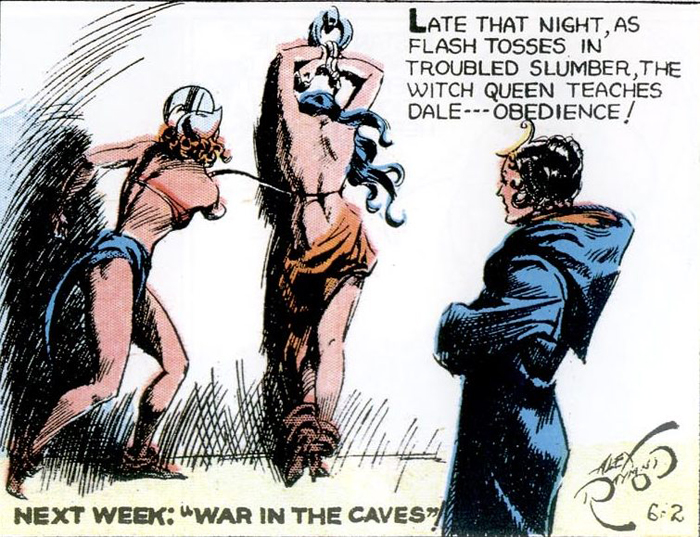
Today's a quickie review of the second installment of IDW's collection of the original Flash Gordon Sunday strips by Alex Raymond as well as his continuing run on Jungle Jim. I covered Volume One about two months back. That one came out December of 2011. Volume Two was August of last year. Volume Three comes out in April. I should get to it some time next November.

Once again, it's a large beautiful book that comes close to the size of the original new prtintings of the strips.   There's a little less wear and tear on the reproductions on this one, though there's a few that have been noticeably marred. The line work looks solid. The colors are rich. Again, it's an impressive collection and the nicest I've ever seen them look. Additionally, there's a fantastic introduction by Bruce Canwell that follows Flash's adventures into magazines, books and the early serials, which includes some wonderful stills, posters, and book covers. I give IDW full marks for the work they've done in putting these volumes together, and fully look forward to Volume Three. However...

Treat yourself to some 20 minute doses of Art Deco Sci-Fi Madness...
My only objection this time has more to do with the material. I imagine that as an excited kid tearing into the lastest adventure in 1937, one would be far less likely to notice the repetitive nature of the story telling. Flash gets in a rocket, it gets shot down, they get out of the wreckage only to be attacked by an animal who they have to fend off, then run into Ming's troops who they then escape. In the three years of strips the book covers, there are two major plot lines where chaos ensues because Flash let's a betrayer off the hook only to have them return to raise holy hell.  Compared to the novelty of the strange sights and sounds of the arrival on Mongo in the first book, the strip seems to have fallen into some complacency here.

Having said that, they were still immense fun to read and it's still impressive to see how Raymond's line work continued to develop and refine itself. In fact, once he seems to have hit a real hot streak with making Flash impressively flashy, Jungle Jim sees a marvelous jump in refinement and nears the elegance of its larger companion strip. I've never gone through the rigors of producing a regular comic strip, but imagining the demands, it's not hard to see where plot formula could be your friend as deadlines were closing in.

And by formula, I mean killer flying squirrels...
Reading this second volume also called to mind Bloom County cartoonist Berke Breathed's complaints about maintaining coherency on the ever shrinking comics page. These full pages are barely enough to contain all the action and adventure, I can only imagine what Breathed was up against.

Tuesday, January 15, 2013

The Horses Always Shoot Twice

Over the holidays, I took a long ride into noir country with two depression era classics.

The first was James M. Cain's The Postman Always Rings Twice (1934). Despite Cain's multitude of successful conversions from print to screen, he's never enjoyed the household recognition of a Chandler or a Hammet. There's a sort of cosmic irony that Chandler, who was largely a washout working as a Hollywood screenwriter, had his greatest success adapting Postman for the screen when he despised Cain's writing. (The book would be adapted again for the screen in 1981 by no less than David Mamet.) Chandler described writers like Cain as, "Such people are the offal of literature, not because they write about dirty things, but because they do it in a dirty way."

I was astounded by the total lack of Postmen in this book.
The story concerns a drifter, Frank Chambers, who happens into a restaurant owned by Nick Papadakis. Frank's trying to figure out how to get out of paying the check when the friendly Greek offers him work, which begins Frank's affair with Nick's wife, Cora.  The liaison leads to the pair thinking of murder to get Nick out of the way and sends them into a spiraling sinkhole of lust and mistrust.   I didn't share Chandler's disdain toward Cain's writing.  I found the story a compelling study of two people who can't help from digging further and further into their sins anymore than they can start up this new fantasy life they expected to live together.   However, once again, Postman represents one of those seminal works that have been hashed and rehashed so many times over the years that much of its original punch has been dulled. The characterizations, the vintage California setting and some of the unique aspects (the puma kitten, for instance) manage to rescue it from the letdown feeling of "Here we go again."

My second book had very little about it that felt all too familiar.

Horace McCoy, a contemporary of Cain's, also ended up working as a screenwriter after failing to make it as an actor and holding a string of different jobs living in Los Angeles. One of those jobs, a bouncer at the Santa Monica Pier, led to his writing the surreal and despondent They Shoot Horses, Don't They? (1935).

The "startling affair" must be in another book that I didn't read...
Horses is the tale of Robert Syverten and Gloria Beatty, two young struggling actors in Depression-era Hollywood who enter a dance marathon in hopes of winning some cash to tide them over until they get a break. The novel opens with Robert, who narrates, telling us that Gloria is dead and that he is about to be sentenced for the murder. Then, the novel takes us back to their meeting and onto and through the strain and spectacle of the marathon with its strange cast of characters en route to Gloria's murder. While the book was largely a failure in the US, it saw popularity within existentialist circles in France, and it's easy to see why.  Though certainly not as alien as a work like Camus' The Stranger, Horses still holds that similar feeling of a character entering a disjointed nightmare of his own choices.  While I can't call it an enjoyable read, I tore through it at a breakneck pace and found it to be a sad study of humanity in extremity, a novel as relevant in this economically difficult time period as it was in the 1930's.

Tuesday, January 8, 2013

The Shadow KNOWS...

Today's review's going to be a quickie.

The Shadow KNOWS....the schedule of the E Train...
In 1930, on a show called Detective Story Hour, a new pop culture phenomenon was created with a character called The Shadow.  But the Shadow wasn't any ordinary gumshoe. He kept his face hidden. He could disappear in plain sight. He could cloud the mind's of men. He had a secret identity. (He had Orson Welles' voice for a while...). The Shadow was one of the original superheroes who made his way from the radio into movies, books, comics, and on into Pop Culture Valhalla.

I first became aware of The Shadow in comics, just about the time that the run-of-the-mill guys in spandex just weren't cutting it for my young teen brain.  Digging through some dusty boxes of comics I came across the above image by the great Mike Kaluta: The big fedora, the red scarf, the dual automatics.  It was something from the past that had come to invade my future.  But like many of my pulp favorites, The Shadow was in some ways of too bygone an era in style to become a true obsession, but like many of my pulp favorites, sometimes I can't resist the allure of his siren call...guess he's clouding my mind.

The Shadow KNOWS...the danger of Radon...
So I picked up this Bantam paperback of The Death Tower I found hidden away on a bottom shelf of a used bookshop. I'd been looking for this edition if only for the fantastic cover by Sandy Kossin.  It's a reprint of a Shadow story from 1932 in which the Shadow does battle with Albert Palermo, a well-respected doctor who also happens to be...dun-dun-DUNNNN...a criminal mastermind. Palermo has been staging disappearances and deaths for his ill-gotten gains, and when the Shadow crosses his path, he thinks himself more than a match for the vigilante and his network of part-time helpers.

There's always a fun pulpy charm to the old Shadow stories that I've read. They move at a breakneck pace. There's always at least a small handful of narrative inconsistencies and a few strange plot contrivances. In some ways, it's what makes them quaint and enjoyable. In others, it's what keeps them from being truly memorable. Maxwell Grant, alias for author and magician Walter B. Gibson, cranked out nearly 300 of these Shadow novellas over 20 years, supposedly writing 10,000 words a day to keep apace of demand.  It's a wonder they make any sense at all.

Walter Gibson...His fingers were each an inch long when he retired from writing The Shadow
And so, like many of my other pulp recommendations, I'd say you could do a lot worse for thrills and a few chills than delving into the annals of this icon of yesteryear (who still shoots his way through the pages of comics) than by picking up one of his old adventures....however, unlike Conan or Matt Helm, I would recommend familiarizing yourself with some of The Shadow's backstory and aliases and support staff, because at the pace these books go, they're not likely to help you out before their simply over.
The Shadow KNOWS...clean energy policy...

Thursday, January 3, 2013

Beat to a Pulp

While shopping for a gift for a friend in a used book shoppe, I came across a book I'd been looking for for ages. And yes, I'm perfectly aware of the existence of Amazon, but I still enjoy the sensation of getting my fingers dusty digging through crates and shelves. If I simply must have something I go on- line, otherwise, I often let fate decide the course of my literary leanings. In any event, there it was: Death of a Citizen by Donald Hamilton, the first Matt Helm adventure. Not a first edition, but a nice looking copy at a reasonable price.  
So it's not a Carter Brown cover by McGinnis...still beats most covers today...
Those familiar with the blog may remember that I took a look back at all four of the Dean Martin vehicles in the Matt Helm film franchise. As I previously stated, the Helm books are not the swanky, swinging 60's romps as portrayed in the movies, but rather a darker, grittier version of a James Bond novel. Helm doesn't swagger through exotic locations and lavish hotels, he gets his hands dirty. Not that I don't love Bond's more jetsetting lifestyle, but sometimes you just want some meat and potatoes action.

The first novel sees Helm settling into soft middle age as a western fiction writer...and a retired ex-secret agent from World War II...when he spots someone from his past at a social gathering. Suddenly, there's a dead counter-agent in his office bathroom and he's back in the twisted world of the spy game. The book alternates between Matt's memories of his past in the war and his chase to thwart an assassination attempt on his friend, a nuclear scientist.

As I had read several of the Helm books before this, it was a bit of a letdown in the get up and go department of the later adventures. It reminded me of watching any of the comic book movies that spend far too long rehashing the characters origin rather than getting them in the suit and beating on baddies. That's not to say the book dragged or was too light on action, it wasn't. In fact, it probably had the most character study of the several that I've read, but did lack the in medias res feel that I value in action/adventure stories. Nevertheless it was solidly written with a healthy dose of suspense and a good helping of hardboiled dialogue.

I have oft considered contacting the Hamilton estate to see if I can use this for my author bio pic as well...
Perhaps one of the most fun aspects of this first Matt Helm outing is how literally in matches the life of it's author in setting. Hamilton had also served during the war, lived in New Mexico with his wife and family, and had written several Western novels such as the The Big Country, which became the 1958 movie with Gregory Peck.  And, I like to think, that every time he "ran down to the store" he was doing a blackout on some Commie plot in the American Southwest. In all, Death of a Citizen was just the sort of page-turning thriller that makes for the perfect material to get you quickly from one end of a holiday flight to the other. Frankly, it's also given me the yen to perhaps revisit this counter agent more often...after all, there's only 20+ more Matt Helm adventures to go through. 

Thursday, December 6, 2012

Only Death and Diamonds are Forever

This week saw a return to the superspy genre as I completed yet another of Ian Fleming's original novels on the eternal James Bond. (And no, sadly, I still haven't managed to catch Skyfall.)  This time it was the fourth Bond outing, Diamonds Are Forever (1956).

Learning Courtesy and Etiquette via classic paperback art.
Initially I was hoping to write this review after I'd had a chance to take in the 1971 film again, but that didn't quite work out. Despite being the final canon Bond film to feature Connery in the role (He would of course play Bond once more in Never Say Never Again (1983), the film made during the Thunderball legal loophole over ownership.), Diamonds is generally considered to be the least of the Connery Bond's, and ranks fairly low on most Bond aficionados hierarchies.  It certainly didn't make much of an impression on me as it's one of only a small handful of Bond films that I've only seen once. However, whatever its flaws, it was able to resuscitate the series after flagging box office returns following the smash success of Thunderball (1965).

See how this is all oddly connected?  No?  The major difference between the book and the movie is the book features a pair of gangsters, the Spang brothers as its villains, whereas the movie would see the return of Bond's arch-nemesis Ernst Blofeld. Blofeld wouldn't appear in print until five books and five years later in ninth Bond novel Thunderball.  But then that's the danger in adapting the books into movies, or seeing the movies/reading the books out of order: continuity problems. Yes?

Let's continue.  Book only.

Sorry Sean...
A few weeks back I reviewed one of Fleming's non-Bond books, The Diamond Smugglers, and wouldn't you know that elements of that book would appear in Diamonds Are Forever...or rather, the reverse.  In my head, I had worked it out that he'd written the non-fiction book first and used it as research for the Bond novel.  The only problem is that the fiction beat the fact to the newsstand by a year. More's the pity, as in retrospect, the Bond novel makes the research book seem even more dry by comparison.
"Excuse Mr. Fleming...could we see what's in that case?"
The plot sees M. assigning Bond to help stop diamond trafficking from Africa, putting him undercover as a low-level hood looking to act as smuggler to get out of England.  His contact is a beautiful but icy girl named Tiffany Case.  Once in America, Bond tries to work his way further into the criminal underworld when he runs into his old pal, Felix Leiter.  Leiter, severely injured during Live and Let Die (the book), now works for the Pinkerton detectives. The two men foil a fixed horse race, and Bond gets sent on to the Spang brothers' headquarters in Las Vegas. I wouldn't want to ruin the rest, but I will say that casinos, a ghost town, and an antique steam engine figure into Bond's future from here.

Of those I've read, this was certainly the most rapidly paced of the Bond novels, which was both a good and bad thing. Dr. No, for instance, did a pretty good job of balancing movement and stillness...but it also came two books after this one (there's that continuity thing again.)  Diamonds chugs along pretty swiftly until a brief dip just before the finale. Fleming still has a tendency to over-describe superfluous details from time to time, but never enough to mar the enjoyment. Bond's love affair is well intertwined into the plot outside of his usual bed 'em and bolt routine. There's a whole bunch of colorful henchmen and hoodlums of the movie gangster variety.

The book did have the good taste to spare us Charles Gray in drag...as did Rocky Horror ironically.
In fact, I'd say the books sole weakness is that it doesn't have a Blofeld. Not that it specifically needed the arch-villain himself, merely that we're not given nearly as good a characterization of the Spang brothers as Dr. No, or Mr. Big, or Goldfinger. They're not totally lifeless, there's just a little less enthusiasm for Bond's going after them as compared to his toppling his more usual big time super-villains. Still and all the other thugs he contends with are at least entertaining enough that it's not terribly noticeable as the story goes.

In all, I would say that Diamonds Are Forever was yet another enjoyable and quick-paced romp in the literary superspy world, a fine getaway for a weekend read.


Tuesday, December 4, 2012

Savior of the Universe...

Like most of my reviews, this one comes well after the release date.  But if you think about some of the movies I've been reviewing, I'm decades late.  And let's not ponder just how I'd zip back to a time before my birth to have caught some of them on opening night.  Or ponder it. Heck, I'm game.


I finally got my hands on the first volume of IDW's new reproduction of Alex Raymond's Flash Gordon and Jungle Jim.  And whoa nelly, it's a beautiful book that was well worth waiting for. Over the years, I've picked up and/or flipped through a number of the reprints of Raymond's seminal space hero only to be let down by one facet of them or another. Now, while we'd all love to see someone track down all the original b&w artwork penned by Raymond for the series, until I'm a bazillionaire who can pull of such a feat, this might be one of the better collections we're going to get.

Alex Raymond (1909-1956) is legendary in the field of comics, not merely for creating Flash (who was originally meant to be competition for the popular Buck Rogers strip) but for creating an elegant, thinly lined realistic style of cartooning. Tragically, his life was cut short in an automobile accident with fellow comic artist Stan Drake (Drake survived.). His professional life and this accident were the intense focus of Dave Sim's otherwise satirical comic Glamourpuss.  Flash, however, continues to thrive and survive and Raymond's other creation, Rip Kirby, outlived its creator by another 40 years.


The introduction does a wonderful job of introducing new readers to Raymond and his work. It also attempts to tackle the controversy regarding long time Flash editor and contributor, Don Moore.  Moore took over writing Flash Gordon after Raymond left the strip to enlist for World War II, but it's often been argued whether he was writing Flash while Raymond drew it, writing additional material, or merely editing Raymond's work. The answer will likely continue to be unknown, but at least that Moore was definitely a part of the Flash and Jungle Jim families receives acknowledgement.


As to the content itself, Flash gets off to a bit of both an abrupt and slightly rough start. Anyone familiar with Raymond's prowess might be surprised just how clunky the earliest of both strips kick off, then how simplistic they become before finally settling into all the flowing line work. I've gone over a number of strip collections and seen the work grow over many years. Raymond, however, moves by leaps and bounds in developing his style...then takes a few steps back...then leaps forward again. If you wanna see an artist grow, you'd be hard-pressed to do better than this book.  The writing too takes a fair bit of time to finally find its legs, but there's never a dull moment as the story rushes headlong forward from the first strip. The only strange part is the weird obsession with characters wanting to marry one another, but you'll have to read them to find out.

I was surprised that the book also featured a warning concerning the racial stereotyping featured in the stories. I'm going to have to say that Jungle Jim, with it's jungle natives and treacherous local guides is far more likely to ruffle feathers.  It certainly doesn't go out of it's way to be offensive like many other works of the time, but it's still offensive. In Flash, on the other hand, it's always surprised me that Ming the Merciless managed to reach a far more neutral place despite his obvious "Yellow Peril" roots. He and his men start as an almost caricature of Sax Rohmer's Fu Manchu. I suppose his escape from stereotype hell has something to do with his being from another planet, and that other than the occasional outfit, there's nothing terribly Asian about him.  In any event, you've been warned.

The book's a good 16" x 12", which might not quite match the newspapers of the day, it's quite generous for a polo-playing space jockey that's nearly eighty years old now. While there's clearly limitations in the source material from one strip to the next, the line work is generally clear and detailed. The colors are well-reproduced, (but...ok, back to my dream project up there...I'd love to see a side by side of the b&w originals paired with the colored version that went to print), but occasionally mask some of the inking beneath. While a few strips looked like they'd had a good washing out, most are probably as crisp if not far crisper than when they saw print in the 1930's. In all, it's a most happy edition to my shelves and a font of inspiration.

(Note: This reproduction's not from this wonderfully printed book...but is hilarious nonetheless.)


Thursday, November 15, 2012

M. Diamant

Today's entry is to be a quickie of sorts.

As I've mentioned before, family and friends come across random books and colorful paperbacks in their various travels, which they often forward on to me. Usually, I enjoy these little oddities, the stranger the better.


This time around, it was a copy of a non-fiction book by James Bond creator Ian Fleming about the illegal diamond trade that centered around the mines of Africa, which was related to him by a man who helped bust up a great many of the smuggling rings.  The book for the most part is an interesting if not terribly compelling affair.  If you're looking for lurid, Scarface-like chainsaw massacres in the bush, you'll be in for quite a disappointment.  However, it is amazing the lengths of creativity some smugglers went to to get stones out, that amount of stones that were just lying around different parts of Africa, and just how many nations were in on the steals.

At the same time, it's a strong reminder of just how colonialism ravaged much of the world while injecting European values into various cultures.  Naturally, one of the first results was the introduction of new disease, such as those that wiped out the Native North Americans. However, at least disease was a two-way street.  Of course new and usually more destructive weapons entered scenes with already strained tribal relationships. Slavery was often an aspect of it.  The rule of the privileged few over the many.  And then there's the one perhaps least spoken of: Drug Trade.  You don't often here much about the Opium Wars started between British colonialists from India and the Chinese, but I've been thinking of them due to the similarities between then and now (ie. The Chinese only exporting goods, but not buying from the rest of the world.) that led to mass trade and popularization of opiates as recreational drugs.

Lastly, there was the element of greed given to groups who often didn't know what the fuss was all about, such as the Inca who freely offered their precious metals and jewels to the Spanish.  To them, it's only value was as decoration...until the Spanish taught them a cruel lesson in economics.  This was given a similar mirror with diamond mining, where not only the workers but also the very countries receive little comparative reward for the precious resources drawn out of the their soil.  Diamond conglomerates reap the rewards and take them out of impoverished countries whose inhabitants, with riches so near at hand, quickly set up illegal ways and means to try and benefit either off their labor or these valuable gemstones. And naturally, over time, corruption becomes an all-encompassing top-to-bottom phenomenon as long as such large amounts of money and such abject poverty live so close together.

This pic of Fleming is about as bad ass as this review's gonna get.
I, however, am moralizing in a way that Fleming's book does not.  Like I said, an interesting if slightly dry account of the policing that had to be established by the various colonial governments to help stop illegal diamond trafficking after World War II. It's just that one can't help but ponder the bigger historical picture of how such interference changes the course of things...it makes me think of Afghanistan...

Thursday, November 8, 2012

"By the prickling of my thumbs..."


A few months back, I reviewed Charles Finney's influential oddity, The Circus of Dr. Lao.  In satisfying my curiosity about Lao's origin and literary history, I came across one of those books I had always meant to read but had simply never gotten around to: Ray Bradbury's Something Wicked This Way Comes (1962). After Ray's passing early this year, I decided it was past time that I should get off my duff and take in a little classic Bradbury. And I figured, as long as I was catching up on reading the book, I may as well watch the movie.

Bradbury has long occupied an odd literary position: one of the few widely respected genre writers (up there with Asimov and Clarke), but in many ways, still dismissed as being largely for young adults. My last exposure to him was in high school.  Because I moved around a lot, my reading list was an odd Frankenstein of books. I missed a lot of the one's everyone read, and caught a lot that no one else did.  So I actually read Fahrenheit 451 on my own, but had to read The Martian Chronicles for class.  Fahrenheit is probably the third best known and often cited science fiction explorations after 1984 and Brave New World, while Chronicles is probably the second best known book about Martians after War of the Worlds. And though I recall enjoying them both, other than a few short stories from various collections, that largely ended my exposure to Bradbury.


It's sort of fitting that as my age has more or less doubled since I last read him, that I should return to him on this darkly-tone exploration of age and maturity.  Something Wicked opens on one of those nostalgic buddy stories that began, in may ways in America, with Tom and Huck.  Will Halloway and his buddy Jim Nightshade are inseparable, living the adventures of young boys in rural America.  One day, a strange lightning rod salesman warns them of a storm coming, and come it does, in the middle of the night, in the form of a strange carnival: Cooger and Dark's Pandemonium Shadow Show.  Soon, strange things begin to happen among the locals, and Will and Jim discover some of the carnival's strange secrets which largely revolve around a magic carousel.  The boys quickly end up way in over their heads in confronting the demonic Mr. Dark whose skin crawls with living tattoos, and must enlist the help of Will's father, Charles, the town librarian, in ridding the town of the magical chaos.

The film, from 1983, with a script by Bradbury, is a fun and fairly faithful adaptation of the novel. And, oddly enough, this is one of those few times, where I wouldn't fall back on that old cliché that the book was wildly better than the movie. The book was quite good, and had multiple passage of poetic beauty that were stunning and surprising.  The movie had a good cast, some very fun thrills, and has aged far better than much of its 80's brethren that were aimed at younger audiences. But, I actually would've preferred something that fell between the two.


Now, without trying to ruin either one, I'll try and briefly discuss what I mean.  The book captured the tone of nostalgia better, where the movie just had well made period look without evoking much of the feel.  In a story that's a study on aging, innocence lost, and regret, the stronger nostalgic tone makes the points resonate.  Now I prefer the book's approach of being less direct about the fate of the people who fall prey to the carnival, letting the boys figure out the mystery for themselves...but, I preferred the movie's more active and direct approach in resolving the conclusion.  To explain myself, I'll need to branch off a bit.

In some ways, Something Wicked appears to follow the usual tropes of the hero's journey:  Will and Jim enter a dark place in order to make a journey that will turn them from boys to men as they conquer their fears to conquer the evil Shadow Show.  Problem is, they don't exactly do it all themselves.    Will ultimately is the protagonist, but it's not just his story, nor Jim's, but also his father's.  Charles Halloway, at first appears to be the wise old man character, but about halfway through the book he becomes a sort of secondary protagonist, and in some ways a future mirror of Will, as if both a young and an old version of the character are both competing for the same goal for different reasons: one to grow up the other to keep from dying.  Now, a little after midway in the book, there comes a point where Charles Halloway gets...shall we say..."preachy", and it bogs down the story as Bradbury commits the literary sin of "telling" rather than "showing".  His speech about the "Autumn people", in the midst of this, is a definite highlight to the book, and I was sad to see it get a sort of glossing over in the movie. The movie, oddly enough, does a better job initially of wedding the two threads together, but just like the book, I ultimately began to feel like I wasn't sure whose story this was supposed to be. Now I applaud Bradbury for bucking the system in several ways, but it's funny how much the change in the ancient formula throws things off.

By the end, the movie institutes a more active and satisfying conclusion as compared to the more "love conquers all" plot device of the book.   I'm not sure if that's just because I've become so accustomed to movie endings that anything more abstract feels like I've been robbed, or if I've just become to jaded to believe in a "love conquers all" finale. In some way, I'm thinking it's the jaded one because, funny enough, the very ending of both book and movie are yet another one where you can't help but wonder what's gonna happen once the "feel good" moment has passed and the townspeople start asking where the carnival vanished to so suddenly and the authorities have to start asking where all the vanished townspeople are.


In wrapping up, I'd like to give the movie a little more attention. It's a good looking film with some pretty snazzy effects for the time period.  While reading the book, I had imagined someone like Robards as Charles Halloway, and though Robards looks a little older than the middle-aged book version of Charles, he put in a warm performance. Jonathan Pryce, who's played a fair few villains, has, to my mind, never been as menacing as he was Mr. Dark.  While he didn't have the sharper more devilish features that I had imagined, he pulls off the role with great aplomb.  The real surprise was Pam Grier as the Dust Witch, which did add an exotic sensuality to the atmosphere of the necromantic carnival.  I had been imagining something between Angela Lansbury in Neil Jordan's strange The Company of Wolves and Zelda Rubinstein, the diminutive medium from Poltergeist. In all, it was a solid adaptation and enjoyable adaptation.


Tuesday, October 23, 2012

"They [women] Love to be Taken."


Dealing with Ian Fleming's novel The Spy Who Loved Me is one of those important times that a working knowledge of pop culture trivia pays off. If you were to pick up this book expecting a wildly exciting opening down a ski slope that was going to lead to a massive battle aboard an underwater superstructure...boy, would you be in for a surprise.

The tenth Bond movie (and the third for Roger Moore) took only its title from the tenth Bond novel.

Critics and fans alike were quite unhappy with how the book came out, a decade and and a half before the movie hit the theaters. It was quite a departure from the usual Bond novel.  In the book, Vivienne Michel, a young Canadian woman, recounts a short history of her youth: growing up in Canada, her first affair with a boy while at finishing school in England, her failed love affair with a German newsman, and the getaway trip she took that led her to a cabin in the American Adirondacks.
This is not the poster of the story described above.
Being in a remote mountain setting might be as close to the movie as the book gets, as the opening has Roger fleeing a cabin on a crazy ski chase.

The cabins are being closed at the end of vacation season, and Vivienne, who had hired on as the receptionist has been left behind to help the owner close up. It's at this point that two hoods show up, and Vivienne does her damnedest to fend them off.  Then, there's a knock at the door.

Two thirds of the way through we finally see 007.  And I'll leave the plot summary there.

In some ways, I like to imagine a Bond or any action movie within which we don't meet the protagonist until the last half hour of the movie.  Granted some other character usually picks up the slack. Obviously, in this case, it's Vivienne, not Bond, whose point of view we're adopting.  But that's not my point, I'm saying things happen and continue to happen for an hour, and then Bond or John McClane or Indiana Jones shows up. I suppose The Good, The Bad and The Ugly sort of comes close, although again Tuco ultimately is the protagonist, but it is interesting how long Eastwood is left out of the action.

Ringo's wife Barbara Bach did not play Viv...but might as well have.
Anyhow. I was surprised at Fleming's choice to adopt a woman's perspective. The writing's not bad although many of the sentiments are cliché. It's not to say that no woman ever had an experience like this, but I feel as though I've heard this sort of scenario before from a number of male authors.  As for the more action end of the plot, it's fairly by the numbers.  In some ways, though you have to admire his decision to experiment this late into a popular game, Fleming handicaps himself by his choice of having Vivienne tell the tale. For one: We know James Bond is not going to die. No one needs the luxury of hindsight for that. And two: The damsel in distress is telling the story, and though she does an admirable job of fending for herself, we know James Bond is not going to let her die.

Now having written out these thoughts, it's only just occurred to me that years and years of cabin-in-the-woods horror movies are also mirrored in this plot long before there was a Camp Crystal Lake.  But while the idea of some psycho or family of cannibals hidden in some remote location seems par the course, it's actually more inventive that the world's top special agent has to fend off a couple of dimestore hoods on an insurance job in the woods in the middle of nowhere. It's one of the most extreme cases of Plot Against Type, I've ever seen.

Kinda like when they don't have a big enough budget on a sci-fi flick, so the robots/aliens/people from the future spend most of their time on Earth at the present time.
"Sorry Rog...we couldn't afford the underwater Lotus. How about a '71 Volvo wagon?
In all, an enjoyable read, if only for a change of pace from the other Bond novels I've read. But how could it not fail at least a tiny bit when in your heart, you're just waiting for Richard Kiel to show up as the beloved Jaws.

Thursday, October 4, 2012

"When You Got a Job to Do...You Gotta Do it Well..."

My love of the movies largely began with ABC's Monday Night at the Movies when I was five or six or so.  The funny thing was that I wasn't allowed to stay up late enough to ever finish anything they showed, with the exception of Star Wars (which I eventually saw in the theater, the summer after seeing The Empire Strikes Back).  So I saw the first half or so of Young Frankenstein and the Carpenter version of The Thing multiple times without knowing how they ended until years later.  When I moved to Michigan, however, there was a great UHF channel that showed blocks of everything from the classics to utter trash, and in a time range where I'd get to finish them.  If memory serves, it was there that I first encountered James Bond, in the form of Roger Moore in Live and Let Die (1973), which coincidentally was Roger's first turn as Bond.

And yes, yes, I know, only Sean Connery was Bond, and Roger gets blamed for everything cartoonish about the series.  But I'd suggest you revisit the last couple of Connery's and Lazenby's one go, and see if you can still tell me straight-faced that it wasn't already headed that way.  Granted, I'll give you Moonraker (1979), as the apex of ridiculousness...in any event...to an eight or nine year old, Live and Let Die was (and mostly still is) a thrilling adventure, worth it if only for the boat chase scene and what's still one of the best Bond theme songs.

...and one of the best Bond posters thanks to Robert McGinnis.
The books, on the other hand, tell a different story as it were. Thanks to VHS and a helpful father, I had seen all the Bond films by the time I was in my teens, but not until my 20's did I actually pick up any of the source material.  Figuring that Goldfinger (1964) was the gold standard in Connery's run as Bond, that was the first book I picked up. About halfway through, I was baffled that one of the most exciting of the movies was one of the dullest books I'd ever read. If it wasn't for the internet, I likely would have never picked up another one, but several reviews of Fleming's canon said much the same, and made their own rankings and suggestions as where better to dive in.  Since then I've read and enjoyed several of the original Bond adventures, both novel-length and short story.

So this past week, as you may have already figured out, I delved into Fleming's second Bond adventure, Live and Let Die (1954).  In it, rare gold coins have been turning up in New York City pawn shoppes, and the U.S. government has contacted the British government over several of the pieces which have been traced to Mr. Big, a Harlem gangster. Bond is sent in to join American agent Felix Leiter in tracking the source of the coins, believed to be the treasure of the infamous pirate Henry Morgan, and distrupt Mr. Big's operations. Big, a practitioner of Voodoo, seems to have an infallible eye and network set up to stop the super-spy from foiling him.

Not my copy, but one with a far cooler cover.
When looking at any of the Bond books, you have to put aside your memory of the movies (if you've seen them obviously), because the books are far more straightforward action/suspense tales and feature far fewer gadgets and hilariously named henchmen than the movies...well, some hilariously named henchmen, but not as many.  Having done that, this book makes for a decent adventure and does a great job with atmospheric description to build some fine suspense. One thing I have noticed, though is that Fleming seems to have trouble holding up the middle. The first third and last thirds of the books are usually action-packed, but a drag always sets in before the finale. The main problem with the plot, however, was that it was very similar to a later Bond novel that took 007 to the tropics, Dr. No (1958), which I had already read. The biggest difference was that Dr. No was a far better developed villain, whereas Big is only dealt with enough to make him intimidating but not very well rounded.

Which leads to a very important point: in today's politically correct world, this book will likely be offensive to new readers. I mention it for two reasons. The first is how far the PC trend has gone: that Huckleberry Finn either gets whitewashed or banned for its coarse racial language and I've read reports of To Kill a Mockingbird being banned for RACISM.  It's more than a little horrifying to become so sensitive so as to miss the point entirely. Are Fleming's somewhat frequent references to "negroid features" and his use of stereotypical "negro" dialect in the dialogue racist?  Absolutely. But other than pointing out the usual (it was a different time, etc.), I won't make any apologies for it. It is what it is.  Big is an interesting villain in that he's physically imposing, cunning, ruthless, able to pray on superstition and fear to subjugate others, philosophical and highly intelligent. In terms of at least three dimensions, he gets a pass. Unfortunately, that's not enough to bolster how more or less stereotypical every other black character around him is.

Believe or not...far less offensive than what's in the book.
Ultimately, it stirred in me the echoes of a great class I took in college on the representation of minorities in film, taught by the great Charles Ramirez-Berg.  At the start of the semester, the professor posited an interesting query: in today's sensitive and politically correct world, can you have a villain? His point being that no matter who you cast as an antagonist, chances are it will ruffle someone's feathers in one way or another.  But he also countered it with the wonderful point that at the same time that didn't mean you couldn't see value in a work just because it had elements that could be construed as racism, nor would every moment or character that might be racist invariably make a negative mark on the mind of the viewer about this or that group. And so, through that lens, I was able to enjoy what was enjoyable about Live and Let Die and lament what was lost to a less considerate age.

Tuesday, October 2, 2012

A King of Pulp Painting

Norman Saunders (1907-1989) was a part of my life long before I ever knew it.

Take that Rockwell! (Norman...not Sam)
In elementary school in the 1980's, most of the kids had gone absolutely nuts over Garbage Pail Kids. Every recess the disgusting trading cards with silly names came out: trades were made, new ones were shown, and some kid always got to show off with cards from the rare and vaunted first series. In between series, the other card companies were quick to compete for the youthful attention and dollar, among them Wacky Packages.   There was something about this satirical send-up of advertising that appealed to me far more than the adolescent gross-out of the Garbage Pail Kids.  Don't get me wrong: I had complete sets of the 2nd-4th series of the Kids. But there was something one-note about the jokes, whereas, and I had no idea at the time, many of the Wacky's were jokes that were 20 years old at that point...and still going.

I eventually gave a way my Garbage Pail Kids...but I still have the Wacky Packs cards, and Norman Saunders painted more than just a few of them.


Despite having a distinctive style, a publishing record in the thousands and an indelible mark on pop culture, Norman Saunders, like so many great illustrators, never got the respect he deserved outside of his peers and fans of his work.  In 2009, his son, artist and pulp historian David Saunders put together the monograph that his father had always deserved.  This is no minor task as pulp painting originals as well as the magazines and paperbacks they were printed on have become very rare and highly collectible. And, I'm happy to say that I finally got my hands on a copy of one. (On a funny side note, one of the postcards inside the book was for a collector offering rewards for Saunders' originals.)

Remember to R.S.V.P!
Starting as a freelance cartoonist for the ribald Captain Billy's Whiz Bang magazine, Norman Saunders soon had a career doing pulp covers and interior art for Fawcett Publications in Minnesota. In them days, as the saying goes, an illustrator often began in the pulps while angling to get into the "slicks", the higher-end glossy magazines. Though he would try time and time again, Saunders found little luck in the slicks.  In the pulps, however, he had a veritable bonanza in a variety of genres. Saunders always prided himself on sticking to a distinctive style of painting rather than being tied to any one subject, which allowed him to work on westerns, sci-fi, horror, and the hardboiled among others

I know, I know: Frazetta = Conan. But this is still a first.
When the initial run of pulps began to fall by the wayside, paperbacks became the new medium, and Saunders moved into them painting the cover to the first paperback printing of Robert E. Howard's Conan the Conqueror.  Saunders also painted a variety of covers for a number of different comic books, and eventually became one of the kings of the Men's Adventure magazines.  It was through Taschen's wonderful book of cover images from these that I became reacquainted with Saunders, and then discovered his late work in trading cards. Wacky Packs were only one of many series he painted having rendered one of the most iconic series of all time: MARS ATTACKS!

I would've gone to more carnivals if this was the prize instead of an off-color stuffed Pink Panther.
If you haven any interest in this sort of work, I can't recommend this book highly enough. The multitude of high quality images, both published and originals, makes it quite a find. David Saunders keeps the writing short and congenial, conveying just the right amount of biographical information and enjoyable quotes to let the art speak for itself. Overall, it's a very fine quality book for an often criminally overlooked American genre of artwork.

Not sure this is Saunders, but couldn't resist.

Thursday, September 20, 2012

The Man Who Makes No Mistakes!

This week, I received a wonderful surprise in the mail.  My mom, while exploring an estate sale, found me a copy of the Pocket Paperback of Our Man Flint, one of my favorite of the 1960's James Bond knock-offs.  Ultimately it was a bit of a letdown, as I was at first excited thinking the movie had been based on a book I'd not heard of, only to find out that it was a novelization of the screenplay.

Mine, unfortunately, doesn't look quite this nice.
Well, let's just say that Jack Pearl isn't Ian Fleming...and, well, it's not as though Fleming was the best novelist in the world.  I still find it one of the great ironies that one of the greatest Bond films, Goldfinger (1964), was one of the dullest books I've ever read.  Now, in many ways, the movie is very faithful to the events of the book, but the movie doesn't waste nearly the same amount of time on a golf game between protagonist and antagonist.  I'm happy to report, however, that while I almost gave up reading another Fleming afterward, I have sense consumed and enjoyed several of the other Bond adventures and short stories.

Back to the matter at hand: The fun thing about novelizations is that they frequently give glimpses of material in the screenplay that didn't make it to the screen.  And in many cases, this alternate material is far wilder than what was eventually filmed. Pearl's book had a few of these but the writing was fairly pedestrian and by the numbers.  The most hilarious part was the frequent mention of female bosoms and buttocks heaving and flexing under whatever "thin" fabric they happened to be wearing.

The fantastic poster by Bob Peak
Reading the book spurred me to revisit the film, which I hadn't watched in some time.  In an article, I wrote many moons ago I discussed the slew of Bond knock-offs that populated the 60's, and the fact that there's a reason why James Bond is still the best known and only survivor of the jetset spy genre.  Now with the Cold War behind us and tough times still ahead, Intelligence has never been more important, but we've all seen that it's definitely not the glamourous affair of strong-arming an informant at a state dinner to find out who put the hit out on the Duke of Wherever.

The Superspy owes a debt to the Surrealists.
Derek Flint was to be the American answer to Bond: hence the explanatory "Our Man" in the title.  An early scene has Flint eschewing the Walther PPK and the myriad of other weapons associated with the movie spygame as barbaric.  Flint is every bit as sophisticated and intelligent as Bond if not more so, and the publicity for the film shows him tackling armies of girls at a time.  The plot concerns a cabal of scientists who are controlling the weather to bring about unilateral disarmament of the world powers.  Flint chases them through exotic locations to their underground paradise of drugged guards and pleasure units (read: hot chicks).

James Coburn is at his charming best as the world class worldly superspy, and he uses his toothy rogueish grin to get him in and out of hot water.  In fact, it's largely Coburn's charisma that helps us overlook Flint's biggest flaw as a protagonist: he's flawless. It's never compelling storytelling when a hero comes off invulnerable, but Coburn keeps Flint completely watchable.  Lee J. Cobb is also enjoyable as Flint's supervisor Cramden, though he and Coburn would have far more fun in their respective roles in the sequel, In Like Flint (1967).  Flint's beauties are a bit on the stiff side, but Gila Golan is both alluring and fun as the turncoat beauty, who lures Flint in only to succumb to his charm.

The only thing preferable to Miller Time.
The sets are big, flashy and ridiculous. The action features a lot of gymnastics and fisticuffs (Coburn was one of Bruce Lee's famous students).  The stock footage and model shots are typically shoddy, but fun.  The pace lags a bit in place, since, like I said, Flint rarely seems to be in any kind of eminent danger.  On the flip side, there's a good dosage of humor...and an eagle that only attacks Americans!  In all, it's a colorful and enjoyable way to pass a couple of hours in the Movie World of superspy-dom.


Tuesday, September 18, 2012

The Other Friday the 13th...

I'm a child of the 13th, and I couldn't tell you whether the bad luck on various birthdays has had anything of whether or not my party fell on a Friday or not.

The interesting thing about superstition is whether or not it's worth crossing it, and that endless loop of what-if's it creates concerning various outcomes if you had waited or just done something on that day.  But what if what you were thinking of doing was bad anyway, and no matter what day it was, someone was likely to get hurt?  Today's review is about a book that puts on the thumbscrews pondering just that sort of thing: Black Friday by David Goodis.


David Goodis is one of the lesser known of the crime fiction greats.  In fact, after his death in the late 60's, Goodis' work went out of print in the U.S., and survived mainly in reprints by the lovers of all things noir, the French (Anyone ever see Moon in the Gutter (aka. La lune dans le caniveau, 1983) starring Depardieu, the French cult classic based on Goodis?).  Like so many of his crime lit brethren, Goodis' works returned to his native soil in the late 80's, thanks to publisher Black Lizard.  In a similar vein to Jim Thompson's ties with the Oklahoma and Texas underworld, Goodis too benefited from time spent in seedy nightclubs and bars in his favorite location to fictionalize, Philadelphia. Sadly, Goodis is perhaps best known today for his famous lawsuit against the 60's TV staple, The Fugitive, for allegedly being lifted from his novel Dark Passage, which unfortunately became more a case about whether his book was in the public domain than whether the ideas were stolen.

Black Friday is a fun pressure cooker of a book.  A fugitive named Hart hops off the train in Philly to avoid capture when he encounters a man dying from a gunshot wound. The man unloads a wad of stolen money on Hart which leads to his being captured by the team of professional thieves that did the shooting.  The plot covers the week before their next heist, which unfortunately falls on Friday the 13th. The team can't let Hart go, even though he can't go to the cops anyway, but they also can't decide whether they can trust him despite his story of being a pro-criminal himself.  The suspense it ratcheted up bit by bit as squabbles break out and romance develops in this little house full of unsavory characters as the clock winds down to go time.


Now, this book may not feature enough crime for fans of modern crime fiction.  It functions much better as a study in personality mechanics, where a new cog is dropped into a smoothly running machine, and with each turn all the paths deviate farther from their standard courses.  So while it delivers on suspense, it's not exactly thrilling per se, and the ending, while appropriate, may not be the climatic stand off you were coming to expect (see: The reaction to the conclusion of No Country for Old Men (2007).)  What's undeniable however is the strength of Goodis' ability to turn dialogue into a  fencing match of words and wits, and an atmosphere that makes you appreciate the shelter of a lion's den to stay out of the cold, hostile, white world outside.