Showing posts with label comic strip. Show all posts

Tuesday, January 22, 2013

More Fun Than a Pack of Rabid Squirlons


Today's a quickie review of the second installment of IDW's collection of the original Flash Gordon Sunday strips by Alex Raymond as well as his continuing run on Jungle Jim. I covered Volume One about two months back. That one came out December of 2011. Volume Two was August of last year. Volume Three comes out in April. I should get to it some time next November.

Once again, it's a large beautiful book that comes close to the size of the original new prtintings of the strips.   There's a little less wear and tear on the reproductions on this one, though there's a few that have been noticeably marred. The line work looks solid. The colors are rich. Again, it's an impressive collection and the nicest I've ever seen them look. Additionally, there's a fantastic introduction by Bruce Canwell that follows Flash's adventures into magazines, books and the early serials, which includes some wonderful stills, posters, and book covers. I give IDW full marks for the work they've done in putting these volumes together, and fully look forward to Volume Three. However...

Treat yourself to some 20 minute doses of Art Deco Sci-Fi Madness...
My only objection this time has more to do with the material. I imagine that as an excited kid tearing into the lastest adventure in 1937, one would be far less likely to notice the repetitive nature of the story telling. Flash gets in a rocket, it gets shot down, they get out of the wreckage only to be attacked by an animal who they have to fend off, then run into Ming's troops who they then escape. In the three years of strips the book covers, there are two major plot lines where chaos ensues because Flash let's a betrayer off the hook only to have them return to raise holy hell.  Compared to the novelty of the strange sights and sounds of the arrival on Mongo in the first book, the strip seems to have fallen into some complacency here.

Having said that, they were still immense fun to read and it's still impressive to see how Raymond's line work continued to develop and refine itself. In fact, once he seems to have hit a real hot streak with making Flash impressively flashy, Jungle Jim sees a marvelous jump in refinement and nears the elegance of its larger companion strip. I've never gone through the rigors of producing a regular comic strip, but imagining the demands, it's not hard to see where plot formula could be your friend as deadlines were closing in.

And by formula, I mean killer flying squirrels...
Reading this second volume also called to mind Bloom County cartoonist Berke Breathed's complaints about maintaining coherency on the ever shrinking comics page. These full pages are barely enough to contain all the action and adventure, I can only imagine what Breathed was up against.

Tuesday, December 4, 2012

Savior of the Universe...

Like most of my reviews, this one comes well after the release date.  But if you think about some of the movies I've been reviewing, I'm decades late.  And let's not ponder just how I'd zip back to a time before my birth to have caught some of them on opening night.  Or ponder it. Heck, I'm game.


I finally got my hands on the first volume of IDW's new reproduction of Alex Raymond's Flash Gordon and Jungle Jim.  And whoa nelly, it's a beautiful book that was well worth waiting for. Over the years, I've picked up and/or flipped through a number of the reprints of Raymond's seminal space hero only to be let down by one facet of them or another. Now, while we'd all love to see someone track down all the original b&w artwork penned by Raymond for the series, until I'm a bazillionaire who can pull of such a feat, this might be one of the better collections we're going to get.

Alex Raymond (1909-1956) is legendary in the field of comics, not merely for creating Flash (who was originally meant to be competition for the popular Buck Rogers strip) but for creating an elegant, thinly lined realistic style of cartooning. Tragically, his life was cut short in an automobile accident with fellow comic artist Stan Drake (Drake survived.). His professional life and this accident were the intense focus of Dave Sim's otherwise satirical comic Glamourpuss.  Flash, however, continues to thrive and survive and Raymond's other creation, Rip Kirby, outlived its creator by another 40 years.


The introduction does a wonderful job of introducing new readers to Raymond and his work. It also attempts to tackle the controversy regarding long time Flash editor and contributor, Don Moore.  Moore took over writing Flash Gordon after Raymond left the strip to enlist for World War II, but it's often been argued whether he was writing Flash while Raymond drew it, writing additional material, or merely editing Raymond's work. The answer will likely continue to be unknown, but at least that Moore was definitely a part of the Flash and Jungle Jim families receives acknowledgement.


As to the content itself, Flash gets off to a bit of both an abrupt and slightly rough start. Anyone familiar with Raymond's prowess might be surprised just how clunky the earliest of both strips kick off, then how simplistic they become before finally settling into all the flowing line work. I've gone over a number of strip collections and seen the work grow over many years. Raymond, however, moves by leaps and bounds in developing his style...then takes a few steps back...then leaps forward again. If you wanna see an artist grow, you'd be hard-pressed to do better than this book.  The writing too takes a fair bit of time to finally find its legs, but there's never a dull moment as the story rushes headlong forward from the first strip. The only strange part is the weird obsession with characters wanting to marry one another, but you'll have to read them to find out.

I was surprised that the book also featured a warning concerning the racial stereotyping featured in the stories. I'm going to have to say that Jungle Jim, with it's jungle natives and treacherous local guides is far more likely to ruffle feathers.  It certainly doesn't go out of it's way to be offensive like many other works of the time, but it's still offensive. In Flash, on the other hand, it's always surprised me that Ming the Merciless managed to reach a far more neutral place despite his obvious "Yellow Peril" roots. He and his men start as an almost caricature of Sax Rohmer's Fu Manchu. I suppose his escape from stereotype hell has something to do with his being from another planet, and that other than the occasional outfit, there's nothing terribly Asian about him.  In any event, you've been warned.

The book's a good 16" x 12", which might not quite match the newspapers of the day, it's quite generous for a polo-playing space jockey that's nearly eighty years old now. While there's clearly limitations in the source material from one strip to the next, the line work is generally clear and detailed. The colors are well-reproduced, (but...ok, back to my dream project up there...I'd love to see a side by side of the b&w originals paired with the colored version that went to print), but occasionally mask some of the inking beneath. While a few strips looked like they'd had a good washing out, most are probably as crisp if not far crisper than when they saw print in the 1930's. In all, it's a most happy edition to my shelves and a font of inspiration.

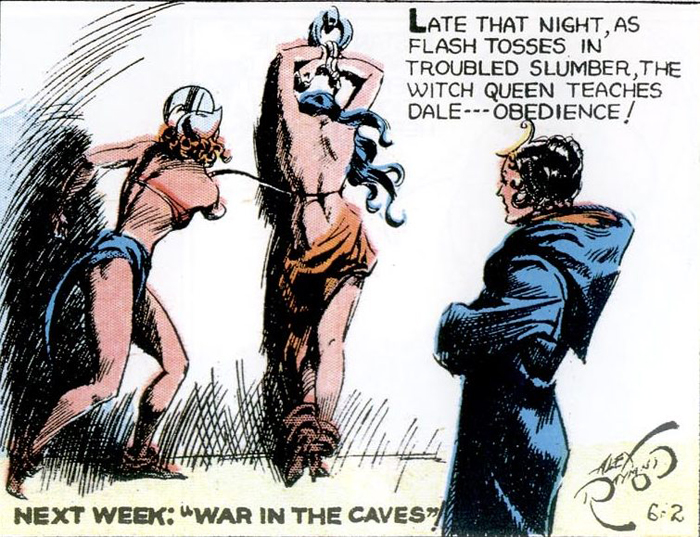
(Note: This reproduction's not from this wonderfully printed book...but is hilarious nonetheless.)


Thursday, July 12, 2012

Flinging Ink...

Famed film director John Frankenheimer once said something about how Los Angeles is not a town for artists.  I'd cite it, but I can't remember where I read it and google's no help.  It's a thought that's stuck with me over the years.  William Faulkner and F. Scott Fitzgerald, two of America's greatest novelists couldn't hack it writing screenplays here.  Many of the world's greatest directors struggled making films here.  The "art", as it were, is primarily driven by money, and if it wouldn't make money, it didn't get made...and yet it's still a town filled with creatives making whatever they want.

I brought along a lot of these thoughts when reading Jim Mahfood's recently published Los Angeles Ink Stains Volume 1, a collection of autobiographical comic strips that Mahfood has penned in the years since he arrived in Southern California.  The experience comes across as a pretty gonzo ride and provides an intimate portrait of a man who works both in and outside the system.  His work has appeared in or on everything from comics to hair care products, but you might also find it scrawled on a bar room wall.

From comic conventions to art shows in cities around the world, the strips spend equal time balancing the trials and tribulations of being a working creative with the wild times that such a venture often opens.  But it's not all random encounters with musicians, filmmakers, and other creatives as the series is never above giving a grocery list of what was eaten and where a bed was found for that night.  In fact, it's these little mundane moments that humanizes the experience in a way most Hunter Thompson-style adventures do not.

The lesson, as I took it, was to do what you do and do it to the hilt.  With talent, passion, and the will to walk outside, you'll catch up with those moments where you'll be in the right place at the right time.  Mahfood's not above spilling some churned up bile in the course of the story, but it's the open-eyed excitement of meeting each day, each person, and each experience that makes even the monotony of working at home or working a convention seem like a new opportunity.  It doles out a generous dose of hope, if you're willing to meet life halfway.  And most of all it's honest.  At one point in one nightly adventure, one of the characters asks if what they're doing will end up in Ink Stains, and Mahfood answers "Probably."

The artwork of Ink Stains is quick and simple cartoon sketches that jump cut the reader from one moment, one day, or one week to the next which keeps the read lively.  The book is punctuated with collages of photos for a different view of the variety of characters who've been rendered by Mahfood's pen.  The opening by Herbert Russel is also a fun-filled and frank exploration of the contents contained therein. In all, Ink Stains presents the sort of vigorously scribbled commotion that you would only dream of finding in someone's diary or journal.

Portrait of this blog's author by Jim Mahfood

Jim Mahfood and his work can be found HERE and HERE.