One of the most interesting aspect of the digital age is being able to see how people found their way to whatever you are posting. Of course, this is also how advertisers and marketers try to figure out how to shill more products to you whether you want them or not. That aside, every now and again, I like to sift through and see what it is about what I put up that brings in my audience. The one that keeps popping out to me is that my coverage of the strange tone of gang rape v. comedy in Hannie Caulder starring Raquel Welch has been a frequent tag that brings in the public. That's not so good.
A nicely laid out poster...with unfortunate whiffs of Hannie Caulder to come...
On the lighter side, people looking for stuff on Dean Martin movies also find their searches directed my way. And now, I've been provided an opportunity to bring both those tastes together (...although, I'm not sure how to feel about this...) as well as close the book on Raquel's trilogy of western films with a look at Bandolero! (1968).
The posters for Bandolero! promise a new fangled look at the old fashioned oater, which makes perfect sense as Sergio Leone had breathed new life into the Western in the U.S. following the release of A Fistful of Dollars in 1967. Try as they may, Hollywood never quite figured out the spaghetti western formula, and they shouldn't have: spaghetti's reflect an outsider's view of the media version of the Wild West, and Hollywood's spaghetti imitators were trying to reflect that reflection while being unable to escape the ties to the culture they themselves came from. Make sense?
Dino does not buy my convoluted explanations...
Casting Dean Martin and Jimmy Stewart seems to me a stab at trying to bring in an older audience to this new, grittier version of the West. Casting Raquel...well...I think we all know that was a stab at bringing anything with a Y chromosome to the theater. In the movie, Martin plays Dee Bishop, an outlaw gunslinger formerly of the Confederacy, who ends up caught with his gang after a bank robbery goes south by Sheriff July Johnson (George Kennedy). During the skirmish, Dee's gang shoots the husband of Maria Stoner (Welch), which opens a relationship door for the amorous sheriff. Former Union soldier turned drifter Mace Bishop (Stewart), discovering that his brother's misdeeds will be leading him to the gallows, launches a plan that will free his brother and end up in kidnapping the young widow. This leads to the Sheriff going on a long chase after the gang into bandit country in Mexico where Mace will try and convince Dee to leave his life of crime.
This is the Jimmy that was sent after bad Jimmy impersonations...which is most of them...
The opening third of the movie, from the bank robbery to the eventual escape, is pure, thrilling movie adventure, but unfortunately the middle third sags from too much time in the saddle and a few too many heart-to-hearts between the brothers in between brush-ups between Mace and Dee's surly gang. The final third picks up the pace but is unfortunately a little too predictable from the moment we see, or rather, don't really see the bloodthirsty arrival of the Mexican bandits who slaughter the Sheriff's posse. And while Welch and Martin have the makings of some fun onscreen chemistry, the "falling for the bad boy" angle isn't quite enough to sell her falling so soon for the man who was responsible for her husband's death. Without getting into the details, there wasn't necessarily a lot of love lost in Mr. Stoner's death for Mrs. Stoner, but for a girl who worked her way up from nothing, to prostitution, to some creature comfort, doesn't quite add up to her going for the guy who murdered her meal ticket.
Having said all that, the movie works more than well enough, and I had a fine time watching it. While Raquel doesn't get a whole lot of screen time, Maria was definitely one of her better dramatic roles, and certainly of greater depth than the beautiful harpy she would play the following year in 100 Rifles. Martin and Stewart are, of course, old hands at this sort of thing. While they don't look anything like brothers, their natural ease of delivery sells it well enough, and they are a joy to watch together even when the riffs of their dialogue grows a little tired. The standout in many ways is Kennedy as July Johnson, an intriguing figure for a movie sheriff, who seems more interested in giving chase to these outlaws due to his love or lust for Mrs. Stoner than the sense of justice he keeps touting. In fact, it must've made an impression on Larry McMurtry who also named a sheriff in Lonesome Dove, July Johnson.
And this is the George Kennedy that could put Cool Hand Luke's George Kennedy in jail...
So if early Westerns are a little too white hat v. black hat for you, and spaghettis are a little too operatic v. nihilistic for you, then Bandolero! might provide a nice middle ground between the two: it's matured from the former, and doesn't strain itself trying to be the latter. For comparison, I would also recommend The Professionals (1966) starring Lee Marvin, Burt Lancaster, and Claudia Cardinale, which also featured a long chase into Mexico that involves a woman. It too features a cast of familiar and enjoyable old hands, but also has a few more twists to the plotting.
(This is an updated and modified post from March 2004 off of my previous blog. ENJOY!)
On Friday, I half watched The Storm Riders (1998, HK), starring Aaron Kwok and Ekin Cheng. I say half because I was doing other things, and I've already seen the movie a dozen times or so. In the movie, two young men, Wind and Cloud, are raised by Conqueror (the great Sonny Chiba), the man who killed each of their fathers during his ongoing struggle to rule the world. Unfortunately for Conqueror, the Mud Budha has prophecied that Conqueror will be invincible for the first half of this life, but in the second half, Wind and Cloud will be his undoing. Naturally, Conqueror doesn't believe it, and fate takes care of the rest.
Believe me, despite that literally being the story and literally how they talk about it in the dialogue, it's not as silly somehow while watching it. If you've never seen it, I don't necessarily recommend rushing out to grab it now. The special effects, at the time for Hong Kong, were strong and inventive, but were still behind Hollywood and now behind for both. I can handle movies that have cheeseball effects or that look dated, but I know that a lot of folks just can't. I do, however, harbor a soft spot for it. It's a pretty strongly realized fantasy martial arts film that tells a far more developed story than most.
On Saturday night, I talked several friends into rewatching Hero (2002, China, d. Zhang Yimou). Hero concerns a county official who is brought before the emperor after vanquishing three of his most dreaded foes. Through the emperor's close cross examination of his savior's tale, the true story slowly emerges.
Like so many movies based on fragmented narratives or dissenting perspectives, Hero certainly owes a debt to Rashomon in its style of storytelling. But, Rashomon is based on three different people's understanding of the same story. Hero, however, is based on a lie, and the combing over of the story elements slowly unravels the various tendrils of fabrication. This film has a breathtaking production design and a skillful use of vibrant color and texture. At the same time, it's painterly tendencies to maintain style sometimes leaves it a little cold and distancing.
Miramax is supposed to release Hero in the U.S., but don't be surprised if it is chopped up and dubbed. In fine Hollywood form, they are apparently suing a man for supplying links to websites carrying original versions of these foreign films. There's a weird conundrum to the whole thing: The majority of people who see these movies are hardcore movie people who want the original version, but the studio butchers them for a broad audience that likely won't go see them anyway. Go figure. (ed. note: Luckily, perhaps having learned a lesson from Shaolin Soccer, Hero was released in its original form in Mandarin.)
Spread between Sunday morning and Sunday evening in two viewings was Battle Royale II (2003, Japan). (Am I pushing it with the Asian cinema?) Boy oh boy...whoa nelly...and by golly. This movie seemed like it wanted to say a hundred things at the same time, and didn't say any of them well. A modern day techno-version of Lord of the Flies, the first Battle Royale was the story of a near future law that tries to reign in rioting children by picking a random class of ninth graders and flying them to a remote spot where they are forced to eliminate one another. Battle Royale II revolves around the terrorist movement created by the survivors of the first movie in an effort to free the children of the world from adult oppression. The tie-in is a new game which sends the random class of 9th graders to the terrorist base where they must infiltrate and kill the terrorist leader.
The most basic failure was really managing to drum up sympathy for any of the characters. The first movie almost suffered from this problem, but two things almost consistently worked for it: early victims got a sympathy vote for looking like helpless children before being killed in nasty ways, while the later victims had some character defining action or backstory to flesh them out during the course of the game. The second film had little to give the new kids or the terrorist children other than a horrific death that because of their anonymity failed to drum up much emotion. This isn't to say the movie was without emotion. Depending on your political leanings, there are certain things in this film that I would hope would speak to anyone, but the whole movie keeps picking up and falling apart around them.
I can't really go through the other problems in the film without doing a point by point breakdown, which would be a lot like the second half of the film: endless. After long jags of scattershot pacing, the film kept gearing up to end and would then keep going (I almost felt like I was watching AI again. The horror. The horror.). Most of this I ascribe to the directionlessness (that has to be a word if it isn't) of the whole thing. If you don't know where you're going, how do you know that you're there? It should be said that the director Kinji Fukasaku passed away during the film's making, and so it was passed on to his son, Kenta. From that vantage, dissection of what made it to the screen becomes a battle of what if's concerning Kenta's capabilities, or whether Kinji would have held the project together better.
The movie's in the can. It just happens to be a thoughtful mess in a can.
The final viewing which took place late Friday night, and finished early on Saturday was Sergio Corbucci's second western, Minnesota Clay (1965, Italy). Minnesota Clay is the story of gunslinger who escapes from prison in order to save his town and his daughter from rival gangs, one of which is led by the man who could prove his innoncence. Clay's primary difficulty is that his skills with a pistol are being lost to the blindness taking over his eyes.
Not bad, not bad at all. The quality of the DVD was surpisingly good. Corbucci, of course, didn't hit stride with westerns until Django, a spaghetti masterpiece. (I think Corbucci was truly the master of what is thought of as the spaghetti western. Leone's films were in a whole other bigger ball park . They just happened to be Euro-westerns.) Minnesota Clay is definitely of that early mold of spaghetti where they conformed highly to Hollywood standards and stories, but it isn't bad in terms of either. Cameron Mitchel is well cast as the aging and ailing gunslinger who's still got more than enough steely-eyed vengeance in him. My primary complaint, as with many of these films, some of the dubbed dialogue (and all of them were, whether in Italian or not) gets laughable just to make sure the character says something when his mouth is open.
Anyhow, not my favorite spaghetti, but a worthy entry into the genre.
I've been some kind of overdue for sitting down to a heapin' helpin' of the Spaghetti West...so here's a couple I took in recently.
We'll start with The Last Killer (L'ultimo Killer, 1967), a lower budget affair with Anthony Ghidra and Euro-exploitation staple George Eastman. Now, the title of this Italian oater often has a "Django" slapped in front of it (as in Django - The Last Killer), as it was yet another cash-in on the popular name, which turned Ghidra's original character name from 'Rezza' to yet another in a long line of Django's. (Speaking of changing names, Anthony Ghidra was the stage name for Serbian actor Dragomir 'Gidra' Bojanić.) The story concerns a group of local farmers being persecuted by a wealthy landowner, Barret, whose "business partner" is a deadly gunfighter, Bart (naturally), and his gang; however, Barret hires local gun-for-hire, Rezza/Django, to take out the unstable Bart while keeping his gang. After Bart's gang kills the family of one peaceful farmer, his son, Ramon (Eastman), is fatally wounded by Rezza while seeking revenge. Rezza takes the boy back to his cabin where he nurses him back to health and trains him to finish his plot for vengeance, which inevitably leads to a number of showdowns.
It's almost 2/3's a strong spaghetti. The first half hour's logic is shaky at best (Ramon's robbed by the hired gang that work for Barret, the man he's going to pay, but this doesn't register before he goes to talk to Barret about why he doesn't have the money?), but once the training begins, Ghidra does a fine job as the wizened gunfighter whose dialogue was reminiscent of a fair few characters played by the great Lee Van Cleef. The rest plays out fairly predictably, but had it shown some of the high atmosphere and theatrics of a Leone or Corbucci, it could've been rather remarkable instead of a second or third tier effort. Also, while Eastman is passable, he lacks a certain earthy quality to be taken seriously as the gun-slinging peone...a role that Tomas Milian played to the hilt in a number of spaghetti westerns.
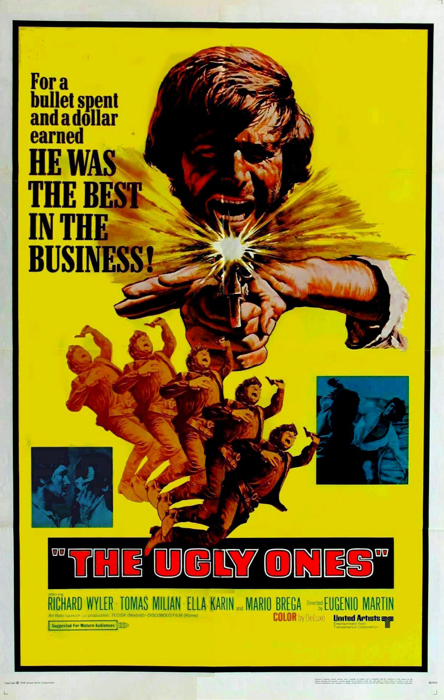
And by happy coincidence, the second Spaghetti feature I watched, The Ugly Ones (aka. The Bounty Killer, El precio de un hombre, 1967), did contain a strong performance by Milian. This is the only Spaghetti I can think of based on an American pulp novel (also called The Bounty Killer by Marvin H. Albert, not remotely to be confused with Marv Albert). And it contained far more of the tension and drama that The Last Killer almost utterly lacked. The populace of a tiny town aids an escaped Mexican bandit, José Gomez (Milian), by helping him to take surly bounty hunter, Luke Chilson (Richard Wyler), hostage. The townspeople believe Gomez to be a lost soul forced into a life of crime to survive, but when Gomez's gang shows up intending to take everything they own while destroying their homes in the process, they decide to free Chilson who had been warning them all along that Gomez was not who they thought he was. Helmed by Spanish director Eugenio Martín, who also directed Requiem for a Gringo (another spaghetti I need to get around to), The Ugly Ones holds a great tension that, while it focuses on the unlikable Chilson and the (initially) charming Gomez, relies more on the shift in attitude of the townspeople. The photography of the sandy hills of Almería is strong (with many recognizable locations from other Spaghettis) while the interiors have an almost heavy gothic atmosphere. While still not Top 10 material, The Ugly Ones was an enjoyable effort that definitely fell far closer to the top of the heap than the middle or bottom.
For this review, I felt the need to return to both my and the internet's roots with some cinematic esoterica. Like so many of my fellow cinephiles, I too would roam from video store to video store collecting both the classics and the dregs of the cinematic experience. As the internet first began to develop it saw not only the development of community around the motion picture arcane, but rapidly became a valued source for building up a lengthy checklist of sought after obscurity. Naturally, Italian genre films of the 60's and 70's were one of the most well-mined of these, and so it was to Italia that I ventured.
How many killers were merely attempting bad tracheotomies?
I kicked things off with the 1971 giallo The Iguana with the Tongue of Fire (L'inguana dalla lingua di fuoco). The story concerns a series of murders surrounding a Swiss diplomat stationed in Dublin. The rather bizarre title (and what great giallo doesn't have a bizarre title?) refers to the killer's enjoyment of throwing acid in the face of victims before slitting their throats. The Inspector in charge of the case calls in disgraced Inspector Norton with the playful nickname "The Brute", played by Euro-genre movie favorite Luigi Pistilli, to get in close to the family to solve the murders despite the difficulties of diplomatic immunity.
The "Brute"..."Groggy"...was Luigi's character ever called "Friendly"?
Like most giallos, as the bodies pile up, everyone becomes a suspect at some point or another, although usually it's mostly the male cast. However, in Iguana the ladies get a fair few visual clue nods. Blending in intrigue with the diplomat's family and the gloomy settings around Dublin gives the film a Gothic feel; however, like too many gialli, atmosphere and a steadily mounting body count take precedence over a coherent story. Pistilli, who I always revert back to thinking of as Indio's trusted man Groggy in For a Few Dollars More, plays a good part...but it's especially disconcerting to hear an Irish brogue coming out of this Italian character actor.
This poster should have Spoiler Alert stamped on it...and maybe this caption should too.
For my second feature I switched to the Wild European West with 1972's Fast Hand is Still My Name ( Mi chiamavano 'Requiescat'...ma avevano sbagliato which actually translates to something more like They called me "Rest In Peace"...But They Were Wrong). After the American Civil War, Union soldiers scour the West for a band of terrorizing southern rebels led by Machedo. When soldier Jeff Madison returns to the Union fort, Machedo's men capture him, and after massacring the other soldiers, they torture Madison before shooting holes in his gun hand and leaving him for dead. Madison returns to foil a bank heist pulled by Machedo in order to exact his revenge as they look for their ill-gotten loot.
Alan Steel stars in Tom of Finland's Zorro!
Fast Hand is a late entry and I wasn't expecting much...and, well, it didn't deliver much. It had the opposite problem of Iguana, in that, it was pretty straight forward but kept throwing in moments and plot elements to make it seem more complex. William Berger, who is a particular favorite spaghetti staple of mine, lapses well into Klaus Kinski level histrionics as Machedo. Alan Steel, far better known for playing in a number of Hercules films (including my favorite, Hercules Versus The Moon Men), makes for one of spaghetti's blandest heroes. Not too mention, he frequently looks like he over did it with the eye make-up. Equally out of place was the movie's oddly moody, jazzy score.
I can't bring myself to mock William Berger...Sorry.
Now, would I recommend either of these movies? Well, that depends. To the general movie-going public...no. To those who love the good and the gloriously bad...a bit more. There's far worse things to waste your time on than this aged genre detritus...like most of the awful, expensive new trash opening at the cinema each week.
In my previous review of Hannie Caulder, I once again touched on my love affair with the Spaghetti Western (I still can't bring myself to say the more PC Euro-western), and how their success led Hollywood to try and embrace the stylings of these European productions. I still haven't seen an American Western that matched or outdid Spaghettis at being Spaghettis (and QT's Django Unchained has yet to be released...and looks to deal more with the Blaxploitation/Spagetti crossovers that were made toward the end of the Euro-western cycle (I did it!)), but at the same time, there are many Spaghettis that fail, for me, because of their attempt to match American Westerns. The more operatic and mythic they get, the better they tend to be. The more traditional they get, the more you start noticing the gaping plot holes and wander about all the pointless and drawn out fistfights.
That said, I sat down for a Spaghetti Double Feature.
Hate Thy Neighbor (Odia il promissimo tuo, 1968) d. Ferdinando Baldi:
After his brother is killed over a stolen treasure map, Ken Dakota and the local coffin-maker head into Mexico in search of the outlaw Gary Stevens, but Stevens is also mixed up in multiple double-crosses over the map with sadistic landowner Chris Malone.
Bury Them Deep (All'ultimo sangue, 1968) d. Paolo Moffa:
Gunslinger Clive Norton is hired by the U.S. Army to track down outlaw Billy 'The Gun' who's stolen a shipment of gold. So Norton takes along another outlaw, El Chaleco, and the two men track down Billy while dodging a gang of Mexican bandits who also hunt the stolen gold.
I can sum up my reviews of both films by merely saying: I had fun watching them, but no, they didn't crack any of my "Top..." lists in any respect. Both were fairly mediocre examples of the genre, and most of the talent involved had been involved with better Spaghettis. That's a part of the problem: the greats were the ones that became most easily available as DVD began to pick up titles, and having seen most of those, you could say I'm working my way down the ladder. A few times I've dipped into the dregs, but these certainly didn't warrant that description either.
Now Hate suffers from what I mentioned above, in that it seems to be going for a more traditional American Western feel. The ubiquitous Euro-movie bad guy George Eastman's outlaw character is saddled with the hilariously non-bad guy name of "Gary Stevens". The opening of the movie is actually quite good as a man runs through the town looking for help or shelter from the pursuing outlaws, but being chased by "Gary Stevens"sounds more like a bully problem at recess in the third grade. This is unfortunate, as Eastman and his German counterpart for ubiquitous Euro-movie bad guy, Horst Frank, who also has a mediocre baddy name, are the most fun things about the movie. And director Baldi did far better work with the kooky flick Blindman (1971, which featured Ringo Starr as a Mexican Bandit!) or the somber Forgotten Pistolero (Il pistolero dell'Ave Maria, 1969).
Bury Them Deep, on the other hand, has a far more Spaghetti feel, but lacks both compelling (in the Spaghetti sense) heroes or villains. None of the actors are bad, per se, but neither can they compete with Van Cleef or Garko or Gian Maria Volonté. Hill was much better in Tonino Valerii's Taste for Killing (Per il gusto di uccidere, 1966). In all, a fairly by the numbers affair, which if you've seen enough Spaghettis (or movies in general), you see where the twists are coming while they're still way out on the horizon...and they make about as much sense half the time as you expect them to. (Also, like many Spaghettis, it features the "Bank of El Paso" set from For a Few Dollars More in an early heist scene.)
Now, since I brought up this American v. Euro-western (that's twice!) comparison, I should mention that both of these films had the one aspect that tend to make most Spaghettis fun: bizarre and creative death/torture scenes. Hate featured the novelty having characters square off in a provincial gladiator style with iron-hooked gauntlets with wicker shields, and at one point Horst has Eastman hung upside down over a snakepit while above him, rats in a cage gnaw at the honey-covered rope. Bury had the leads first tied to stakes in the sun while (obviously non-venomous) snakes started coming at them, and then later, the far more creative torture of having them tied to nooses from the same rope while balancing on a tossed together seesaw.
And to think, people only assume that modern movies could give people wacky ideas.
Maybe it was because I was first introduced to the world of the Western through the films of Clint Eastwood that I was never able to enjoy the genre as a whole. To my grandmother's infinite dismay, I never took a shine to John Wayne. She complained that Clint had the same expression whether "he's shooting a guy or kissing the girl" to which I replied that Wayne came off the same to me. I probably saw The Outlaw Josey Wales the most as a kid, but I remember taking an afternoon to watch The Good, The Bad, and The Ugly with my dad, and I was hooked on that desolate, yet operatic, overblown vision of an Old West that had more dirt and grit than the average Western but was at the same time even less realistic.
Apart from Leone's Dollars movie with Eastwood, I didn't really know what a spaghetti western was until probably Junior High, and I didn't get to see any others until college (Thanks Vulcan and I Love Video in Austin!). It was a whole other bizarre and fascinating world: exploitation films of the wild west as interpreted through the vision of European filmmakers. In the 60's, in the U.S., the western was foundering. After all, it had been the most popular and highly produced genres since silent films, but had lost steam after fifty plus years. Leone's films would give it a much needed shot in the arm, and upon seeing their success, Hollywood not only imported more movies from the deserts of Almeria, Spain, but even tried making a few, like Hang 'Em High (1968), A Town Called Hell (1971), and today's subject, Hannie Caulder (1971).
(Sadly, this movie was the best I could do as tribute to Ernest Borgnine. RIP.)
Raquel Welch plays the titular gunfighter, who sets out on a path of revenge after being raped by the Clemens Brothers who killed her husband. Hannie enlists the help of a seasoned bounty hunter, played by Robert Culp, who gets her a gun and instructs her in the ways of gunplay. Together, they go in pursuit of the Clemens Brothers through the country side and towns. Fairly standard, straightforward Western stuff, yes?
There's only one huge problem. The Clemens Brothers, played by Ernest Borgnine, Jack Elam and Strother Martin, are introduced as a cruel and callous bunch, and the rape scene, while not on the level of Irreversible, is about as pleasant as...well...a rape scene. From there, however, the trio takes on an unbelieavably bungling tone: imagine the Three Stooges as cowboy hat wearing villains and you're about there. Strother Martin had played a similar role as the screeching dirtbag bounty hunter in Peckinpah's The Wild Bunch, but that hadn't been for the laughs this movie was looking for. It's one of the strangest tonal shifts I've ever scene. Now, this is a revenge movie, like many movies of this genre are, but I've never seen one that started so dark then try to shoot for something so light. It doesn't help that Welch goes from being a rape victim to this...
That's a perfectly sexy image BUT not after a brutal gang rape!
The movie never really recovers from this weird inconsistency, which is a shame, as it seems like it should've been fun if they had come up with almost any lighter scenario for putting Welch on the Clemens' trail. After all, three of the best Western character actors, Borgnine, Elam and Martin, play the bumbling brothers to the hilt, and seem like they're having a great time. Culp plays the intelligent gunfighter admirably. There's even a strange cameo by Christopher Lee as a seemingly Mexican gunsmith. However, there's definitely a reason this movie hasn't become the lovable midnite movie fodder that Welch's other vehicles like Fantastic Voyage (1966) or One Million Years B.C. (1966) have over the years, and I'm going to guess that first act gang rape in a movie largely played for laughs pretty well sums up why.
I sit around most days and create. I've written 4 books (2 available through my site or Amazon), a small stack of screenplays, and a bunch of ad and web copy. When not using words, I paint and draw quite a fair bit. Occasionally, I'm paid for doing this. I like paper, pens, india ink, celluloid and alcohol. I hope you enjoy a little of what I've made for you, my love...my storm...my anonymous public...