A friend recently brought up his love for Adrian Lyne's Jacob's Ladder, which led to a discussion of its progenitor, "An Occurrence at Owl Creek Bridge" by Ambrose Bierce. Bierce's story was the grandaddy of all "life flashing before one's eyes" stories, a sort of subset of the "it was all a dream" motif. Much like Connell's "The Most Dangerous Game" and Hammett's Red Harvest, "Owl Creek Bridge" has seen its basic tenets hashed and rehashed in numberless stories since its publication.
So it was a sort of odd coincidence that I should happen to throw on Claude Chabrol's Alice ou la dernière fugue (aka. Alice or The Last Escapade, 1977). The film is the tale of Alice Carroll, played by Sylvia Kristel, the Dutch actress best known for her portrayal of the infamously sensual Emmanuelle, who leaves her husband into a torrential downpour in the French countryside. Forced to stop by a cracked windshield, she finds herself welcomed into an old chateau, wherein she has a bizarre series of encounters among the denizens of the grounds while discovering that she can't seem to leave her rest stop. There's no real way to say SPOILER ALERT at this point, but if you look back to the first paragraph, you might just be able to tell where this story goes from there.
As I mentioned, most cineastes and literary fiends are all too familiar with the Bierce plot to experience any sort of surprise at the twist to this particular tale. It makes for unfair bias when looking back to a time before the plot device had become a touch on the hackneyed side. So how does the rest of the film hold up despite that? That's harder to say. More scholarly critics than myself saw a great depth to this film that I felt it lacked. It's definitely made by the steady, controlled hand of a master: it's beautifully shot, makes fantastic use of its location, has wonderful atmosphere, and was remarkably compelling for how little interaction there is between Kristel and the film's other characters.
However, while it makes stabs at depth, it never seems to make it past an entry level course on philosophy. For fantastic films of possible afterlives, I was instantly reminded of Cocteau's Orpheus films, which I found to have a more artful approach to the material as well a more relatable thoughtfulness about them. I could follow the progression of Chabrol's film, but never felt terribly engaged with the discussion. Furthermore, the film is also an allusion to Lewis Carroll's Alice in Wonderland, which it also never quite plumbed to any real depth, so that what little tie there was to the celebrated Victorian tale seemed trite. In all, a gorgeous but unsatisfying film...but perhaps, my wondering if it's not I that's missing something says quite a bit in and of itself.
(This is an updated and modified post from March 2004 off of my previous blog. ENJOY!)
On Friday, I half watched The Storm Riders (1998, HK), starring Aaron Kwok and Ekin Cheng. I say half because I was doing other things, and I've already seen the movie a dozen times or so. In the movie, two young men, Wind and Cloud, are raised by Conqueror (the great Sonny Chiba), the man who killed each of their fathers during his ongoing struggle to rule the world. Unfortunately for Conqueror, the Mud Budha has prophecied that Conqueror will be invincible for the first half of this life, but in the second half, Wind and Cloud will be his undoing. Naturally, Conqueror doesn't believe it, and fate takes care of the rest.
Believe me, despite that literally being the story and literally how they talk about it in the dialogue, it's not as silly somehow while watching it. If you've never seen it, I don't necessarily recommend rushing out to grab it now. The special effects, at the time for Hong Kong, were strong and inventive, but were still behind Hollywood and now behind for both. I can handle movies that have cheeseball effects or that look dated, but I know that a lot of folks just can't. I do, however, harbor a soft spot for it. It's a pretty strongly realized fantasy martial arts film that tells a far more developed story than most.
On Saturday night, I talked several friends into rewatching Hero (2002, China, d. Zhang Yimou). Hero concerns a county official who is brought before the emperor after vanquishing three of his most dreaded foes. Through the emperor's close cross examination of his savior's tale, the true story slowly emerges.
Like so many movies based on fragmented narratives or dissenting perspectives, Hero certainly owes a debt to Rashomon in its style of storytelling. But, Rashomon is based on three different people's understanding of the same story. Hero, however, is based on a lie, and the combing over of the story elements slowly unravels the various tendrils of fabrication. This film has a breathtaking production design and a skillful use of vibrant color and texture. At the same time, it's painterly tendencies to maintain style sometimes leaves it a little cold and distancing.
Miramax is supposed to release Hero in the U.S., but don't be surprised if it is chopped up and dubbed. In fine Hollywood form, they are apparently suing a man for supplying links to websites carrying original versions of these foreign films. There's a weird conundrum to the whole thing: The majority of people who see these movies are hardcore movie people who want the original version, but the studio butchers them for a broad audience that likely won't go see them anyway. Go figure. (ed. note: Luckily, perhaps having learned a lesson from Shaolin Soccer, Hero was released in its original form in Mandarin.)
Spread between Sunday morning and Sunday evening in two viewings was Battle Royale II (2003, Japan). (Am I pushing it with the Asian cinema?) Boy oh boy...whoa nelly...and by golly. This movie seemed like it wanted to say a hundred things at the same time, and didn't say any of them well. A modern day techno-version of Lord of the Flies, the first Battle Royale was the story of a near future law that tries to reign in rioting children by picking a random class of ninth graders and flying them to a remote spot where they are forced to eliminate one another. Battle Royale II revolves around the terrorist movement created by the survivors of the first movie in an effort to free the children of the world from adult oppression. The tie-in is a new game which sends the random class of 9th graders to the terrorist base where they must infiltrate and kill the terrorist leader.
The most basic failure was really managing to drum up sympathy for any of the characters. The first movie almost suffered from this problem, but two things almost consistently worked for it: early victims got a sympathy vote for looking like helpless children before being killed in nasty ways, while the later victims had some character defining action or backstory to flesh them out during the course of the game. The second film had little to give the new kids or the terrorist children other than a horrific death that because of their anonymity failed to drum up much emotion. This isn't to say the movie was without emotion. Depending on your political leanings, there are certain things in this film that I would hope would speak to anyone, but the whole movie keeps picking up and falling apart around them.
I can't really go through the other problems in the film without doing a point by point breakdown, which would be a lot like the second half of the film: endless. After long jags of scattershot pacing, the film kept gearing up to end and would then keep going (I almost felt like I was watching AI again. The horror. The horror.). Most of this I ascribe to the directionlessness (that has to be a word if it isn't) of the whole thing. If you don't know where you're going, how do you know that you're there? It should be said that the director Kinji Fukasaku passed away during the film's making, and so it was passed on to his son, Kenta. From that vantage, dissection of what made it to the screen becomes a battle of what if's concerning Kenta's capabilities, or whether Kinji would have held the project together better.
The movie's in the can. It just happens to be a thoughtful mess in a can.
The final viewing which took place late Friday night, and finished early on Saturday was Sergio Corbucci's second western, Minnesota Clay (1965, Italy). Minnesota Clay is the story of gunslinger who escapes from prison in order to save his town and his daughter from rival gangs, one of which is led by the man who could prove his innoncence. Clay's primary difficulty is that his skills with a pistol are being lost to the blindness taking over his eyes.
Not bad, not bad at all. The quality of the DVD was surpisingly good. Corbucci, of course, didn't hit stride with westerns until Django, a spaghetti masterpiece. (I think Corbucci was truly the master of what is thought of as the spaghetti western. Leone's films were in a whole other bigger ball park . They just happened to be Euro-westerns.) Minnesota Clay is definitely of that early mold of spaghetti where they conformed highly to Hollywood standards and stories, but it isn't bad in terms of either. Cameron Mitchel is well cast as the aging and ailing gunslinger who's still got more than enough steely-eyed vengeance in him. My primary complaint, as with many of these films, some of the dubbed dialogue (and all of them were, whether in Italian or not) gets laughable just to make sure the character says something when his mouth is open.
Anyhow, not my favorite spaghetti, but a worthy entry into the genre.
Though mainstream Hollywood had had its fair share of leading ladies in dramatic roles, for everything else, and for minorities, I always felt that genre cinema was one of the few places where new ground in portrayals of all kinds could first be broken. Looking back over time, of the few stand-out ladies of whoop-ass action, blaxploitation produced two of the most iconic in the form of one Pam Grier and Tamara Dobson.
Tamara Dobson had worked as a fashion model and commercial actress before being launched onto the silver screen versus an exceptionally crazy Shelley Winters in the original Cleopatra Jones (1973). Cleo, a sort of drug enforcement version of James Bond, returns to Los Angeles from ridding the world of the drug trade to zip around town in a tricked-out Corvette in order to stop local drug kingpin, Mommy, who's had the cops leaning on her boyfriend's community drug rehabilitation center to get revenge on Cleo.
Created by legendary entertainer Max Julien, Cleopatra Jones' greatest fault is that she's...well...a little too indestructible. Even Bond occasionally got hurt or captured, but never once does Cleo seem like she may not quite get out of the scrape. So most of what little emotional resonance there is in the picture falls to perpetual movie pimp/dealer/fall guy Antonio Fargas as the gangster Doodlebug. Fargas stands out as the second most memorable character in the film and delivers a monologue about his hair that was almost worth the run time of the movie. The most memorable is far and away Shelley Winters at her scenery-chewing best as the red-haired, leather clad, evil lesbian villainess, Mommy. She hams it up to her evil best, but almost seems like a good replacement for Frankie and Annette's nemesis, Eric Von Zipper in the 60's Beach movies. In all, it's a very fun flick with plenty of action and excitement, a little intrigue, some creative movie deaths, and about as kooky as you can get in 60's fashion...until you get to...
Cleo's second outing, Cleopatra Jones and the Casino of Gold (1975). This time the creative team moved the production to Hong Kong and partnered with martial arts movie legend Run Run Shaw of the Shaw Brothers. This time, Cleo's cohorts, the Johnson brothers, are captured while trying to bust a heroin ring, and Cleo arrives to join forces with a local Chinese detective team to complete the bust on the "Dragon Lady" Bianca Javin (Stella Stevens).
The sets are bigger and more lavish. The action is way more over-the-top. The outfits for Cleo are more colorful and outrageous. But is it a better movie than the original? In a way, yes. I was generally more entertained, much in the way most martial arts movies' acrobatics and choreography can carry even the thinnest storylines. However, Cleo comes off just as indestructible as ever, and most of her dialogue is a series of stilted one-liners. Dobson, who was every bit a statuesque and beautiful lady, lacks the smoldering sexiness and vulnerability that made the aforementioned Pam Grier so great. In some respects, especially in this sequel, she's almost more of an animated part of the set than the leading lady of the movie. Also, this one trades one evil lesbian villainess for another, and while Stella Stevens is adequately menacing as Bianca, she's nowhere near as indelible as Winters' Mommy. Nevertheless, Cleopatra Jones is definitely an icon of the blaxploitation era, and I genuinely had a good time watching both films.
On a trivial side note, I had a good chuckle that each film featured a staple of my youthful television watching. The first film had Esther Rolle, who I grew up watching as Florida Evans in Good Times, and the second featured Norman Fell, who I first new as Mr. Roper on Three's Company.
James Bond's nemesis, Ernst Stavro Blofeld, leader of SPECTRE (SPecial Executive for Counter-intelligence, Terrorism, Revenge and Extortion) is often cited as the prototype for the master-villain, the faceless brain behind mass conspiracies of villainy. For his first two appearances in Bond films, he was more or less depicted solely as an arm before finally being revealed in You Only Live Twice (1967) played by the bald, scarred-eye, Nehru-collared form of Donald Pleasance...an image used and reused both seriously and for parody in countless movies and TV programs since. Though he's in six of the canon Bond films, he's only in three of Fleming's original novels: Thunderball, On Her Majesty's Secret Service, and You Only Live Twice, otherwise known as the Blofeld trilogy. Having been given a copy of Majesty's, I found myself having to track down Thunderball to get started.
After all, it seems strange when he's revealed if you haven't seen the movies in order...so I figured it'd be just as strange if not stranger to read the books out of order.
The book opens with James Bond in sorry shape. He's been drinking and smoking a little too much after having been beaten up a bit too much by his work. So M, on a health kick, sends him to a spa in the English countryside. There, a brusque brush-up with one of the other spa visitors ends up tying into a conspiracy that involves the theft of an RAF plane and it's payload of two nuclear weapons, which are then used to try and blackmail $100, 000, 000 ransom from the world governments.
Naturally, this is the work of Blofeld and SPECTRE. Blofeld, who came up through government bureaucracy was immersed in the world of espionage during the second World War and has since used his ability to buy and sell information to form a dangerous network of spies and criminals into a global conspiracy. No one knows where the plane went. No one knows where the bombs are. And Bond is dispatched into the field to try and stop this plot. So...on M's hunch, Bond is sent to Nassau in the Bahamas where he meets the "treasure-hunter" Emilio Largo and his kept woman, the lovely Domino. With the help of Felix Leiter, Bond begins to assemble clues that point to Largo as the man behind hi-jacking the plane and stealing the bombs.
In all, Fleming's novel moves at a pretty good clip and Blofeld is introduced in grand style with a well-built background for evil. Largo, too, is an enjoyable antagonist: the rich playboy, who is, in fact, a total scumbag who knows how to torture with a cigar and some ice. Bond is, well Bond, and benefits from the presence of the ever plucky Leiter (who is always whole in the movies, but after events in the book Live and Let Die, is missing an arm). And Domino, for the books, is one of Bond's more remarkable conquests, although she leads Fleming into one of the most hilarious sexist rants about women-drivers I've ever read. Domino, of course, is a great driver, and the sole exception to the diatribe.
I did, however, have a couple of problems with how the book played out. For one, though the events and resutls of the time at the health spa are amusing, they meander for a bit too long, and are tied into the main plot by only the flimsiest of threads. So inevitably they end up eating up a fair bit of time, as does many of Fleming's various asides about a variety of topics from technology to a dinner menu. Detail often brings a world to life, but in several cases in this book (and in other Bond novels I've read) it just seems like an oddly placed editorial. It's not as off-putting as some of the pages and pages of technical jargon in modern spy/military thrillers, but it does throw off the plotting. And finally, too much of the initial part of the main plot rely on hunches and coincidences (ie. With no idea who or where SPECTRE is, Bond just happens to end up in the right place at the right time for no real good reason but happenstance.) Still and all, these aren't documentaries on spying but meant as entertainment, and on that score, Thunderball was largely successful despite these distractions.
Of course, one can't address Thunderball without addressing the controversy over the book that lead to a decades long legal dispute. Before Albert Broccoli and Sean Connery made a little movie called Dr. No (1962), Fleming and his friend Ivar Bryce teamed up with an Irish filmmaker, Kevin McClory, to form a production company to produce a Bond film, whose plot elements eventually became Thunderball. While that movie was never made, Fleming adapted certain characters and elements from what had been fleshed out for the film project into the novel which later became its own movie and so on without McClory receiving any credit. While I don't seek to settle what all transpired between these men, suffice it to say that McClory's legal pursuit of restitution from Fleming and his estate led to the loophole that allowed for a remake of Thunderball, which saw the return of Connery to the role that he made famous and that made him a star in this here...
After covering the last Fred Williamson Western Adios Amigo, I figured I'd cover two of Fred's earlier Western entries, which have become infamous if only for their titles.
It appears to be proof of just how much of a comeback the Western had had thanks to the European set that this blaxploitation flick got off the ground a year before Fred starred in perhaps his biggest hit of the era with Black Caesar, and the fact that Fred was coming off his run on the groundbreaking and tender TV series Julia (1968-1971) that The Legend of N*gger Charley (1972) made it to the big screen. And people at the time were no more comfortable with the title than they are now. The story concerns a slave blacksmith who's given his freedom by his dying master only to have it revoked by an abusive heir. In a fit of rage-fueled revenge, Charley kills the heir and escapes to the West with his two compatriots, Tobey and Joshua. They're pursued by a fugitive-slave hunter and his posse, and after confronting them in a western town shootout, they're hired by a farmer to rid himself of a crazy outlaw preacher and his gang.
Sound like too much for one movie? Well, simply put: it is. Any one of the three acts of the story could've been enough for a decently constructed movie, but as it is, it just kinda ends up as a structural mess. When Charley and gang have the shootout with the slave-hunter in the middle of the movie, it seems as though that would be the end except that we're given a whole new storyline that doesn't have enough time to be set up properly for their to be any kind of tension before it's all over. As it is, it's an adequate if disjointed piece of entertainment. Fred is his usual charming self. D'urville Martin is competent comic relief. And for being on the lower end of the genre, it's not a wholly bad looking film (although the print I saw was awful). And both villains, the slave hunter and the outlaw reverend both seemed ripe for being entertaining villains if only either of them had enjoyed adequate screen time or development.
In the end, Legend was either successful enough or demand was still great enough, that Paramount (yup, the big movie studio paid for both of these movies) put Fred back in the saddle for The Soul of N*gger Charley (1973) the following year. This time Charley's mythos has spread through the West, and when he comes across a murderous band of former Confederates capturing former slaves to take to a new slave state in the Mexican wilds, you know damned well Charley's going to put a stop to it. This bigger and badder affair features a Quaker community, crazy Confederates, a big train robbery of $100,000 in gold, and more bandidos than you can shake a six-shooter at.
As a story, Soul is a far more cohesive affair that dumps you right into the action with an opening massacre, but occasionally stalls out with unnecessarily long riding sequences. A good twenty minutes could've been stricken from the run-time merely by cutting to the chase so to speak with many of these long vista rides. Still and all, it doesn't quite gel into a great Western as their are still a sizable number of gaps in logic and in both movies, there's a tendency to hit jags of unnecessary and out of place moments of melodrama. And again, there was a lack of development on the part of the villains. Primary villain, Colonel Blanchard is adequately crazy and creepy, if his crack squad of soldiers seem appallingly inept much of the time, but it almost feels as though it needed more of just how awful the evil new Confederacy they were building was going to be. I suppose it's like what I call "Nazi Shorthand", meaning that if you make an obvious villain/s the villain/s you don't have to waste time developing him, her, or them. And while most of us are all too familiar with the evils of the slave plantations, the movie barely answers what that would look like in the north of Mexico. In any event, a superior effort, if lacking a bit of the vitality, to the original.
(Sorry folks, couldn't find any trailer to go with these.)
I've been some kind of overdue for sitting down to a heapin' helpin' of the Spaghetti West...so here's a couple I took in recently.
We'll start with The Last Killer (L'ultimo Killer, 1967), a lower budget affair with Anthony Ghidra and Euro-exploitation staple George Eastman. Now, the title of this Italian oater often has a "Django" slapped in front of it (as in Django - The Last Killer), as it was yet another cash-in on the popular name, which turned Ghidra's original character name from 'Rezza' to yet another in a long line of Django's. (Speaking of changing names, Anthony Ghidra was the stage name for Serbian actor Dragomir 'Gidra' Bojanić.) The story concerns a group of local farmers being persecuted by a wealthy landowner, Barret, whose "business partner" is a deadly gunfighter, Bart (naturally), and his gang; however, Barret hires local gun-for-hire, Rezza/Django, to take out the unstable Bart while keeping his gang. After Bart's gang kills the family of one peaceful farmer, his son, Ramon (Eastman), is fatally wounded by Rezza while seeking revenge. Rezza takes the boy back to his cabin where he nurses him back to health and trains him to finish his plot for vengeance, which inevitably leads to a number of showdowns.
It's almost 2/3's a strong spaghetti. The first half hour's logic is shaky at best (Ramon's robbed by the hired gang that work for Barret, the man he's going to pay, but this doesn't register before he goes to talk to Barret about why he doesn't have the money?), but once the training begins, Ghidra does a fine job as the wizened gunfighter whose dialogue was reminiscent of a fair few characters played by the great Lee Van Cleef. The rest plays out fairly predictably, but had it shown some of the high atmosphere and theatrics of a Leone or Corbucci, it could've been rather remarkable instead of a second or third tier effort. Also, while Eastman is passable, he lacks a certain earthy quality to be taken seriously as the gun-slinging peone...a role that Tomas Milian played to the hilt in a number of spaghetti westerns.
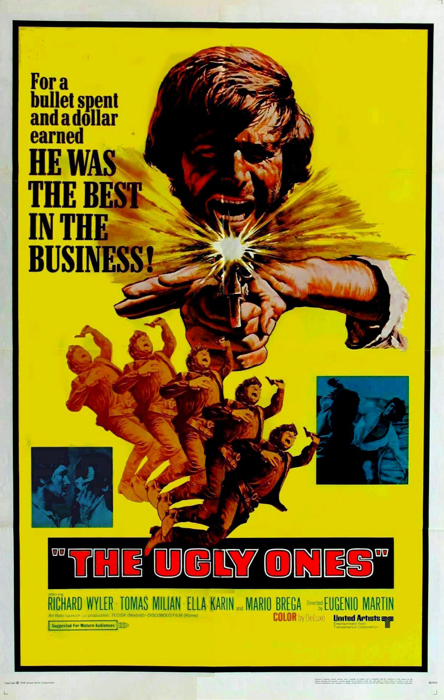
And by happy coincidence, the second Spaghetti feature I watched, The Ugly Ones (aka. The Bounty Killer, El precio de un hombre, 1967), did contain a strong performance by Milian. This is the only Spaghetti I can think of based on an American pulp novel (also called The Bounty Killer by Marvin H. Albert, not remotely to be confused with Marv Albert). And it contained far more of the tension and drama that The Last Killer almost utterly lacked. The populace of a tiny town aids an escaped Mexican bandit, José Gomez (Milian), by helping him to take surly bounty hunter, Luke Chilson (Richard Wyler), hostage. The townspeople believe Gomez to be a lost soul forced into a life of crime to survive, but when Gomez's gang shows up intending to take everything they own while destroying their homes in the process, they decide to free Chilson who had been warning them all along that Gomez was not who they thought he was. Helmed by Spanish director Eugenio Martín, who also directed Requiem for a Gringo (another spaghetti I need to get around to), The Ugly Ones holds a great tension that, while it focuses on the unlikable Chilson and the (initially) charming Gomez, relies more on the shift in attitude of the townspeople. The photography of the sandy hills of Almería is strong (with many recognizable locations from other Spaghettis) while the interiors have an almost heavy gothic atmosphere. While still not Top 10 material, The Ugly Ones was an enjoyable effort that definitely fell far closer to the top of the heap than the middle or bottom.
We'll kick off with the bigger disappointment. Pretend you're a filmmaker in the 1970's. You want to make a western, which are on the fade again...BUT you want it to be funny, which thanks to Blazing Saddles (1974), should be a go. You take the handsome, charismatic hot black property, Fred Williamson, and you take the hottest black comedian of the time, Richard Pryor...and you should be able to spin gold, yes?
Of Fred Williamson's four forays into Westerns, Adios Amigo (1976) is far and away the most disappointing, especially as it was his last one. Now Richard Pryor...well, Richard's motion picture legacy despite his stand-up genius is wildly uneven, mostly skewing to the not-so-great, unless Gene Wilder is around. If you don't agree or don't believe me, spend the evening with Adios Amigo double-featured with Superman III and see if you still feel the same. The story is simple, Fred gets into a fight in town, which thanks to corrupt locals gets him shipped to prison on a stagecoach that's robbed by Pryor setting Fred free. Inexplicably, instead of going home to avenge himself on the corrupt townsfolk that ran him off, Fred chases after Pryor for his part of the loot from the robbed stagecoach. What follows is a repetitive formula of Pryor encountering people, messing with them, stealing from them, and running off, leaving the pursuing Fred to take the blame in a series of mostly flat scenes that are neither funny nor exciting. Fred as usual seems earnest and game for the antics, but they're just not there...and neither really is Pryor who seems to mumble his way through most scenes as if half-asleep/half-crazed and/or half-drunk, which, sadly, he may have been all at the same time. Even the dread Cactus Jack (1979) had more inspired moments than this and it too was awful.
But being no stranger to the weird and the awful, I tried again. So this time we're going to rewind the clock back to 1969. Now we're in the hot stretch for Westerns following Sergio Leone's Dollars trilogy, and Hollywood wants to cash in. You've got young up-and-comer Burt Reynolds whose already been in one Italian oater (Navajo Joe, 1966), and you've got black football sensation Jim Brown whose was in one of the action hits of the 60's, The Dirty Dozen (1967). Add to that the smoldering sex-pot that is Raquel Welch, and again, you should have gold, yes?
Well....100 Rifles (1969) seems to take much of its direction for the great Sergio Corbucci's The Mercenary (Il Mercenario), which also featured a cunning peone, a hard-fighting foreign outsider, and a hot girl in the midst of some Mexican revolutionizing. But while Rifles seems to have the characters and have the chemistry, it never coheres into the adventure that The Mercenary pulls off. Instead it sort of wobbles, betwixt endless chase scenes, between half-comical banter and Peckinpah-esque brutality. Still, it's not all a bad time, if you can get past the stunning gaps in character-driven logic. All I know is, if I'm trying to escape from a pursuing Mexican general, who's a tad on the butchery side, and his well-armed troops, I don't stop for a chat or a fistfight until I'm way way way far away. Having said that, it was a generally enjoyable way to pass some time. Burt was well on his way to being Burt. Raquel Welch has a sexy shower under a train cooling tower. And the film was cut or banned in a number of places for some smoldering horizontal monster mashing between Jim Brown and Raquel. The movie's well-shot, the scenery gorgeous, and the action, especially the finale, exciting...it just never adds up to much.
I sit around most days and create. I've written 4 books (2 available through my site or Amazon), a small stack of screenplays, and a bunch of ad and web copy. When not using words, I paint and draw quite a fair bit. Occasionally, I'm paid for doing this. I like paper, pens, india ink, celluloid and alcohol. I hope you enjoy a little of what I've made for you, my love...my storm...my anonymous public...