Thursday, March 21, 2013

"You Know Much About Guns, Mr. Bond?" "No, but I Know a Little About Women."


James Bond's nemesis, Ernst Stavro Blofeld, leader of SPECTRE (SPecial Executive for Counter-intelligence, Terrorism, Revenge and Extortion) is often cited as the prototype for the master-villain, the faceless brain behind mass conspiracies of villainy. For his first two appearances in Bond films, he was more or less depicted solely as an arm before finally being revealed in You Only Live Twice (1967) played by the bald, scarred-eye, Nehru-collared form of Donald Pleasance...an image used and reused both seriously and for parody in countless movies and TV programs since. Though he's in six of the canon Bond films, he's only in three of Fleming's original novels: Thunderball, On Her Majesty's Secret Service, and You Only Live Twice, otherwise known as the Blofeld trilogy. Having been given a copy of Majesty's, I found myself having to track down Thunderball to get started.

 After all, it seems strange when he's revealed if you haven't seen the movies in order...so I figured it'd be just as strange if not stranger to read the books out of order.

The book opens with James Bond in sorry shape. He's been drinking and smoking a little too much after having been beaten up a bit too much by his work. So M, on a health kick, sends him to a spa in the English countryside. There, a brusque brush-up with one of the other spa visitors ends up tying into a conspiracy that involves the theft of an RAF plane and it's payload of two nuclear weapons, which are then used to try and blackmail $100, 000, 000 ransom from the world governments.

Naturally, this is the work of Blofeld and SPECTRE. Blofeld, who came up through government bureaucracy was immersed in the world of espionage during the second World War and has since used his ability to buy and sell information to form a dangerous network of spies and criminals into a global conspiracy. No one knows where the plane went. No one knows where the bombs are. And Bond is dispatched into the field to try and stop this plot. So...on M's hunch, Bond is sent to Nassau in the Bahamas where he meets the "treasure-hunter" Emilio Largo and his kept woman, the lovely Domino. With the help of Felix Leiter, Bond begins to assemble clues that point to Largo as the man behind hi-jacking the plane and stealing the bombs.


In all, Fleming's novel moves at a pretty good clip and Blofeld is introduced in grand style with a well-built background for evil. Largo, too, is an enjoyable antagonist: the rich playboy, who is, in fact, a total scumbag who knows how to torture with a cigar and some ice. Bond is, well Bond, and benefits from the presence of the ever plucky Leiter (who is always whole in the movies, but after events in the book Live and Let Die, is missing an arm).  And Domino, for the books, is one of Bond's more remarkable conquests, although she leads Fleming into one of the most hilarious sexist rants about women-drivers I've ever read. Domino, of course, is a great driver, and the sole exception to the diatribe.

I did, however, have a couple of problems with how the book played out. For one, though the events and resutls of the time at the health spa are amusing, they meander for a bit too long, and are tied into the main plot by only the flimsiest of threads. So inevitably they end up eating up a fair bit of time, as does many of Fleming's various asides about a variety of topics from technology to a dinner menu.  Detail often brings a world to life, but in several cases in this book (and in other Bond novels I've read) it just seems like an oddly placed editorial. It's not as off-putting as some of the pages and pages of technical jargon in modern spy/military thrillers, but it does throw off the plotting. And finally, too much of the initial part of the main plot rely on hunches and coincidences (ie. With no idea who or where SPECTRE is, Bond just happens to end up in the right place at the right time for no real good reason but happenstance.)  Still and all, these aren't documentaries on spying but meant as entertainment, and on that score, Thunderball was largely successful despite these distractions.

Of course, one can't address Thunderball without addressing the controversy over the book that lead to a decades long legal dispute. Before Albert Broccoli and Sean Connery made a little movie called Dr. No (1962), Fleming and his friend Ivar Bryce teamed up with an Irish filmmaker, Kevin McClory, to form a production company to produce a Bond film, whose plot elements eventually became Thunderball. While that movie was never made, Fleming adapted certain characters and elements from what had been fleshed out for the film project into the novel which later became its own movie and so on without McClory receiving any credit. While I don't seek to settle what all transpired between these men, suffice it to say that McClory's legal pursuit of restitution from Fleming and his estate led to the loophole that allowed for a remake of Thunderball, which saw the return of Connery to the role that he made famous and that made him a star in this here...


Tuesday, March 12, 2013

"Somebody Warn the West..."

After covering the last Fred Williamson Western Adios Amigo, I figured I'd cover two of Fred's earlier Western entries, which have become infamous if only for their titles.

It appears to be proof of just how much of a comeback the Western had had thanks to the European set that this blaxploitation flick got off the ground a year before Fred starred in perhaps his biggest hit of the era with Black Caesar, and the fact that Fred was coming off his run on the groundbreaking and tender TV series Julia (1968-1971) that The Legend of N*gger Charley (1972) made it to the big screen.  And people at the time were no more comfortable with the title than they are now. The story concerns a slave blacksmith who's given his freedom by his dying master only to have it revoked by an abusive heir. In a fit of rage-fueled revenge, Charley kills the heir and escapes to the West with his two compatriots, Tobey and Joshua. They're pursued by a fugitive-slave hunter and his posse, and after confronting them in a western town shootout, they're hired by a farmer to rid himself of a crazy outlaw preacher and his gang.

Sound like too much for one movie?  Well, simply put: it is. Any one of the three acts of the story could've been enough for a decently constructed movie, but as it is, it just kinda ends up as a structural mess. When Charley and gang have the shootout with the slave-hunter in the middle of the movie, it seems as though that would be the end except that we're given a whole new storyline that doesn't have enough time to be set up properly for their to be any kind of tension before it's all over.  As it is, it's an adequate if disjointed piece of entertainment. Fred is his usual charming self. D'urville Martin is competent comic relief.  And for being on the lower end of the genre, it's not a wholly bad looking film (although the print I saw was awful). And both villains, the slave hunter and the outlaw reverend both seemed ripe for being entertaining villains if only either of them had enjoyed adequate screen time or development.

In the end, Legend was either successful enough or demand was still great enough, that Paramount (yup, the big movie studio paid for both of these movies) put Fred back in the saddle for The Soul of N*gger Charley (1973) the following year. This time Charley's mythos has spread through the West, and when he comes across a murderous band of former Confederates capturing former slaves to take to a new slave state in the Mexican wilds, you know damned well Charley's going to put a stop to it. This bigger and badder affair features a Quaker community, crazy Confederates, a big train robbery of $100,000 in gold, and more bandidos than you can shake a six-shooter at.

As a story, Soul is a far more cohesive affair that dumps you right into the action with an opening massacre, but occasionally stalls out with unnecessarily long riding sequences. A good twenty minutes could've been stricken from the run-time merely by cutting to the chase so to speak with many of these long vista rides. Still and all, it doesn't quite gel into a great Western as their are still a sizable number of gaps in logic and in both movies, there's a tendency to hit jags of unnecessary and out of place moments of melodrama. And again, there was a lack of development on the part of the villains. Primary villain, Colonel Blanchard is adequately crazy and creepy, if his crack squad of soldiers seem appallingly inept much of the time, but it almost feels as though it needed more of just how awful the evil new Confederacy they were building was going to be. I suppose it's like what I call "Nazi Shorthand", meaning that if you make an obvious villain/s the villain/s you don't have to waste time developing him, her, or them. And while most of us are all too familiar with the evils of the slave plantations, the movie barely answers what that would look like in the north of Mexico.  In any event, a superior effort, if lacking a bit of the vitality, to the original.

(Sorry folks, couldn't find any trailer to go with these.)

Tuesday, March 5, 2013

Penultimate Killers

I've been some kind of overdue for sitting down to a heapin' helpin' of the Spaghetti West...so here's a couple I took in recently.


We'll start with The Last Killer (L'ultimo Killer, 1967), a lower budget affair with Anthony Ghidra and Euro-exploitation staple George Eastman.  Now, the title of this Italian oater often has a "Django" slapped in front of it (as in Django - The Last Killer), as it was yet another cash-in on the popular name, which turned Ghidra's original character name from 'Rezza' to yet another in a long line of Django's. (Speaking of changing names, Anthony Ghidra was the stage name for  Serbian actor Dragomir 'Gidra' Bojanić.) 

The story concerns a group of local farmers being persecuted by a wealthy landowner, Barret, whose "business partner" is a deadly gunfighter, Bart (naturally), and his gang; however, Barret hires local gun-for-hire, Rezza/Django, to take out the unstable Bart while keeping his gang. After Bart's gang kills the family of one peaceful farmer, his son, Ramon (Eastman), is fatally wounded by Rezza while seeking revenge. Rezza takes the boy back to his cabin where he nurses him back to health and trains him to finish his plot for vengeance, which inevitably leads to a number of showdowns. 


It's almost 2/3's a strong spaghetti. The first half hour's logic is shaky at best (Ramon's robbed by the hired gang that work for Barret, the man he's going to pay, but this doesn't register before he goes to talk to Barret about why he doesn't have the money?), but once the training begins, Ghidra does a fine job as the wizened gunfighter whose dialogue was reminiscent of a fair few characters played by the great Lee Van Cleef. The rest plays out fairly predictably, but had it shown some of the high atmosphere and theatrics of a Leone or Corbucci, it could've been rather remarkable instead of a second or third tier effort. Also, while Eastman is passable, he lacks a certain earthy quality to be taken seriously as the gun-slinging peone...a role that Tomas Milian played to the hilt in a number of spaghetti westerns.


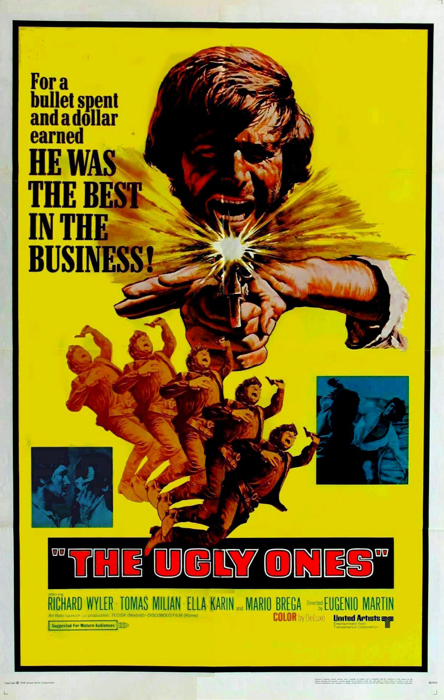
And by happy coincidence, the second Spaghetti feature I watched, The Ugly Ones (aka. The Bounty KillerEl precio de un hombre, 1967), did contain a strong performance by Milian. This is the only Spaghetti I can think of based on an American pulp novel (also called The Bounty Killer by Marvin H. Albert, not remotely to be confused with Marv Albert). And it contained far more of the tension and drama that The Last Killer almost utterly lacked.

The populace of a tiny town aids an escaped Mexican bandit, José Gomez (Milian), by helping him to take surly bounty hunter, Luke Chilson (Richard Wyler), hostage. The townspeople believe Gomez to be a lost soul forced into a life of crime to survive, but when Gomez's gang shows up intending to take everything they own while destroying their homes in the process, they decide to free Chilson who had been warning them all along that Gomez was not who they thought he was. Helmed by Spanish director Eugenio Martín, who also directed Requiem for a Gringo (another spaghetti I need to get around to), The Ugly Ones holds a great tension that, while it focuses on the unlikable Chilson and the (initially) charming Gomez, relies more on the shift in attitude of the townspeople. The photography of the sandy hills of Almería is strong (with many recognizable locations from other Spaghettis) while the interiors have an almost heavy gothic atmosphere. While still not Top 10 material, The Ugly Ones was an enjoyable effort that definitely fell far closer to the top of the heap than the middle or bottom. 


Tuesday, February 26, 2013

All They Need Is....A Better Script!

Today's quickie review is a two-fer.

We'll kick off with the bigger disappointment.  Pretend you're a filmmaker in the 1970's.  You want to make a western, which are on the fade again...BUT you want it to be funny, which thanks to Blazing Saddles (1974), should be a go. You take the handsome, charismatic hot black property, Fred Williamson, and you take the hottest black comedian of the time, Richard Pryor...and you should be able to spin gold, yes?


Of Fred Williamson's four forays into Westerns, Adios Amigo (1976) is far and away the most disappointing, especially as it was his last one.  Now Richard Pryor...well, Richard's motion picture legacy despite his stand-up genius is wildly uneven, mostly skewing to the not-so-great, unless Gene Wilder is around.  If you don't agree or don't believe me, spend the evening with Adios Amigo double-featured with Superman III and see if you still feel the same.  The story is simple, Fred gets into a fight in town, which thanks to corrupt locals gets him shipped to prison on a stagecoach that's robbed by Pryor setting Fred free.  Inexplicably, instead of going home to avenge himself on the corrupt townsfolk that ran him off, Fred chases after Pryor for his part of the loot from the robbed stagecoach. What follows is a repetitive formula of Pryor encountering people, messing with them, stealing from them, and running off, leaving the pursuing Fred to take the blame in a series of mostly flat scenes that are neither funny nor exciting.  Fred as usual seems earnest and game for the antics, but they're just not there...and neither really is Pryor who seems to mumble his way through most scenes as if half-asleep/half-crazed and/or half-drunk, which, sadly, he may have been all at the same time.  Even the dread Cactus Jack (1979) had more inspired moments than this and it too was awful.

But being no stranger to the weird and the awful, I tried again.  So this time we're going to rewind the clock back to 1969. Now we're in the hot stretch for Westerns following Sergio Leone's Dollars trilogy, and Hollywood wants to cash in.  You've got young up-and-comer Burt Reynolds whose already been in one Italian oater (Navajo Joe, 1966), and you've got black football sensation Jim Brown whose was in one of the action hits of the 60's, The Dirty Dozen (1967).  Add to that the smoldering sex-pot that is Raquel Welch, and again, you should have gold, yes?


Well....100 Rifles (1969) seems to take much of its direction for the great Sergio Corbucci's The Mercenary (Il Mercenario), which also featured a cunning peone, a hard-fighting foreign outsider, and a hot girl in the midst of some Mexican revolutionizing. But while Rifles seems to have the characters and have the chemistry, it never coheres into the adventure that The Mercenary pulls off. Instead it sort of wobbles, betwixt endless chase scenes, between half-comical banter and Peckinpah-esque brutality. Still, it's not all a bad time, if you can get past the stunning gaps in character-driven logic.  All I know is, if I'm trying to escape from a pursuing Mexican general, who's a tad on the butchery side, and his well-armed troops, I don't stop for a chat or a fistfight until I'm way way way far away. Having said that, it was a generally enjoyable way to pass some time.  Burt was well on his way to being Burt. Raquel Welch has a sexy shower under a train cooling tower. And the film was cut or banned in a number of places for some smoldering horizontal monster mashing between Jim Brown and Raquel.   The movie's well-shot, the scenery gorgeous, and the action, especially the finale, exciting...it just never adds up to much.


Tuesday, February 19, 2013

"I Curse You With My Name! You Shall Be...Blacula!!!"

Let's jump right into this quickie review of perhaps the first Blaxploitation movie I ever saw, 1972's Blacula...and while we're at it, the follow-up, 1973's Scream Blacula Scream

The first time I saw it, I was probably around 10 years old or so and switched on the TV to some UHF station.  I remember it was sunny outside, but once I caught my first glance of William Marshall as the Black Prince of Darkness I sat it out until the end. Revisiting it the other day, I could still see the finale as clear as on that sunny afternoon of my youth when Blacula mounts the stairs...Well, I don't want to say too much.

So, the movie opens with African prince Mamuwalde (Marshall) and his lovely wife at Count Dracula's castle trying to convince the Count to join him on a campaign to get the European powers to end slavery.  The Count, more than a little dismissive of the proposition, starts a fight and gives Mamuwalde the damning bite of the vampire before sealing him with his wife into an oubliette in the castle walls. Years later, in the 1970's, two offensively flamingly gay antiques dealers buy the castle and set Blacula free. But in his quest to wed the young Tina (Vonetta McGee), the spitting image of his dead wife (could be because she played his dead wife in the opening sequence... ;-) ), he leaves a trail of newly undead shambling around which put the disbelieving cops on his trail. 

I'll just say now that summarizing Scream Blacula Scream is a spoiler alert in and of itself. So much for my effort to not give away the ending of Blacula above. When an aged voodoo priestess dies and chooses her apprentice Lisa (Pam Grier) over her son Willis (Richard Lawson) to take over their group, Willis resurrects Blacula to exact his revenge. However, Willis merely ends up a vampire himself, while Blacula tries to get Lisa to exorcise him of the evil bestowed upon him by Count Dracula while, once again, the cops are closing in due to all the non-corpse corpses running around.


Now, neither one of these movies was ever meant to be award-winners but both were quite enjoyable, thought not without considerable shortcomings. First of all, one has to get past the name Blacula, and the ludicrous way it's worked into the plot (see Drac's quote in the review title above).  From there, the first film is a fairly by the numbers vampire flick whose main difference is its urban setting and black cast. William Marshall does his damnedest to add enough gravitas to keep the proceedings from delving into purely hokey drivel, and he's fantastic at creating a sympathetic villain.  The filmmakers, however, can't seem to resist adding enough cornball to keep it from being something more akin to Shaft: The Vampire Years (which, to my mind, would've been awesome)...still, it does fair far better than Blackenstein (1973).

Scream Blacula Scream is much the same only it can't help but just get purely silly.  To set the tone: Moments after Willis performs his voodoo resurrection rites over the bones of Blacula (which must've been cow bones or some large animal because they're far too large and thick to be human bones), he leaves the room, plunks down in a chair, and drinks a cool Coors with his back to the room he just left, leaving himself wide open for resurrected vampire attack.  At least it makes sense why his mom didn't pick him to take over.  The rest of move pretty much follows suit. Sadly, the effects have gotten better since the first film, but like I said, everything else has gotten sillier. 


On a side note, both films contain fantastic graphic displays for their title sequences...if you're into that sort of thing. 

So in summary: If you're just looking for a good time and a good laugh...something to go with a cool Coors 12 oz. on a lazy afternoon or weekend evening...then, by all means, enjoy Blacula and its sequel. If, however, you want a surreal arty conceptualization of a black vampire, I recommend Bill Gunn's wild Ganja and Hess (1973).


Thursday, February 7, 2013

"Ain't No Cure For Them Jungle Blues..."

Australia is one of the few places that during it's early colonial era experienced a history not disimilar to the Wild West of the United States.  But much like I would've never expected an Aussie to write a Southern Gothic novel as Nick Cave did with And the Ass Saw the Angel, nor would I expect one to record not one but two albums of country blues mixed with hints of ragtime and calypso as C.W. Stoneking has. And he's done it well.


Stoneking's 2008 Jungle Blues is an enjoyable trip through a kaleidoscope of a rich musical past.  "Jailhouse Blues" is every bit country blues as "The Love Me or Die" is flavored with the Caribbean, while the title track, "Jungle Blues," has a heavy streak of vaudevillian carnival that a Tom Waits track might warble over.  He's obviously well-immersed in his chosen genres, and plays the music as more of a continuation rather than as merely a pale throwback. While a few tracks have some affectation, Stoneking has thankfully kept from immersing his entire album in canned scratches, hiss, and pops unlike a fair few modern revivalists, but as the sound seems to come from so genuine a place, they would hardly be necessary.

The album's only problem is that for the uninitiated to these earlier forms of music, the steam might run out for them a couple of tracks before the end. Either the album might have benefited from one or two more hookier upbeat numbers or at least a jostle to the track order, but it's hard to believe someone with a passion for this form of artistry would be trying to grab a mainstream audience.  In the end, I would think it beneficial for a first-time listener to not know or try and forget Stoneking's pedigree to keep this from merely coming off as a striking novelty record. At the right moment in the right setting (I'm thinking late in the evening, a few drinks in, maybe a smokey game of pool being played...) throw C.W. Stoneking's Jungle Blues on the old juke, and you'd be in for a treat.


Tuesday, February 5, 2013

Blaxploitation One-Two Punch

After revisiting Jackie Brown, it seemed appropriate to run a blaxploitation double feature. So let's cover a couple of quickies.
Note: I will not be addressing the terrible joke of this title.
Black Eye (1974) saw Fred Williamson as the former cop turned private investigator, Stone, whose investigation into a murdered friend turns into a chase for a dead movie star's cane while also searching for a missing girl. Could the two cases be connected?  Of course they are, but it takes a long, loose, and seedy trip behind the scenes of 70's Hollywood glam, through porn sets, "psychics", hippie Jesus freaks and an informant named "Worm" to get there.

Despite the giallo-esque elements of the poster up there, Black Eye is an enjoyable if by-the-numbers 70's mystery that probably could've benefited from some of that gothic atmosphere. In many ways, it reminded me of a 70's version of The Big Sleep, though Stone is no Philip Marlowe.  Having said that, however, Fred's just as handsome and charming as ever, and his general charisma carries the picture through the slow or rough patches.  I've seen Fred do better, but I've also seen Fred do far worse.  The most entertaining aspect was to spot various familiar locations around Los Angeles starting with the main entrance to the Venice Boardwalk.


There was a fair share more of this tour of LA's past to be found in Rudy Ray Moore's return as Dolemite, The Human Tornado (1976).  Successful stand-up act, Dolemite, is donating his money and his home as a children's shelter when the small town sheriff performs a raid on the benefit party. Dolemite and his buddies skip town for Los Angles where they find nightclub owner Queen Bee embroiled in a war with rival nightclub gangsters. Naturally, it's time for Dolemite to bust a lot of kung fu ass-whoopin's to settle the score.

The plot of dueling nightclubs in many ways has a mighty resemblance to Moore's Petey Wheatstraw  only without the supernatural angle (although there is a witch woman that reminded me of the PCP hallucinations from Disco Godfather (1979)). It's the usual fast, loose, and often disconnected Rudy Ray Moore effort (whatever happened to the kids' shelter?) with stand-up, musical numbers, the world's funniest kung fu noises, and occasionally some plot.  Off the top of my head, there are two moments that will decide whether you can enjoy this movie: 1) The lead character displaying his name on a large flowing cape in the opening credits, and 2) a climatic shoot-out which results in the lead character's being shot only to invoke the name of the movie and walk away. Now, can you dig it?