Tuesday, August 14, 2012

Nekkid Strangers.

Everywhere I turn...50 Shades of Meh....and everything old is new again.

It seems as though everyone forgot that there was such a thing as dirty books.  Pornography, of course, has become ubiquitous since the 1970's, but since it seems I need to remind everyone that for many centuries before quick photography, cheap printing and eventually, the internet, erotica used to rely on little more than the written word.  Everyone remember the Kama Sutra?  Both a wedding of poetry and prose, it is at once a religious guide and sex manual...oh, and it's been around for well over 2, 000 years.  Everyone with me?  And what about the Marquis de Sade? There's no S&M without "S", and since he spent about half his life in jail, he had plenty of time to write...and one of those books was partially written in his own blood when he had no other way of procuring ink.  How's that for kinky?


Since I like to make things personal, I'll bring it back to my own experience.  I think I was in the 5th or 6th grade when I snuck a late night peek at Kim Basinger and Mickey Rourke getting frisky and then dark in Adrian Lyne's 9 1/2 Weeks (1986).  I think for a lot of folks in my age range, this was often not only our introduction to sex, but also some of the, albeit minor, strange derivations thereof.  And as Lyne had made it quite stylish and elegant, it sure beat being introduced to the sexual world by the vision of "pumping hairy man ass", as Bill Hicks would describe porn from the era. Weeks was based on the memoirs of a woman named Elizabeth McNeil, an executive who began a wild relationship with a domineering man she met casually.  In the book, the characters have no names, but in the movie, Mickey Rourke's character's name is....wait for it....John Gray.

Have you sighed in minor disgust yet?


I've already mentioned de Sade above.  Two of his books, Justine and Juliette, center around the unfortunate adventures of Monsieur de Bertole's daughters.  Justine is often set upon and forced into vice, while in her sister's narrative, Juliette runs head first into depravity.  Sade's writing is juvenile at best and frequently way over the top. Consider the following: 

A) de Sade: "Then do so, my darling, do whatever your heart desires," was Delbene's humble reply; she presented her buttocks. "There," said she, "mark it well. And spare it not."

B) 50 Shades: "I moan loudly. He moves, pounding into me, a fast, intense pace against my sore behind. The feeling is beyond exquisite, raw and debasing and mind-blowing ..."

Are we seeing any difference in the level of discourse here besides the Age difference in vocabulary?

But certainly, there wasn't merely a 200 year gap between the "divine" Marquis and Elizabeth MacNeil.  Other infamous examples of erotica filled in the time, and two also got treated in film.  Emmanuelle Arsan created a namesake character in her first book that's still with us today in a cheeseball softcore version on late night cable (I, myself, had the distinction of working on the set of the wonderfully awful Emmanuelle 2000 for Cinemax a few years back.)  But more in keeping with the thread I've tried weaving through, there was Pauline Réage's Story of O (aka. Histoire d'O, 1954, Réage was the pseudonym for Anne Desclos). Reage's heroine, O, is led on a wild journey through sexual bondage by her lover René who hands her over to the wealthy and domineering Sir Stephen. O made it to the big screen in 1975 with Corinne Cléry and Udo Kier.


However, it's not merely the fact that there are all these forgotten literary precursors to 50 Shades that's got me rankled. It's that this wild bestseller started as badly written fan fiction for an already badly written series, Stephanie Meyer's Twilight.  Not that that's without precedent. Literary lifting is nothing new: Terry Southern and Mason Hoffenberg's erotic farce Candy (1958) was a bestseller, also starting out behind shoppe counters, that was liberally lifted from Voltaire's classic, Candide.  The major difference being that Southern and Hoffenberg crafted a well-written satire based on what's considered one of the best books ever written. And I suppose with 50 Shades I want more acknowledgment of that origin...and I suppose, I wish the origin was enough to keep people from taking it so damned seriously.

Which brings me to my final point: Naked Came the Stranger by "Penelope Ashe", the once well-known literary hoax that was a past commentary on my current point. Conceived by Newsday columnist Mike McGrady, Naked was written by twenty-four Newsday journalists and editors and was meant to take on the "literary" best-sellers of the 60's, like the works of Harold Robbins and Jacqueline Susann.  If you've ever tried to make it through Susann's Valley of the Dolls, you know it's a combo of tripe and trash...hilariously entertaining tripe and trash...but tripe and trash none the less. The plot of Naked centers around a female radio host, who upon finding out her husband is cheating on her, seeks to seduce each and every man in their upscale New England neighborhood in increasingly ridiculous scenarios. The point of Naked's creation was to purposely write an awful book full of sex and violence and when it sold, to expose how pointlessly vulgar popular culture had become.  The plan went off without a hitch and McGrady ended up sending his own sister out on the talk show circuit as the non-existent authoress, Ashe.

In the end, though, it's dubious whether they proved anything: the book sold, and once the hoax was revealed, it wasn't as though everyone suddenly changed their pop-culture trash consuming ways.  Which I guess brings me back to my own dubious point.  I can't change that 50 Shades has sold a depressingly large number of copies, nor that a movie is in the works...but I want more acknowledgement of it for what it is, that it's not innovative but merely another in a long line of trashy books, only sold on the rack beside the shoppe counter rather than behind it.  After all, take a close look at the cover: it's perhaps one of the chintziest Photoshop jobs ever conceived for a huge best-seller...and that's totally fitting.

Thursday, August 9, 2012

"How Like a Worm You Are. Be One."

My earliest memory of Vincent Price was his appearance on The Muppet Show (see below), and not too long after, his voice appeared for the ghoulish narration at the end of Michael Jackson's Thriller, which I received for Christmas in 1982.  And over the years, I was aware of who he was, and what he was known for, but somehow I never really caught up on actually watching his films until I got older.  The hilarious part then was finding out that he'd played in a variety of films before landing firmly in the familia horror niche.  Even more surprising was his avid art collecting.  In any event, I've slowly sought to rectify this gap in my visual consumption.
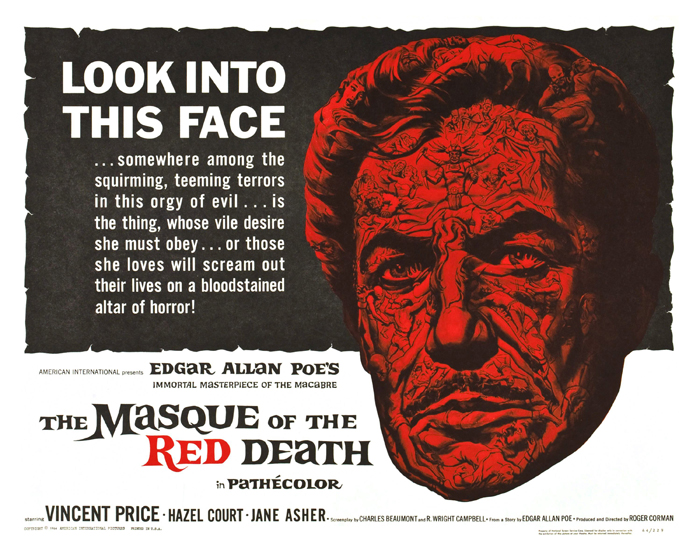
A favorite image long before I saw the film
The Masque of the Red Death (1964) was the seventh of Roger Corman's adaptations of Edgar Allan Poe for American International. It stars Price, of course, Northern Irish actor Patrick Magee, and English actress Jane Asher. The film concerns an exclusive party thrown in a remote castle by the satan-worshiping Prince Prospero while a mysterious plague, the Red Death, ravishes the villagers of the surrounding countryside.  The film not only relates the Poe story, but also wedges in another minor Poe tale, "Hop-Frog", as a subplot.


Price is deliriously decadent as the Prince, with nary a trace of the comedic ham he sometimes sprinkled into other horror roles.  His presence fills the screen and his voice delivers lines with not a few thrills and the occasional chill, as it were.  The other nobles, with the exception of Magee, become something of a faceless mass of revelers, which is fully appropriate as that's what they were.  It conjures up a vision not unlike the stories of Roman debauchery from the histories of Suetonius where the Emperor du Jour led ta mass of nobles and courtesans in sadistic charades.  Magee, as I mentioned, though in a fairly small role, stands out as that guy at the party who can't quite fit in, and despite all the excess still wants more.   Asher, on the other hand, need do little more than look the part of the frightened, innocent virgin for us to mourn her slow transition to darkness, and she succeeds.


American International Pictures was largely known for throwing together low-budget exercises for teeny-boppers in the 50's and 60's, but thanks to Corman's success with the Poe material, the shoestring budget seems little in evidence here.  (Apparently, Roger got an opulent, by AIP standards, five weeks to shoot Masque).  The sets, many reused from the Richard Burton vehicle Becket, give a sumptuous feel, and though the costumes have that older movie feel, there's a lovely nostalgia to their glamor.  Corman, it probably goes without saying, keeps the movie moving at a good clip and is able to layer in some fine atmosphere and a few solid surprises.  The orchestration of the climatic finale hasn't aged so well, but was a fitting theatrical finalé to what had come before.


I was surprised at the heavy use of the Satan-worshipping element of the plot.  Granted, in old Hollywood fashion, you can't help but see the mechanics of the morality play that will eventually deliver the goods to the baddies, and yet, I was still surprised at the frankness of the depiction.  Although, I guess it shouldn't be all surprising, it was about this time that Church of Satan founder Anton LaVey would become something of a Hollywood scenester and a regular talk show guest.  But it still seems strange that the children of the 60's seeing this would become the paranoid parents of the 80's crusading against heavy metal and Dungeons and Dragons. (Then again, parents often have a knack for denying teen proclivities like sex despite what they and their friends got up to in their own youth.)

In all, for a fun night at home, particularly in the fall, I think you'll find The Masque of the Red Death and some popcorn a fine way to spend an evening with the late, great Vincent Price.


Tuesday, August 7, 2012

"Well, Where is this Moon? And Show Me Where I Can Find It!"

Is there anyone left who doesn't know who the black private dick that's a sex machine to all the chicks is?  (Hint: If an image other than Richard Roundtree or Isaac Hayes enters your mind, we might have to have words.)

I believe the first Blaxploitation film I ever saw was on a Saturday morning, after cartoons were over, on some forgotten UHF channel (Oops, I may have just fessed up to my age).  It was the glorious Blacula (1972) starring the great William Marshall, and despite the goofy title was a pretty damned good vampire flick.  Over the years, much like the kung fu and Hercules movies I'd soak up, Blaxploitation became a regular part of my visual collection.  And though there are others I might find throw on more often, I still have a huge soft spot for Shaft, and even went so far as to put together a collection of all the books, including the rare final volume, The Last Shaft (1975).


Keenan Ivory Wayans gave the genre a pretty good send up in 1988's I'm Gonna Git You Sucka, which featured some of the greats of the genre who also saw new interest in their classic stylings in QT's Jackie Brown (1997) and Larry Cohen's Original Gangstas (1996) (Cohen had directed Blaxploitation classic Black Caesar in 1973).  But no one had really revisited the era itself until Michael Jai White dropped his creation Black Dynamite on us in 2009.   As hilarious as it is faithful to the source material, Black Dynamite became the little indy that could finding a quick and devoted following...and now it's returned to the little big screen with a new animated series.


Delivering laughs as consistently as the film, the series sees the return of White as our aforementioned hero, Byron Minns as Bullhorn, Tommy Davidson as Cream Corn and Kym Whitley as Honey Bee.  So far the plots have dealt with iconic 70's material centering around Michael Jackson, Richard Pryor, and early black porn.  The references to Blaxploitation fly fast and wild, but not catching them won't ruin your enjoyment of the series.  Titmouse, who've delivered a fine array of Adult Swim cartoons, have created a fluid, action-packed animation with character design out of the best Luke Cage comic book.  (I know a couple of people over there and have considered texting one to tell him to give any random co-worker a high-five for all the laughs.)


I don't normally follow enough TV (it's a time thing, not a snobbery thing) to give any kind of review of any series.  After the latest episode, however, I felt I had to say something.  Though strange to see a Christmas themed episode in August, this two-fer managed in equal measures the usual Blaxploitation laughs as well as a spot-on parody of conspiracy theorists' delight Capricorn One (1978). For those who don't watch enough 60's and 70's craziness, Capricorn tells the story of a group of astronauts, which includes O.J. Simpson pre-Naked Gun, who are forced to fake a Mars landing and who are subsequently forced to escape when they realize they're going to be killed to cover the hoax.  Like I said, good to know, but not essential to enjoy Black Dynamite being teamed up with a 70's era O.J. on a mission to the moon.  Now, I can't say much more without spoiling too much, but I should think that every line above this one should had you watching the episode before you even read this far.

So, in summary, if you've not been watching Black Dynamite, the animated series...or, God forbid, you haven't seen the movie, you, my friend, have a fair amount of catching up to do.

Thursday, August 2, 2012

Bombs. Bordellos. Burials.

Is it morbid to wonder what I'll be working on when I die?

I had already read Dickens' A Tale of Two Cities when I moved back to Detroit in my junior year of high school as had several other transplants, and so our teacher let us choose to cover any other Dickens novel we cared to.  Now, I'm not a fan of ol' Charlie, and was just coming off the relentlessly pedantic sarcasm disguised as social commentary in Oliver Twist at the time, so that made the decision a tough one. I briefly considered Barnaby Rudge as I was a Monty Python addict at the time ("And perhaps to save time, I should add that we don't have Carnaby Fudge by Darles Chickens, or Farmbrous Sludge by Miles Pickens, or even Stickwick Stapers by Farles Wickens with four M's and a silent Q!") until I discovered what a tome it was.  Then I spotted The Mystery of Edwin Drood...the title was intriguing...and I really started getting into it...and then it just ended and I discovered that he'd never completed it.  The book cover hadn't mentioned it, my teacher hadn't mentioned it, and this was before Google was immediately available at lightning speeds on everything ("Toaster, what is the airspeed velocity of a laden swallow?") and so the best Dickens I'd read came prematurely to a close.

Since then, I've perused other unfinished works such as Chester Himes' Plan B, Kafka's The Castle, and a volume that contained every draft of Twain's The Mysterious Stranger.  But the other day, someone mentioned Jack London's unfinished work The Assassination Bureau Ltd., and naturally, with a title like that, I had to look into into it, wherein I discovered that it was not only a book but a film as well.

Another amazing poster by Robert McGinnis
Now normally I wouldn't dive into a film based on a book like this without having tracked down the book (much like I did with last week's review of Dr. Lao), but it was hard enough finding a copy of the movie.  Also, the book, were I to find it, was completed by another author, and that doesn't entirely count anyhow...besides, it was a Friday night, I was tired of painting, and had little else to do for the evening.

The lovely Diana Rigg not being the iconic Emma Peel
The plot is a rather simple one: Sonia Winter (Diana Rigg), a women's rights advocate and reporter,  with her paper's support, hires the chairman of a clandestine organization of self-righteous murderers, Ivan Dragomilof (Oliver Reed) to assassinate himself.  Intrigued and amused, Dragomilof accepts the challenge which pits his skills against the entire board of his organization. Winter follows Dragomilof on his cross-continental kill-or-be-killed adventure where they discover that perhaps Winters' employers reasons for chasing down Dragomilof may not be as noble as they first appeared, and that the Bureau may be the orchestrators of World War I.

A debonair Oliver Reed
Now, the novel (and I hope to verify this one day) is supposed to be a serious affair, on par with the examination of philosophical ideals, both good and evil, in Chesterton's The Man Who was Thursday, and I've seen a few comparisons with Rand's habit of having characters living and dying by unrealistically lofty ideals.  The movie, on the other hand, is a fun, goofy romp in sumptuous locations with a cavalcade of international stars. Dianna Rigg is great fun as the prim and proper lady turned adventuress. Oliver Reed is at his dashing best in the years before he became relegated to the intimidating heavy.  Telly Savalas is perhaps miscast as a British Lord, but spot-on perfect at being Telly Savalas.  I was also excited to see a youthful appearance by the prolific Phillipe Noiret, perhaps best known as the projectionist Alfredo from Cinema Paradiso, as the French assassin, M. Lucoville.

Telly at his most Telly-esque with the statuesque Annabella Incontrera
The special effects for the film have not aged well, and while it does lean a hair on the cornball side, it has that one quality that most big budget affairs of this sort lack today: FUN.  Everyone in it appears to be having a great time, and I never found myself scoffing or yawning as the scenes played out.  And while the book might be more lofty, and I do love idealistic loftiness in explorations of morality, that tends to come off as terribly pretentious or hilariously comic book on the big screen.  And at least this movie got away with it's basic premise of a moralistic assassination squad intact, unlike say the film adaptation of Mark Millar's Wanted (2008).  In all, I couldn't help but enjoy myself watching this only to lament how often new movies try to be too serious and realistic when they should be fun, and how often older movies were fun when they might have tried to be at least a hair more solemn.

Tuesday, July 31, 2012

Hate Thy Neighbor, and Bury Them Deep

In my previous review of Hannie Caulder, I once again touched on my love affair with the Spaghetti Western (I still can't bring myself to say the more PC Euro-western), and how their success led Hollywood to try and embrace the stylings of these European productions.  I still haven't seen an American Western that matched or outdid Spaghettis at being Spaghettis (and QT's Django Unchained has yet to be released...and looks to deal more with the Blaxploitation/Spagetti crossovers that were made toward the end of the Euro-western cycle (I did it!)), but at the same time, there are many Spaghettis that fail, for me, because of their attempt to match American Westerns.  The more operatic and mythic they get, the better they tend to be.  The more traditional they get, the more you start noticing the gaping plot holes and wander about all the pointless and drawn out fistfights.

That said, I sat down for a Spaghetti Double Feature.

Hate Thy Neighbor (Odia il promissimo tuo, 1968) d. Ferdinando Baldi:

After his brother is killed over a stolen treasure map, Ken Dakota and the local coffin-maker head into Mexico in search of the outlaw Gary Stevens, but Stevens is also mixed up in multiple double-crosses over the map with sadistic landowner Chris Malone.


Bury Them Deep (All'ultimo sangue, 1968) d. Paolo Moffa:

Gunslinger Clive Norton is hired by the U.S. Army to track down outlaw Billy 'The Gun' who's stolen a shipment of gold. So Norton takes along another outlaw, El Chaleco,  and the two men track down Billy while dodging a gang of Mexican bandits who also hunt the stolen gold.


I can sum up my reviews of both films by merely saying: I had fun watching them, but no, they didn't crack any of my "Top..." lists in any respect.  Both were fairly mediocre examples of the genre, and most of the talent involved had been involved with better Spaghettis.  That's a part of the problem: the greats were the ones that became most easily available as DVD began to pick up titles, and having seen most of those, you could say I'm working my way down the ladder.  A few times I've dipped into the dregs, but these certainly didn't warrant that description either.

Now Hate suffers from what I mentioned above, in that it seems to be going for a more traditional American Western feel.  The ubiquitous Euro-movie bad guy George Eastman's outlaw character is saddled with the hilariously non-bad guy name of "Gary Stevens".  The opening of the movie is actually quite good as a man runs through the town looking for help or shelter from the pursuing outlaws, but being chased by "Gary Stevens"sounds more like a bully problem at recess in the third grade.  This is unfortunate, as Eastman and his German counterpart for ubiquitous Euro-movie bad guy, Horst Frank, who also has a mediocre baddy name, are the most fun things about the movie.  And director Baldi did far better work with the kooky flick Blindman (1971, which featured Ringo Starr as a Mexican Bandit!) or the somber Forgotten Pistolero (Il pistolero dell'Ave Maria, 1969).

Bury Them Deep, on the other hand, has a far more Spaghetti feel, but lacks both compelling (in the Spaghetti sense) heroes or villains.  None of the actors are bad, per se, but neither can they compete with Van Cleef or Garko or Gian Maria Volonté.  Hill was much better in Tonino Valerii's Taste for Killing (Per il gusto di uccidere, 1966).  In all, a fairly by the numbers affair, which if you've seen enough Spaghettis (or movies in general), you see where the twists are coming while they're still way out on the horizon...and they make about as much sense half the time as you expect them to. (Also, like many Spaghettis, it features the "Bank of El Paso" set from For a Few Dollars More in an early heist scene.)

Now, since I brought up this American v. Euro-western (that's twice!) comparison, I should mention that both of these films had the one aspect that tend to make most Spaghettis fun: bizarre and creative death/torture scenes.  Hate featured the novelty having characters square off in a provincial gladiator style with iron-hooked gauntlets with wicker shields, and at one point Horst has Eastman hung upside down over a snakepit while above him, rats in a cage gnaw at the honey-covered rope.  Bury had the leads first tied to stakes in the sun while (obviously non-venomous) snakes started coming at them, and then later, the far more creative torture of having them tied to nooses from the same rope while balancing on a tossed together seesaw.

And to think, people only assume that modern movies could give people wacky ideas.


Thursday, July 26, 2012

Dr. Lao is Coming to Town!

Of the many complaints about the internet, one that often comes to mind is how the rare and bizarre have now become commonplace.  I remember how long it took for me to track down movies like Eraserhead and El Topo on VHS or digging through bins for old comics, rare music, or long out-of-print books.  Now, it's not even a matter of on-line shopping, but with forums and blogs (...like this one! oops!) it only takes moments to delve into whole worlds of esoterica. And while those who are into the weird and rare want to share these lost gems, but...well, the truth is WE, as individuals, want to share them, like gatekeepers.  It's a selfish act: we do the searching, and we want the gratification of knowing some rarity.  But what's more, there's a reverence for these things...they're just not for everyone.  It's all a strange cycle, since, as the lost and forgotten, they weren't for everyone in the first place.

(The cover for a later paperback, as I lack a cool dust jacket for mine)

When I was in Texas last, still in love with digging through dusty stacks and bins, I found a first edition copy of The Circus of Doctor Lao by Charles G. Finney (not to be confused, as I was several times, with Jack Finney, author of The Body Snatchers...as in Invasion of...).  Sadly, the dust jacket was missing, but otherwise, it's a fine copy.  Now Doctor Lao was one of those oddball classics I'd often heard of in the strange circus/carnival pulp subgenre (I'm still on the lookout for a copy of Fred Brown's Madball.), but it's a far sharper satire than the pulp company I've often heard it mentioned in.  And while, it's not so well known now, it was the source for a grandiose MGM production, The 7 Faces of Dr. Lao (1964) starring Tony Randall and directed by sci-fi legend George Pal.

The book's plot, what little there is, concerns a strange circus of legendary beasts and figures that comes to the small town of Abalone, Arizona led by the mysterious Dr. Lao.  The locals, after quibbling over the contents of the circus parade, attend the spectacle of strange delights in small vignettes that eventually culminate in the final show in which they experience a sacrificial ritual to the god Yottle.    The film, however, adds a well-worn Western plotline, by which a wealthy landowner seeks to buy out the locals who are unaware how valuable their land will be when the railroad arrives.  After experiencing the circus and through the magical interferences by Lao, the townsfolk and the wealthy landowner experience a change of heart.


Though the film is an enjoyable wonder to watch (it was one of the first films to receive a special nod from the Oscars for its make-up effects), it unfortunately eliminates much of the book's sharp satire.  In the written episodes, each of the local characters are explored, and their interactions with the wonders on display (the satyr, the medusa, etc.) directly corresponds to the type of people they represent. One of the few that makes it in wholesale to the film conerns an older woman who has her monotonous and boring fortune revealed to her by the legendary Apollonius of Tyana.  Though he tells her that she won't get rich off her land nor marry any handsome stranger but will live a life of petty drudgery, she still emerges claiming that he revealed the possibility of a bright future.  The tone, however, has been changed as Apollonius appears sad to reveal such things in the movie, but merely delivers the prognostication as a matter-of-fact rebuke to a wasted life in the book. (I believe the point being, in both cases, people will believe whatever they want to believe no matter what you tell them.)


The other interesting facet of the book that the movie somewhat preserves is the way that Dr. Lao's speech varies between polished and educated, and an extremely stereotypical pidgin English.  In the book, it again seems to be a part of the commentary as well as merely a trait of the contrary character of Lao.  The level of his speech often appears to change depending on the nature of the character he's addressing: those who seek wisdom get one version, and those who demonstrate their ignorance get the other.  In the movie, however, it often plays only on the level of offensive stereotype, especially when wed to the fact that this is a white actor portraying an Asian character.  While watching films from this era and earlier, it's up to the viewer whether to damn them for such portrayals, or write if off as being "just part of the time period."  Lao as a character, however, shifts from the page where he plays a more mystical guide character outside of good and bad (à la Merlin), to a more supernatural assist character who is there to help along the good characters with things they could not achieve on their own. I would argue something like Jeannie from I Dream of Jeannie, but that would be inaccurate and merely to wedge in Barbara Eden who also stars in the film.

In all, it presents one of those difficult conundrums: you can't literally translate the book into a film (certainly not a Hollywood film), but while the liberties they take translate into a fairly effective film, it changes the tone of the book.  At the same time, despite the alluring possibilities with the visuals based on the wonderful characters, one still has to wonder how they thought this would ever make a movie at all.  In any event, both exist, and I would very much recommend tracking down the book as it is a fun read and provides plenty of food for thought, but if you'd like to see the movie, I can't say it's not worth if if only for Randall's performances in a myriad of roles beyond just Lao and the general gaiety of the spectacle.

Tuesday, July 24, 2012

"The First Lady Gunfighter..."


Maybe it was because I was first introduced to the world of the Western through the films of Clint Eastwood that I was never able to enjoy the genre as a whole.  To my grandmother's infinite dismay, I never took a shine to John Wayne.  She complained that Clint had the same expression whether "he's shooting a guy or kissing the girl" to which I replied that Wayne came off the same to me.  I probably saw The Outlaw Josey Wales the most as a kid, but I remember taking an afternoon to watch The Good, The Bad, and The Ugly with my dad, and I was hooked on that desolate, yet operatic, overblown vision of an Old West that had more dirt and grit than the average Western but was at the same time even less realistic.

Apart from Leone's Dollars movie with Eastwood, I didn't really know what a spaghetti western was until probably Junior High, and I didn't get to see any others until college (Thanks Vulcan and I Love Video in Austin!).  It was a whole other bizarre and fascinating world: exploitation films of the wild west as interpreted through the vision of European filmmakers.  In the 60's, in the U.S., the western was foundering. After all, it had been the most popular and highly produced genres since silent films, but had lost steam after fifty plus years. Leone's films would give it a much needed shot in the arm, and upon seeing their success, Hollywood not only imported more movies from the deserts of Almeria, Spain, but even tried making a few, like Hang 'Em High (1968), A Town Called Hell (1971), and today's subject, Hannie Caulder (1971).

(Sadly, this movie was the best I could do as tribute to Ernest Borgnine. RIP.)

Raquel Welch plays the titular gunfighter, who sets out on a path of revenge after being raped by the Clemens Brothers who killed her husband.   Hannie enlists the help of a seasoned bounty hunter, played by Robert Culp, who gets her a gun and instructs her in the ways of gunplay.  Together, they go in pursuit of the Clemens Brothers through the country side and towns. Fairly standard, straightforward Western stuff, yes?

There's only one huge problem. The Clemens Brothers, played by Ernest Borgnine, Jack Elam and Strother Martin, are introduced as a cruel and callous bunch, and the rape scene, while not on the level of Irreversible, is about as pleasant as...well...a rape scene.  From there, however, the trio takes on an unbelieavably bungling tone: imagine the Three Stooges as cowboy hat wearing villains and you're about there.  Strother Martin had played a similar role as the screeching dirtbag bounty hunter in Peckinpah's The Wild Bunch, but that hadn't been for the laughs this movie was looking for.  It's one of the strangest tonal shifts I've ever scene.  Now, this is a revenge movie, like many movies of this genre are, but I've never seen one that started so dark then try to shoot for something so light.  It doesn't help that Welch goes from being a rape victim to this...
That's a perfectly sexy image BUT not after a brutal gang rape!

The movie never really recovers from this weird inconsistency, which is a shame, as it seems like it should've been fun if they had come up with almost any lighter scenario for putting Welch on the Clemens' trail.  After all, three of the best Western character actors, Borgnine, Elam and Martin, play the bumbling brothers to the hilt, and seem like they're having a great time. Culp plays the intelligent gunfighter admirably.  There's even a strange cameo by Christopher Lee as a seemingly Mexican gunsmith.  However, there's definitely a reason this movie hasn't become the lovable midnite movie fodder that Welch's other vehicles like Fantastic Voyage (1966) or One Million Years B.C. (1966) have over the years, and I'm going to guess that first act gang rape in a movie largely played for laughs pretty well sums up why.