Tuesday, September 4, 2012

All Without a Steam-Powered Crucifix-Stake Launcher


I've always known that I was never alone in a desire to romanticize the past.  Where I always felt that my view of a previous age veered from most was that I knew that this perfect past age filled with heroism and adventure never went any further than the movie I was watching or the book I was reading; whereas, all too often, many people who feel this way think there's some perfect age that they wished they could escape back to.  Take a moment to peruse one of those "Life in the Middle Ages" type books, and realize that were you to somehow make it back, you'd probably be dead of cholera, dysentery, and/or plague before the first day was up (perhaps a slight exaggeration on my part...but not entirely off mark).

It's why I've always loved the "Constitutional Peasant" scene in Monty Python and the Holy Grail (1975) which injected anachronistic political ideals into Arthurian romance just before it shifts to a lengthy derision of those same Arthurian legends (see it HERE ).

In any event, if I were to live in a past age, I'd want it to be the movie version of some past age.  Nowadays, however, there seems to be a need to spice up this age that didn't exist.  And while I can enjoy some steampunk up to a point, and can thrill to the off-the-wall kung fu Native American capers of Brotherhood of the Wolf (Le pacte des loups, 2001), I've never seen it as necessary to make any age with swordplay more interesting.  And now with all the unrelentingly silly retro-tech built into movies like Van Helsing (2004) and Jonah Hex (2010), the slightest hint of it in trailers often makes me queasy, which made today's review quite refreshing...

Apparently aka. Captain Kronos - Ladykiller
Captain Kronos - Vampire Hunter (1974) is largely considered one of the last great films from Hammer Film Productions (The Label has seen a revival in recent years with the release of Let Me In (The 2010 remake of 2008's Let the Right One In) and The Woman in Black (2012)). Hammer was probably best known for the long running reinventions of the early Universal Monsters (Dracula, Frankenstein, and the Mummy) starring Peter Cushing and Christopher Lee that ran through the 1960's.  Kronos, however, was an original story of a former British military man who's teamed up with a hunchbacked doctor in ridding the countryside of vampires.  Not the traditional bloodsuckers, these vampires suck the life force from young maidens and cannot be killed with the stake through the heart.

"You're eyeliner is smudged."
Kronos stars the popular German actor Horst Janson in the leading role (who, this time around, reminded me more than a little of a Germanic Michael York from the same time period), English heart throb Caroline Munro (star of the unbelievable Italian bizarrity Star Crash (1979) whose review I might have to repost) as the peasant girl who offers Kronos aid and...ahem...moral support, and a cast of familiar character actors from the era.  As I've often espoused with today's comic book movies, the only way to pull off goofy fun like this is to have serious actors.  They can't make a swashbuckling vampire movie into Shakespeare, but they can certainly make you invest in it for an hour and half without feeing ridiculous.
Caroline usually received excellent marks on her only jobskill: looking sultry
For the most part, it's a straight forward affair: girls wander off into the forest to have their life force drained by a cloaked figure(s?), Kronos arrives to investigate, the shady family from the distant castle is revealed, the stakes are raised so to speak, and the fun picks up from there.  Director Brian Clemens, who created the fantastic BBC adventure series The Avengers, does a fine job of keeping the plot popping along while creating a decently foreboding atmosphere.  It's simple. It's direct. It's effective.  And perhaps most importantly of all: it lacks that all too common today terrible tone of irony.  It's never nodding or winking at you while daring you to call it on its bullshit, nor taking said bullshit to atmospheric heights that can't possibly pay off.  In other words, it plays like a lost art.

Now, don't think that means I'm calling it some sort of lost classic, but I am calling it the most enjoyable costume drama with a British officer with a samurai sword fighting soul-sucking vampires in an old castle film I've probably ever seen.  I would certainly hope that you would feel the same.  But I fear that  the old man in me is right when he tells me that a generation brought up on a CGI vampire-fighting Lincoln would merely find it tedious.


Thursday, August 30, 2012

Back to the Well...With John Carter.

Here's another modified post from one I wrote many many moons ago (March 2004) when John Carter was first seriously getting kicked around Hollywood as a movie. Now, in 2012, the movie was finally made a reality...So we'll pick up my thought from then and wed then to the now...no one has to know:

The forefront of Venusian studies in 1935.

Barsoom Lost.

In the world of Edgar Rice Burroughs, Tarzan, Lord of the Apes, is definitely the A-List. Carson of Venus is probably C-List. And rightly so, as the title (of the blog this was originally posted to, The B-List Super Hero Roll Call) suggests: John Carter, Warlord of Mars, is my B-List superstar. To be honest, I don't know thing one about Carson Napier of Venus other than that his schtick sounds a lot like my man John Carter. But for those of you living wildly outside of pop culture for the past century, Tarzan was an English Lord who was raised by apes in the jungle. For those of you outside of the hipster geekdom of classic sci-fi or comics, John Carter was the Warlord of Mars.

I'm kidding.

John Carter, a post Civil War Virginian gentlemen and adventurer, travelled out west to strike a fortune in gold. Instead, he found hostile Indians, a mysterious cave, and himself...buck naked on the Martian soil. He rescues a Princess, who turns out to be his true love, from the four-armed clutches of the Green Men of Mars and the party begins. Eventually he teams up with his Green Man buddy, Tars Tarkas, who I must point out has four arms, and they go tear-@$$ing all over the planet fighting the good fight.

I've read A Princess of Mars, The Gods of Mars, The Warlord of Mars, Thuvia Maid of Mars, and The Chessmen of Mars. And that's only half of them. (I do own a complete run of the comics and the annuals. It should be noted that Issue #18 featured the first work of Frank Miller for Marvel; however, if you only know Frank from Sin City and beyond, don't go out of your way to pick this book up.) And yes everything from the titles to nearly everything in the book is 'of Mars'...except John Carter who is of Earth....but becomes Warlord of Mars.


Note the lack of the moniker Classics Illustrated...but plenty of whoop-ass.

Again, the question: Are they GREAT Books? The answer: No, they are by no means great literature. They are however, once again, fun reads for what they are. They're compelling page turners and they tell fun heroic stories. Are these books timeless like Lord of the Rings? While certainly moreso than a lot of the current sci-fi/fantasy crap that's far too closely paired to technology or ideas that are outdated by the time the book hits shelves, Burroughs outclasses them by merely being a progenitof of the genre and the touching kitsch value over any real literary value. Wells and Verne probably have the title locked up for making the jump from genre fare to literature in this category for the earliest phases, Burroughs has become part of the pop culture paradigm ad infinitum with Tarzan alone.

But you know what's best about reading a John Carter book? The Imagination.

It's the charm of most early sci-fi: the total exclusion of most standard scientific knowledge and logic of the world outside the Earth. It doesn't defy it, it just innocently ignores it. It's escapism. Somewhere to go and live someone else's reality, as long as you don't try to make it conform to the laws and logic of the world you see in front of you. We know there are no people on Mars (though this book implies that this was a very ancient civilization that John Carter travelled back in both time and space to), no animals (except maybe....MAYBE...bacteria) and no vegetation (at least not in the trees, bushes, and grass sense so far).  John Carter has all of them: men, animals, plants, and many kooky variations thereof. And that's just for starters.

A perfect encapsulation of the adventure and excitement to be had on Mars.

That isn't to say that there aren't writers who create pure escapism toay. Take the genre I harp on harshest, Fantasy. Weird worlds, strange characters and stranger beasts certainly allow the imagination to run wild, but without firm foundation in some kind of reality and a good fleshing out, it gets real hollow, real fast. And it takes a good author to develop thos things without it become a boring hammering out of exposition like the technical specs of some jet in a Tom Clancy book. What bothers me most when trying to read these things is the simple stupid things like the characters' names. Xyanathorqor is not a name, and you line up a 1000 page story with eighty characters with unpronouncable names with more consonants than vowels and it gets to be unreadable.  Why is it that all the early fantasy authors wrote short stories and novellas that piped in twice the quality storytelling than these mammoth dead weights do (and with better cover art usually)?

Besides that, there's often an air of self-consciousness about them, whereas these early books like John Carter have such a goofy but lovable naiveté. To be fair to modern fantasy fans, it's that same  kiddy innocent quality in them that can also make them very hard to swallow as well. The endless idealism of early sci-fi/fantasy can be both inspiring and also as insipid as my own pet peeve I described above. (That's where I always say that Robert E. Howard is a great way to go in Fantasy-land. Again, he's of the super old school, but he's dark and fun fantasy that I don't feel like an idiot while reading one.) I think the trick is (which is something my mother taught me) is to learn how to watch certain movies and read certain books like a big overgrown kid. I think it's quite refreshing if you find that you can still find the innocence to read stuff like this with the right kind of eyes, and shut out all the reality for brief moments in time. You know...without drugs and alcohol.

Original cover art for War & Peace.

Which brings us to the time period in which John Carter now exists as a movie. Now, I feel the movie got a bad rep before it even hit the shelves. Several articles I've read place the blame squarely on the shoulders of director Andrew Stanton who was given an unprecedented control over the marketing of the movie, but I have a hard time believing that Disney, one of the most controlling studios of its image and properties, would give anyone carte blanche to do what they would with so expensive an endeavor. Regardless, no matter who did what, the first mistake I believe was leaving out any reference to "of Mars" in the title.  I did my own market research and found that most people I talked to were much more interested in a movie called John Carter: Warlord of Mars or simply Warlord of Mars than they were in seeing something called merely John Carter.  Furthermore, the strangely moody and oblique trailer did not communicate the wild adventure contained within that I knew it would be because I knew the John Carter books.

Now that, I do know was one of Stanton's faults: assuming anyone knew or cared who or what John Carter was.  As I joked above, nearly everyone knows Tarzan, but Carter is a far distant second in terms of pop culture consciousness, and nothing in the initial presentation of posters and trailers bridged that gap. Second of all, Carter's been well mined in sci-fi terms (everything from Flash Gordon to Star Wars to Avatar owes it at least a nod for inspiration), so it's gonna be tough to take something of a more simple time fantasy-wise and keep it from being tired to a modern audience....and it sort of managed that...except that by adding the super weapon (not in the original book) and a little too much tech, it made the guys in loincloths fighting with swords come off as more silly than it should have. (I think of it this way, if you can still get people roaring about guys in togas and tunics as in Ridley Scott's Gladiator (2000), or all of Snyder's 300 beefcake, you should be able to pull of John Carter's outfits.)

"I say, is that a raygun? Then I shall keep this sword in its scabbard."

But the biggest problem, and one I feel that most movies seem to miss (especially all these heavy handed gloom and doom comics movies), is the overall tone.  As I mentioned above, these aren't great literature, they're fantastic pulp.  Trying to make John Carter into A Tale of Two Cities simply isn't going to happen, no matter how much you love it. And it was very obvious that Stanton loved it, but the reverence worked to his disadvantage. (Since I mentioned Zach Snyder, Watchmen (2009) has so strict an adherence to the book for the bulk of the movie that it came off stiff, lifeless, and devoid of much of the humanity the book delivered in non-moving drawings.) In all, I would say that had he treated it like an 80's Spielberg adventure, a sort of Raiders of the Lost Ark meets Flash Gordon, and I think it would've been spot on.  And while the cast was fine and the CG very well done, it needed that Harrison Ford-type as the leading man, because that is Carter, the guy who doesn't know what he's doing in this situation but with that cocksure "what the hell" attitude that let's him get knocked down for  laughs and still be heroic. (This would be the point where normally someone would shop Han Solo's head onto Taylor Kitsch's body surrounded by Green Men, but I'm neither that good, nor that bored.)

As the project had been in development hell for a solid decade, and many writers and directors had come and gone, I had sort of hoped that it would never get made...at least not until I got a stab at it.  But it did, and sadly it suffered a fate worse than it deserved.  And while, I would hope it would teach a lesson on understanding your source material and your audience...I'm not going to hold my breath.

There's no joking when it comes to the awesomeness that is Frazetta.

Tuesday, August 28, 2012

Launching Less than Gently Into the Night

I meant this to be a book review, but this one might prove to be something of a quickie, as I was less than rested this weekend.

The thing about living in Los Angeles is that you can get out and about into all sorts of weirdness at all hours that can often span the entire length and width and depth of the town.  I've had quiet nights at home where a late phone call or text summons me to some hanging out in one part of town that suddenly ended in the exact opposite part of the town at 4 a.m. with several stops in between.  To be honest, I've developed something of a barometer for it that scales the summons, the starting location, as well as the participants to decide just what sort of evening it's going to be.  And while, I'm still surprised occasionally, there are many nights when I just know it's going to be a big one...so I tell my bed not to wait up for me.


This whole weekend sort of turned out to be one of those.  So it was oddly fated that during the proceeding week I should revisit the crazy evening depicted in John Landis's lesser known work Into the Night (1985).

Starring Jeff Goldblum (fresh off his stint as the cowboy New Jersey in the cult classic Adventures of Buckaroo Banzai...) and Michelle Pfeiffer, Into the Night concerns cubicle drone Ed Okin who attempts to escape his boredom, insomnia, and unfaithful spouse by taking a night drive to LAX, and gets more than he bargained for when a beautiful gem smuggler leaps into the car after being pursued by Persian mercenaries.  The film's an 80's cavalcade of Los Angeles locations and a barrage of cameos, many of which only the film connoisseur will ever pick up on (such as director David Cronenberg, Muppeteer Jim Henson, special effects make-up whiz Rick Baker, as well Landis himself to name a few).


The most interesting thing to me about revisiting movies from this time, especially comedies, is how tonally different they are from modern movies.  If you go back and revisit Landis's Trading Places (1983), it's still a great movie, and to me has aged well, but most striking is that it doesn't seem compelled to be hurling gags at you every nanosecond.  The movie is plenty funny, but isn't bending over backwards to convince you of that fact.  And despite everything coming out of the Hollywood studios today being labelled high concept, there have been few that relate a mature and/or well conceived narrative that also happens to have laughs.  I can't even conceive of something as neon noir yet funny as Walter Hill's 48 Hours getting made exactly as it was today.

Having said that, I must confess that Into the Night sags a little more than those above in the comedy department.  Don't get me wrong, it's an enjoyable ride, but even with that 80's tone, the lack of consistent laughs or heavy suspense leaves it in a nebulous zone between comedy and thriller.  Goldblum and Pfeiffer both do fine jobs in their roles, but as they say (do they, really?) the sparks never exactly fly. At nearly two hours, you begin to feel it.  From my personal perspective, I feel the drag began when the sun comes up in the movie. In my kookier nights out, when the sun came up, that was usually the sign that the affair had gone on too long, and this one keeps going after that.

In any event, it certainly doesn't diminish my love for Landis's work as many of them occupy my movie shelf, and it was a great revisit to an interesting time period when you could have a level of maturity while still being silly.

And for no other reason than I want to, here's a picture of the Hong Kong Cavaliers. That's Goldblum on the right with the hat.


Thursday, August 23, 2012

Tried and Failed? Tried and Died.: The Non-Glamourous Life of Sequels


(From the Archives: This is a revamp of a post I wrote back in 2004, that for some reason is still one of the most popular on-line articles I've ever written.)

I spent entirely too much time reading reviews of Jaws - The Revenge this morning (If you've never read it, Roger Ebert's take brings tears of laughter: http://bit.ly/UojYa ). What made passing the time this way both an enjoyable and sad experience at the same time was that I had seen all four of them multiple times. I must've watched Revenge alone on cable at least four or five times. Jeez. This is not the week for me (Note: I haven't seen it since then).

All New! More Dennis Quaid than previous Jaws movies!
I must admit that the third installment was the one I saw least. That fact was easily explainable by what happened the first time I saw it: The third Jaws film was originally shown in 3-D. Everyone remember the brief return of the 3-D craze in the 80's? If you don't, be glad you've forgotten or missed it. The problem with most early 3-D films is that once you take the 3-D aspect out of them, the interest diminishes exponentially. The primary reason for this is that the story usually ends up more built around the effect so the shot composition throughout the film becomes very bizarrely stilted. Every object and motion starts to be directly and obnoxiously coming out from the movie at the audience. The newest wave of 3-D has the opposite problem: things that weren't meant to be 3-D are suddenly saddled with it unnecessarily.

The only fun in watching the third Jaws is to see just how bad the effects could get without the 3-D. There are several shots where the shark is supposed to be coming at you, but without blue and red glasses it seems to just be hovering in space and looking not at all menacing. The other classic moment is the shot of the scuba diver trying to claw his way out of the shark's mouth. I repeat: SHOT FROM INSIDE THE SHARK'S MOUTH.

The thing that kept circling around my head was: How many movie series that get past a second sequel have any kind of dignity by a fourth (or fifth)? I've noticed that usually by a third most of the magic is gone...the saddest is when they drag everyone out for a fourth way after the fact. (Here's looking at you Lethal Weapon series.)

I just chose this for the Further Adventures moniker.
From what I remember, we should all be thankful
there were no further Further Adventures.
To start with you have to make an important distinction in sequel movies. There are three categories:

1. Continuity Sequels: These are movies who feature the same characters in a usually epic story going from one film to the next. Star Wars is a good example.

2. Further Adventures of...Sequels: These sequels involve the same character/s from one adventure going on to the next, and does not have to be in order or have any direct story elements from previous films (accept for certain important moments like the death of a spouse). Take James Bond or Indiana Jones for example.

3. Sequels that Center around a Villain: The most common of these are slasher movies like Friday the 13th where there's usually no story or character continuity other than more people lose their lives because of a villain.

4. The Random Sequels: Sequels who share nothing but a name and usually a genre. The best example is Halloween III which had absolutely nothing to do with it's Michael Myers related predecessors. And then there's internet favorite Troll 2. European exploitation is positively riddled with these things (see: Django related movies)

There's more variations of course, and certainly these four categories overlap from time to time.

I know the motivation is money. I know that anyone could give an example of a sequel or two that was successful or almost as good as the first. Mostly, however, you have to wonder, who honestly goes in thinking they're going to beat the odds and make the sequel that pans out. The real oddities are the sequels to movies where you don't know anyone who saw the movie or liked the movie for it to get a sequel. And the worst are usually the straight to video sequels, especially the ones that fall into the fourth category and are just renamed to follow something successful.

The worst case scenario is a movie so beloved you feel compelled to see the sequel...just because it exists. If it's only one sequel, and it's bad or at least not as good as the first, then it just drags down the original. If there are multiples, if you can push the distaste far enough out of your mind, it usually makes the first movie that you loved look even more shiny. I'm not sure how or why it works that way, but it always seems to.

Let's take one of my favorites: The Howling.

Still one of the great horror posters.
The original, made in 1981, was helmed by creature movie auteur Joe Dante, at least half-written by John Sayles based on the novel by Gary Brandner, and had effects by a young Rob Bottin (competing with Rick Baker's American werewolf at the ripe age of 21). So it had quite a good bit going for it. Is it the greatest movie? No, but it's more effective and well-crafted than many horror movies (and certainly better than any of it's sequels). The plot concerns a reporter on the trail of a serial rapist/murderer who after a scare that leads to his capture is sent to a retreat where the inhabitants are a bit more than they seem. Fair enough.

The First Sequel: The Howling II (aka The Howling II: My Sister is a Werewolf) (1985). Now I was young the first time I saw this, but the "my sister as a werewolf" thing should have been warning enough. The fact that the main villainess name is Stirba should've been the final nail in the coffin. This was the first Howling movie Phillipe Mora was responsible for, and about the only smart move he made was capturing a teen boy audience with werewolves and Sybil Danning's oft-bared chest. This was probably one of the worst leaps from movie one to movie two.

The Second Sequel: The Howling III: The Marsupials (1987). Now Brandner wrote four Howling novels (I read two of them), but these sequels don't have...pardon me...a damn thing to do with them. As I said, Philippe Mora did two, and this was his second. There wasn't much in improvement. Now it is better than II...sort of. The concept is interesting in proposing the whole alternate evolutionary line for werewolves. That's where it ends. The rest is just bad. Worst of all, the movie takes a moment for one of the characters to trash Bottin's werewolf effects from the first movie. How this budgetless goof fest got the nerve, I'll never know.

The Third Sequel: The Howling IV: The Original Nightmare (1988). Ok, for a moment, we almost stepped back up. Director John Hough partially returned to the source material, and started off well enough. Unfortunately, with no budget, the pacing suffers from too much boring story per werewolf scare, and the werewolves end up being pretty weak when they arrive. However, with an obviously sincere desire to steer the series back to its roots,  it almost got back a touch of dignity. This lasted a nano-second.

(Anyone appalled I lasted this long?)

The Fourth Sequel: The Howling V: The Rebirth (1989). At this point only an idiot would realize that anything with a werewolf in it was being slapped with a Howling title. You would think that some people would run like hell from being given the name whether it was straight-to-video crap or not. This one is way off the beaten path. A group of strangers gather for a Ten Little Indians style murder mystery whose big twist is that the murderer is a werewolf. I doubt I could sit through this one again, but as a teenager it was actually vaguely entertaining. In the end thought, with it's varied background cast plodding their way through the "plot", it ends up being as Joe Bob Briggs said best, "it's "Gilligan's Island" with a body count."

The Fifth Sequel: The Howling VI: The Freaks (1991). Here's where I gave up. I had trouble convincing myself to watch it at the time. Again, decent premise in one really broad stroke: werewolf vs. vampire. This was long before Underworld, and even longer before Twilight. However, the actual plot:  werewolf  circus freak vs. vampire is something less than spectacular. This movie also featured quite possibly the crappiest looking werewolf of the whole lot (and that's saying something). The really sad thing is that with millions of dollars and state-of-the-art effects, Underworld didn't manage any better than Baker or Bottin's work from decades before.

"Look upon my crapiness and tremble!"
Ok at this point I did give up, but...

The Sixth Sequel: The Howling VII: New Moon Rising (1995). I don't know if I need to do much research past the first review (on a bad movie site where they love these things) which said, "Worst Werewolf Movie Ever." Considering there aren't many good ones, that had to be a mark of distinction. Not to mention that just beating out The Howling VI for that distinction is quite a landmark.

I could've sworn there was a Seventh, but I can't find a listing for it. You can't tell me that everyone gave up after this treasure trove of masterpieces. (Apparently, in 2011, there was another attempt at reviving the name with an Anchor Bay produced sequel, The Howling: Reborn.)

If this doesn't prove my aforementioned premise (it's in their somewhere) that the sequels can be so bad as to make the original look like cinematic gold, I don't know what does.  Most of the 80's slasher films don't even have a drop off this bad. (Although, Jason Takes Manhattan, where 10 minutes of the movie actually appears to take place in NYC...).  In the end, I guess the point is much like the old cliché, "if you don't have anything nice to say...", and that if there's really no reason to haul a flagging premise back in front of a camera, then just let it go.  Money's one of the primary motivations to do anything, but do you really want to have your name on this cinematic detritus?  If you have any doubts, read the Ebert review from above again.

Tuesday, August 21, 2012

"You Don't Know Nothin', Bay-beeeeee!"

I've long been a fan of Nicolas Roeg's The Man Who Fell to Earth (1976).  The tragic surreal tale of Thomas Jerome Newton, who could likely have not been played by anyone but David Bowie, who comes to Earth in attempt to secure water for his drought-ridden planet.  In several sequences, Bowie absorbs the native culture via a wall of television screens, one of which plays an image that stuck with me: a tall black man in a Nehru jacket/lab coat tussles with a man in a dark room with a wooden floor. Even years later, with the aid of the internet, I was still unable to find the identity of this movie, assuming it to be one of the martial arts mixed blaxploitation movies of the late 70's.

And then I sat down to watch one of the last Terry Southern (Dr. Strangelove (1964), Easy Rider (1969)) penned scripts that I hadn't seen, an adaptation of John Barth's The End of the Road, and then there it was in color, sound, and full-blown strangeness.

The Book
I only recently became familiar with Barth's work after The Sot-Weed Factor was recommended to me during a discussion about how much I enjoyed Thomas Pynchon's Mason & Dixon.  Now, while Sot-Weed wasn't without its charms, I would summarize it as being a colonial America version of Voltaire's Candide, and I probably would've enjoyed it better had it been a little closer to that immortal novel in length (Barth's book runs overlong at somewhere between 700-800 pages). The End of the Road was an earlier work before Barth had hit this more mature stride, and told the story of Jacob Horner, a man who suffers from "cosmopsis" or the inability to make choices from the infinite array of possibilities of any action, who meets a strange doctor who encourages him to take a teaching job at a local school where he becomes embroiled in a relationship with another teacher and his wife.  While the book might have been at the cutting edge of modern literature, Barth apparently wasn't prepared for the psychedelic treatment it would receive at the hands of Southern and director Aram Avakian.
The film
I'm not entirely sure what angle to take to relate this film to you. Was it interesting? Sure.  Did it have laughs or a message? Both. Had I seen anything like it before? Sort of.  End of the Road has the feel of a fair few late 60's anti-establishment films with its surreal elements and avant-garde tone.  The characters are less characters and more symbolic archetypes (is that redundant?) who represent any number of aspects of society.  The first half of the film where Jacob (Stacey Keach) is treated at the strange asylum of the unnamed black doctor (James Earl Jones) was far more interesting than the maudlin latter half when Jacob becomes entangled in an affair with a fellow teacher's wife.  Now, I don't have a problem with a film that's more about ideas than plots or realistic characters, but End of the Road isn't satisfying in that way either, as the style often gets in the way of the substance.  Dr. Strangelove, for instance, communicates its ideas far more clearly and with more laughs.  Or Robert Downey Sr.'s Putney Swope (1969), which is a super-stylized satirical attack on advertising that again was both more entertaining and far less muddled.

James Earl Jones munches scenery like he's been starved for days.
Oddly enough, from a writing standpoint, it seemed to be a very personal project for Southern who also produced, but was ultimately offensive to Barth, even though it was far from his favorite amongst his own novels.  I can't say that I would respond well to any production taking my own work, and introducing a "chicken-rape" scene into it for no apparent reason. (I mean that literally, one of the insane asylum inmates does...well...rape a chicken.)  And so, I'm even more confused where to fall on this one: I can't exactly recommend it, certainly not in a broad sense, but nor would I say it was without interest (It should probably be viewed if only for one of the wildest, over-the-top performances by James Earl Jones).  So I guess I'll say, save End of the Road until your 60's arthouse film journey is getting close to the end of its road.

Tuesday, August 14, 2012

Nekkid Strangers.

Everywhere I turn...50 Shades of Meh....and everything old is new again.

It seems as though everyone forgot that there was such a thing as dirty books.  Pornography, of course, has become ubiquitous since the 1970's, but since it seems I need to remind everyone that for many centuries before quick photography, cheap printing and eventually, the internet, erotica used to rely on little more than the written word.  Everyone remember the Kama Sutra?  Both a wedding of poetry and prose, it is at once a religious guide and sex manual...oh, and it's been around for well over 2, 000 years.  Everyone with me?  And what about the Marquis de Sade? There's no S&M without "S", and since he spent about half his life in jail, he had plenty of time to write...and one of those books was partially written in his own blood when he had no other way of procuring ink.  How's that for kinky?


Since I like to make things personal, I'll bring it back to my own experience.  I think I was in the 5th or 6th grade when I snuck a late night peek at Kim Basinger and Mickey Rourke getting frisky and then dark in Adrian Lyne's 9 1/2 Weeks (1986).  I think for a lot of folks in my age range, this was often not only our introduction to sex, but also some of the, albeit minor, strange derivations thereof.  And as Lyne had made it quite stylish and elegant, it sure beat being introduced to the sexual world by the vision of "pumping hairy man ass", as Bill Hicks would describe porn from the era. Weeks was based on the memoirs of a woman named Elizabeth McNeil, an executive who began a wild relationship with a domineering man she met casually.  In the book, the characters have no names, but in the movie, Mickey Rourke's character's name is....wait for it....John Gray.

Have you sighed in minor disgust yet?


I've already mentioned de Sade above.  Two of his books, Justine and Juliette, center around the unfortunate adventures of Monsieur de Bertole's daughters.  Justine is often set upon and forced into vice, while in her sister's narrative, Juliette runs head first into depravity.  Sade's writing is juvenile at best and frequently way over the top. Consider the following: 

A) de Sade: "Then do so, my darling, do whatever your heart desires," was Delbene's humble reply; she presented her buttocks. "There," said she, "mark it well. And spare it not."

B) 50 Shades: "I moan loudly. He moves, pounding into me, a fast, intense pace against my sore behind. The feeling is beyond exquisite, raw and debasing and mind-blowing ..."

Are we seeing any difference in the level of discourse here besides the Age difference in vocabulary?

But certainly, there wasn't merely a 200 year gap between the "divine" Marquis and Elizabeth MacNeil.  Other infamous examples of erotica filled in the time, and two also got treated in film.  Emmanuelle Arsan created a namesake character in her first book that's still with us today in a cheeseball softcore version on late night cable (I, myself, had the distinction of working on the set of the wonderfully awful Emmanuelle 2000 for Cinemax a few years back.)  But more in keeping with the thread I've tried weaving through, there was Pauline Réage's Story of O (aka. Histoire d'O, 1954, Réage was the pseudonym for Anne Desclos). Reage's heroine, O, is led on a wild journey through sexual bondage by her lover René who hands her over to the wealthy and domineering Sir Stephen. O made it to the big screen in 1975 with Corinne Cléry and Udo Kier.


However, it's not merely the fact that there are all these forgotten literary precursors to 50 Shades that's got me rankled. It's that this wild bestseller started as badly written fan fiction for an already badly written series, Stephanie Meyer's Twilight.  Not that that's without precedent. Literary lifting is nothing new: Terry Southern and Mason Hoffenberg's erotic farce Candy (1958) was a bestseller, also starting out behind shoppe counters, that was liberally lifted from Voltaire's classic, Candide.  The major difference being that Southern and Hoffenberg crafted a well-written satire based on what's considered one of the best books ever written. And I suppose with 50 Shades I want more acknowledgment of that origin...and I suppose, I wish the origin was enough to keep people from taking it so damned seriously.

Which brings me to my final point: Naked Came the Stranger by "Penelope Ashe", the once well-known literary hoax that was a past commentary on my current point. Conceived by Newsday columnist Mike McGrady, Naked was written by twenty-four Newsday journalists and editors and was meant to take on the "literary" best-sellers of the 60's, like the works of Harold Robbins and Jacqueline Susann.  If you've ever tried to make it through Susann's Valley of the Dolls, you know it's a combo of tripe and trash...hilariously entertaining tripe and trash...but tripe and trash none the less. The plot of Naked centers around a female radio host, who upon finding out her husband is cheating on her, seeks to seduce each and every man in their upscale New England neighborhood in increasingly ridiculous scenarios. The point of Naked's creation was to purposely write an awful book full of sex and violence and when it sold, to expose how pointlessly vulgar popular culture had become.  The plan went off without a hitch and McGrady ended up sending his own sister out on the talk show circuit as the non-existent authoress, Ashe.

In the end, though, it's dubious whether they proved anything: the book sold, and once the hoax was revealed, it wasn't as though everyone suddenly changed their pop-culture trash consuming ways.  Which I guess brings me back to my own dubious point.  I can't change that 50 Shades has sold a depressingly large number of copies, nor that a movie is in the works...but I want more acknowledgement of it for what it is, that it's not innovative but merely another in a long line of trashy books, only sold on the rack beside the shoppe counter rather than behind it.  After all, take a close look at the cover: it's perhaps one of the chintziest Photoshop jobs ever conceived for a huge best-seller...and that's totally fitting.

Thursday, August 9, 2012

"How Like a Worm You Are. Be One."

My earliest memory of Vincent Price was his appearance on The Muppet Show (see below), and not too long after, his voice appeared for the ghoulish narration at the end of Michael Jackson's Thriller, which I received for Christmas in 1982.  And over the years, I was aware of who he was, and what he was known for, but somehow I never really caught up on actually watching his films until I got older.  The hilarious part then was finding out that he'd played in a variety of films before landing firmly in the familia horror niche.  Even more surprising was his avid art collecting.  In any event, I've slowly sought to rectify this gap in my visual consumption.
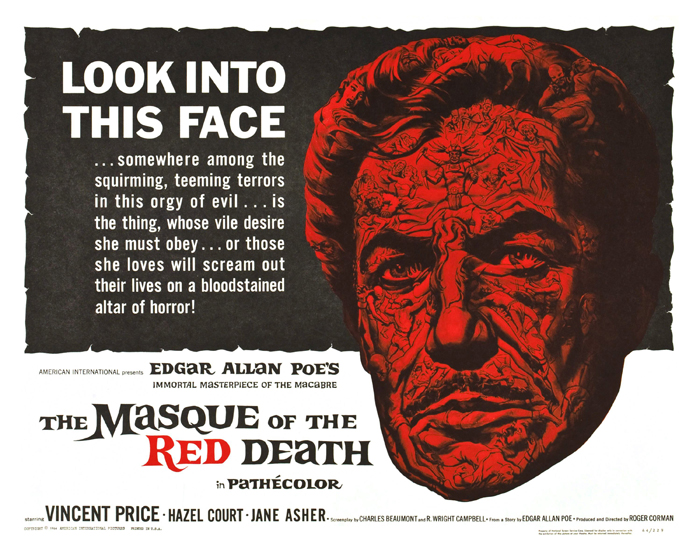
A favorite image long before I saw the film
The Masque of the Red Death (1964) was the seventh of Roger Corman's adaptations of Edgar Allan Poe for American International. It stars Price, of course, Northern Irish actor Patrick Magee, and English actress Jane Asher. The film concerns an exclusive party thrown in a remote castle by the satan-worshiping Prince Prospero while a mysterious plague, the Red Death, ravishes the villagers of the surrounding countryside.  The film not only relates the Poe story, but also wedges in another minor Poe tale, "Hop-Frog", as a subplot.


Price is deliriously decadent as the Prince, with nary a trace of the comedic ham he sometimes sprinkled into other horror roles.  His presence fills the screen and his voice delivers lines with not a few thrills and the occasional chill, as it were.  The other nobles, with the exception of Magee, become something of a faceless mass of revelers, which is fully appropriate as that's what they were.  It conjures up a vision not unlike the stories of Roman debauchery from the histories of Suetonius where the Emperor du Jour led ta mass of nobles and courtesans in sadistic charades.  Magee, as I mentioned, though in a fairly small role, stands out as that guy at the party who can't quite fit in, and despite all the excess still wants more.   Asher, on the other hand, need do little more than look the part of the frightened, innocent virgin for us to mourn her slow transition to darkness, and she succeeds.


American International Pictures was largely known for throwing together low-budget exercises for teeny-boppers in the 50's and 60's, but thanks to Corman's success with the Poe material, the shoestring budget seems little in evidence here.  (Apparently, Roger got an opulent, by AIP standards, five weeks to shoot Masque).  The sets, many reused from the Richard Burton vehicle Becket, give a sumptuous feel, and though the costumes have that older movie feel, there's a lovely nostalgia to their glamor.  Corman, it probably goes without saying, keeps the movie moving at a good clip and is able to layer in some fine atmosphere and a few solid surprises.  The orchestration of the climatic finale hasn't aged so well, but was a fitting theatrical finalé to what had come before.


I was surprised at the heavy use of the Satan-worshipping element of the plot.  Granted, in old Hollywood fashion, you can't help but see the mechanics of the morality play that will eventually deliver the goods to the baddies, and yet, I was still surprised at the frankness of the depiction.  Although, I guess it shouldn't be all surprising, it was about this time that Church of Satan founder Anton LaVey would become something of a Hollywood scenester and a regular talk show guest.  But it still seems strange that the children of the 60's seeing this would become the paranoid parents of the 80's crusading against heavy metal and Dungeons and Dragons. (Then again, parents often have a knack for denying teen proclivities like sex despite what they and their friends got up to in their own youth.)

In all, for a fun night at home, particularly in the fall, I think you'll find The Masque of the Red Death and some popcorn a fine way to spend an evening with the late, great Vincent Price.