Over the holidays, I took a long ride into noir country with two depression era classics.
The first was James M. Cain's The Postman Always Rings Twice (1934). Despite Cain's multitude of successful conversions from print to screen, he's never enjoyed the household recognition of a Chandler or a Hammet. There's a sort of cosmic irony that Chandler, who was largely a washout working as a Hollywood screenwriter, had his greatest success adapting Postman for the screen when he despised Cain's writing. (The book would be adapted again for the screen in 1981 by no less than David Mamet.) Chandler described writers like Cain as, "Such people are the offal of literature, not because they write about dirty things, but because they do it in a dirty way."
I was astounded by the total lack of Postmen in this book.
The story concerns a drifter, Frank Chambers, who happens into a restaurant owned by Nick Papadakis. Frank's trying to figure out how to get out of paying the check when the friendly Greek offers him work, which begins Frank's affair with Nick's wife, Cora. The liaison leads to the pair thinking of murder to get Nick out of the way and sends them into a spiraling sinkhole of lust and mistrust. I didn't share Chandler's disdain toward Cain's writing. I found the story a compelling study of two people who can't help from digging further and further into their sins anymore than they can start up this new fantasy life they expected to live together. However, once again, Postman represents one of those seminal works that have been hashed and rehashed so many times over the years that much of its original punch has been dulled. The characterizations, the vintage California setting and some of the unique aspects (the puma kitten, for instance) manage to rescue it from the letdown feeling of "Here we go again."
My second book had very little about it that felt all too familiar.
Horace McCoy, a contemporary of Cain's, also ended up working as a screenwriter after failing to make it as an actor and holding a string of different jobs living in Los Angeles. One of those jobs, a bouncer at the Santa Monica Pier, led to his writing the surreal and despondent They Shoot Horses, Don't They? (1935).
The "startling affair" must be in another book that I didn't read...
Horses is the tale of Robert Syverten and Gloria Beatty, two young struggling actors in Depression-era Hollywood who enter a dance marathon in hopes of winning some cash to tide them over until they get a break. The novel opens with Robert, who narrates, telling us that Gloria is dead and that he is about to be sentenced for the murder. Then, the novel takes us back to their meeting and onto and through the strain and spectacle of the marathon with its strange cast of characters en route to Gloria's murder. While the book was largely a failure in the US, it saw popularity within existentialist circles in France, and it's easy to see why. Though certainly not as alien as a work like Camus' The Stranger, Horses still holds that similar feeling of a character entering a disjointed nightmare of his own choices. While I can't call it an enjoyable read, I tore through it at a breakneck pace and found it to be a sad study of humanity in extremity, a novel as relevant in this economically difficult time period as it was in the 1930's.
Even in the age of hip hop and internet-hyped esoterica, Rudy is in many ways as underground as he ever was. A legend of rude comedy, Moore released what were known as "party records" throughout the 60's and 70's. He's perhaps best remembered now for his string of low-budget blaxploitation films, particularly Dolemite (1975), but by "best remembered" I mean remembered mostly by film geeks and hip hop aficionados. Rudy Ray Moore is one of those rare creatures who's still distributed following someone saying something like "You've never seen a Rudy Ray Moore Movie?!? Then you have to see...."
I took a trip down memory lane and revisited Moore's bizarre later entry Petey Wheatstraw: The Devil's Son-in-Law (1977), and boy, was it awful. As awful as it ever was. And awful in that special way that makes an Ed Wood movie charming. But there's something disturbing about it...
Petey is born as a six-year old during a hurricane and after receiving martial arts training as a teen, grows up to become a stand-up comedian. (Got your attention now, don't I?) Petey flies into to town for a series of dates that coincide with the opening of a new club by his comedy rivals and hoods Leroy and Skillet. Leroy and Skillet have their men "persuade" Petey not to perform in a series of mounting incidents that leads to Petey and friends being gunned down in front of a church after a funeral. In the afterlife, Lucifer convinces Petey to marry his hideous daughter, and in exchange resurrects Petey to exact his revenge on Leroy and Skillet with the help of his magical cane. But bowing to no man, Petey also seeks to outwit the devil and free himself from marrying Lucifer's daughter.
Now, if in some ways, minus the crazy suits and martial arts sequences, this sounds something like a blues song, I'm rather sure that's intentional. There was an early blues-folk singer William Bunch who performed as "Peetie Wheatstraw", a name from black folklore (Some suggest Bunch himself was the origin of said folklore.). Both Bunch and Robert Johnson, who was influenced by Bunch, have tall tales circling them that they sold their souls for musical fame. However, the movie never delves all that deep into the idea.
In fact, it's difficult to say whether the over-the-top opening sequence of Petey's birth wouldn't be more at home in a blatantly racist production. As Petey's mother struggles (and hams it up to the nth degree with the rest of the cast) to give birth, the doctor first removes a large watermelon from between her legs before Petey himself arrives. In fact, watermelon makes frequent and strange appearances throughout the film, including the exploding of a truck loaded with the fruit. In many respects, I feel like the movie was trying to develop some kind of subtext but either the message didn't come through, or I'm completely wrong and it was all meant for hackneyed laughs.
Only a master filmmaker could've talked anyone into these outfits...
Otherwise, it's the usual hokey fun, you'd expect from a Rudy Ray Moore vehicle: the stiff kung fu sequences, the bombastic rhyming delivery, a bizarre orgy scene, and lots of hyperactivity. It also features a bizarrely catchy theme song that's difficult to shake (but luckily not as dangerous to be singing as the theme to one of my favorite Fred Williamson films...look it up.). Petey isn't the place to start with Rudy Ray Moore (that would probably be Dolemite) and it's not my favorite (that, for whatever weird reason, would probably be Disco Godfather (1979)...anyone know where Bucky is or what he has had?), but for the completist, or the person that just needs one more dose, it can't be beat.
The Shadow KNOWS....the schedule of the E Train...
In 1930, on a show called Detective Story Hour, a new pop culture phenomenon was created with a character called The Shadow. But the Shadow wasn't any ordinary gumshoe. He kept his face hidden. He could disappear in plain sight. He could cloud the mind's of men. He had a secret identity. (He had Orson Welles' voice for a while...). The Shadow was one of the original superheroes who made his way from the radio into movies, books, comics, and on into Pop Culture Valhalla.
I first became aware of The Shadow in comics, just about the time that the run-of-the-mill guys in spandex just weren't cutting it for my young teen brain. Digging through some dusty boxes of comics I came across the above image by the great Mike Kaluta: The big fedora, the red scarf, the dual automatics. It was something from the past that had come to invade my future. But like many of my pulp favorites, The Shadow was in some ways of too bygone an era in style to become a true obsession, but like many of my pulp favorites, sometimes I can't resist the allure of his siren call...guess he's clouding my mind.
The Shadow KNOWS...the danger of Radon...
So I picked up this Bantam paperback of The Death Tower I found hidden away on a bottom shelf of a used bookshop. I'd been looking for this edition if only for the fantastic cover by Sandy Kossin. It's a reprint of a Shadow story from 1932 in which the Shadow does battle with Albert Palermo, a well-respected doctor who also happens to be...dun-dun-DUNNNN...a criminal mastermind. Palermo has been staging disappearances and deaths for his ill-gotten gains, and when the Shadow crosses his path, he thinks himself more than a match for the vigilante and his network of part-time helpers.
There's always a fun pulpy charm to the old Shadow stories that I've read. They move at a breakneck pace. There's always at least a small handful of narrative inconsistencies and a few strange plot contrivances. In some ways, it's what makes them quaint and enjoyable. In others, it's what keeps them from being truly memorable. Maxwell Grant, alias for author and magician Walter B. Gibson, cranked out nearly 300 of these Shadow novellas over 20 years, supposedly writing 10,000 words a day to keep apace of demand. It's a wonder they make any sense at all.
Walter Gibson...His fingers were each an inch long when he retired from writing The Shadow
And so, like many of my other pulp recommendations, I'd say you could do a lot worse for thrills and a few chills than delving into the annals of this icon of yesteryear (who still shoots his way through the pages of comics) than by picking up one of his old adventures....however, unlike Conan or Matt Helm, I would recommend familiarizing yourself with some of The Shadow's backstory and aliases and support staff, because at the pace these books go, they're not likely to help you out before their simply over.
While shopping for a gift for a friend in a used book shoppe, I came across a book I'd been looking for for ages. And yes, I'm perfectly aware of the existence of Amazon, but I still enjoy the sensation of getting my fingers dusty digging through crates and shelves. If I simply must have something I go on- line, otherwise, I often let fate decide the course of my literary leanings. In any event, there it was: Death of a Citizen by Donald Hamilton, the first Matt Helm adventure. Not a first edition, but a nice looking copy at a reasonable price.
So it's not a Carter Brown cover by McGinnis...still beats most covers today...
Those familiar with the blog may remember that I took a look back at all four of the Dean Martin vehicles in the Matt Helm film franchise. As I previously stated, the Helm books are not the swanky, swinging 60's romps as portrayed in the movies, but rather a darker, grittier version of a James Bond novel. Helm doesn't swagger through exotic locations and lavish hotels, he gets his hands dirty. Not that I don't love Bond's more jetsetting lifestyle, but sometimes you just want some meat and potatoes action.
The first novel sees Helm settling into soft middle age as a western fiction writer...and a retired ex-secret agent from World War II...when he spots someone from his past at a social gathering. Suddenly, there's a dead counter-agent in his office bathroom and he's back in the twisted world of the spy game. The book alternates between Matt's memories of his past in the war and his chase to thwart an assassination attempt on his friend, a nuclear scientist.
As I had read several of the Helm books before this, it was a bit of a letdown in the get up and go department of the later adventures. It reminded me of watching any of the comic book movies that spend far too long rehashing the characters origin rather than getting them in the suit and beating on baddies. That's not to say the book dragged or was too light on action, it wasn't. In fact, it probably had the most character study of the several that I've read, but did lack the in medias res feel that I value in action/adventure stories. Nevertheless it was solidly written with a healthy dose of suspense and a good helping of hardboiled dialogue.
I have oft considered contacting the Hamilton estate to see if I can use this for my author bio pic as well...
Perhaps one of the most fun aspects of this first Matt Helm outing is how literally in matches the life of it's author in setting. Hamilton had also served during the war, lived in New Mexico with his wife and family, and had written several Western novels such as the The Big Country, which became the 1958 movie with Gregory Peck. And, I like to think, that every time he "ran down to the store" he was doing a blackout on some Commie plot in the American Southwest. In all, Death of a Citizen was just the sort of page-turning thriller that makes for the perfect material to get you quickly from one end of a holiday flight to the other. Frankly, it's also given me the yen to perhaps revisit this counter agent more often...after all, there's only 20+ more Matt Helm adventures to go through.
Another round of marital infidelity as I continue my Dino-fication while taking in Billy Wilder's 1964 effort, Kiss Me, Stupid.
The sequel happened in Intercourse, Pennsylvania...
Generally left out of the majors of Wilder's considerable canon (Double Indemnity, Sunset Boulevard, Some Like It Hot, among many other greats), Kiss Me Stupid was condemned by the Catholic Legion of decency and was largely considered vulgar by reviewers. Time, however, has done its usual work at toning down what might have ruffled feathers in 1964. To me, it stood up well, and was an enjoyable, if farcical, concocted comedy of errors.
In the film, a small town duo of songwriters, Orville Spooner (Ray Walston) and Barney Millsap (Cliff Osmond), luck into their first contact with a big star when Vegas sensation, Dino (Dean Martin) rolls through their town on his way to Los Angeles. Barney, who runs the filling station, sabotages Dino's car to keep him around while they pitch the singer their horde of near-miss songs. Orville, an insanely jealous husband, fears having his wife anywhere near the famous lothario, so Barney cooks up a plan to get Zelda (Felicia Farr) out of the house and substitute another woman for her, the pretty barmaid, Polly the Pistol (Kim Novak). Despite his best efforts, Orville barely gets his wife out the door before Polly turns up. Of course, hijinks have already ensued from the word go, but at this point they're merely knocked up another dozen notches as Polly ends up falling for Orville rather than Dino, and Zelda ends up passed out in Polly's trailer behind the roadhouse.
Walston's in Nevada after leaving Roswell...but before moving in with Bill Bixby...(look it up)
At this point, I don't want to give too much more away though I've already hinted at the problems the public had with it above. It's sort of hilarious to me that five years before, the public and critics had far less trouble with a pair of musicians going in drag to chase girls...and escape the mob...in Some Like it Hot. Naturally, fifty years and movies like Indecent Proposal, have made the elements of Kiss Me, Stupid ludicrously tame. In fact, I'll go so far as to say that this movie does a fine job of making marital infidelity quite touching considering the scenario involved.
Wilder is a master, and not just because film history books tell us so. The Austrian-born filmmaker first escaped to France as the Nazis came to power to start making pictures before continuing on to Hollywood. His films have both the meticulous feeling of a powerful hand in charge while still managing to be light and often wildly inventive (I recommend reading about some of the crazier things he wanted to do with Sunset Boulevard, a film that still ended up pretty damned inventive with what he did do with it). And while this one lacks some of the flair and zany fun of a Some Like it Hot, it's still firmly in the master's hands.
Dino's commentary on chianti or lady's footwear?
Ray Walston does a wonderful, if occasionally over-the-top job as Orville. He's a little too archetypal jealous husband, constantly chasing away anything with a Y chromosome, but is still entertaining to watch as he's able to pivot emotional direction on a dime. Felicia Farr as Zelda is very obviously desirable both in terms of looks and personality, but gets a little less of a chance to shine as character in comparison to Kim Novak as Polly. Polly, like Orville, is again a touch too archetypal in the "hooker with a heart of gold vein," but still managed to tug at a few heart strings as the story progressed. The biggest surprise is Dino, who in many respects is presented as playing himself, and it's none too flattering. The film opens with him charming a crowd with song and jokes from the stage, but once in Orville's house he's all "Roman Hands and Russian Fingers" as the saying goes. He comes off as a first class heel, but at least he does it well.
Sexier to Billy: being on set with Kim Novak or writing with Raymond Chandler?
Kiss Me, Stupid may not be the one you choose to show if only allowed to present one Billy Wilder vehicle, but I admit to having a soft spot for interesting if lesser-known works. After all, I'd probably show The Wild Bunch if I could only show one Peckinpah, but I savor the flawed and highly personal Pat Garrett and Billy the Kid on a more personal level. As I mentioned in my review of Who's Been Sleeping in My Bed?, I do love the movie world created especially well in older movies, and while Kiss Me, Stupid delivers on that, it's also nice that it has just the right amount of real world honesty.
My earliest foray into earning cash was in music stores. Music stores are...perhaps were...a great place to expand one's cultural horizons as all the employees tend to be deep into one type of music or another. Some stuff they agree on, much they do not. And eventually you find your place in the spectrum.
More or less exactly how I looked in 1995 at my store in Pontiac, MI.
It also does a fine job embittering you to how generally awful and limited the taste of the general public is. And I don't say that because they didn't like specifically what I liked. No, they didn't tend to see eye-to-eye with any of my fellow employees on much of anything, and not because we were all elitist (though some definitely were). We all had our guilty pleasures, but the public tended toward the bland chart toppers, the same greatest hits collections, and whatever was passing for bad dance music at the time.
In any event, at various times, I learned to try it all and give anything a chance if only to see where it fit in. I love not only knowing who influenced the artists I liked, but also who they influenced. Nothing's created in a vacuum, so I like to find the threads in the tapestry. But there are ends I stop short of that usually start with the non-hyperbolic modifier "deep."
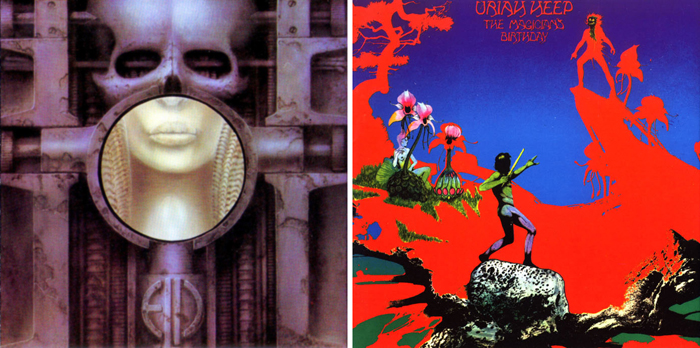
Symphonic or Prog rock tends to fall on the "deep" end of the rock spectrum: large, expansive, heavily layered, experimental walls of sound that can frequently be impenetrable. The cover art usually depicts an otherworldly place that only this music could be the soundtrack to. And like the sci-fi/fantasy worlds it seems to depict, it's usually only there for those who really care to plumb the depths. It's usually not catchy. It's not hooky. It's a twenty minute odyssey that will in no way break the radio play charts. And just because it's symphonic doesn't mean it's melodic.
"On your left you can see Detroit, Michigan...and on your left Fresno..."
There are some exceptions of course, but if you came at a prog fan with only Pink Floyd, The Moody Blues or the couple of pop hits that Yes cranked out, you'd only receive the smug derisive chuckling that the initiate reserves for the outsider. All the same, I'm not generally a fan of the stuff. Seeking to expand the sound of rock and add weight to it isn't a terrible goal, but considering rock's roots, it was perhaps a bit wrongheaded. Addition and expansion eventually become bloat and pretension, which in this case led to the stripped down distorted roar of punk.
Having said all that, I took a wild stab at a prog album from Japan: 1979's Shingetsu by the band of the same name. Shingetsu, which means "new moon," lasted a mere six years and only produced this one work, but what they did do has been heralded an exalted enough to continue to be dispersed in this modern age. I can't say that I disagree.
Seems like a good place to reaffirm my love for a well done "Alice" tribute
Much of my exposure to Japanese music has fallen into one of three categories: the sugary overload of J-pop, the wild experimentation of the electronic, and the melodic melancholy of the more traditional or musical scores. Shingetsu doesn't fall into any of those three categories. Though it has moments that have a more pop feel than a fair amount of prog, it certainly doesn't have much of the trite Top 40 Tokyo feel. Though it is certainly experimental with the multiple layers of sound, it's doesn't have some of the rabbit punches of abrasiveness I've come to expect. And while it does have enough of the mood of some of the more traditional stuff, it would be more like the soundtrack to a late 70's animé version of Heavy Metal.
Ok...with just a smidge of Goblin mixed in there at varying points.
Lead vocalist Makoto Kitayama has a gentle, emotional voice with some fine acrobatics to match the highs and lows of the tunes. The band is a sharp set of musicians who are more than capable of spinning a pretty good sound web. Each song usually features a pretty steady rise and fall in arrangement and tempo making for miniature musical journeys in the framework of the whole. I can't comment as to the quality of the lyrics as I'm not as well versed in Japanese as I'd like to be. It could be all about Yōkai playing poker while eating pickles atop Mount Fuji while the Lord of the Rings is re-enacted in the various Japanese theater styles below. I don't think it is, but I have just thought of a pretty good theme for my next concept album.
I'll confess that though I'll occasionally still give prog a chance, it rarely talks me into a second listen, either because it's simply too dense for me to get into, too ethereal to make much of an impression, or simply too pretentious a bloated mess for me to care about. Shingetsu, however, has managed to keep me quite well enchanted for the half-dozen spins I've given it thus far. I shall look forward to spinning it again.
I sit around most days and create. I've written 4 books (2 available through my site or Amazon), a small stack of screenplays, and a bunch of ad and web copy. When not using words, I paint and draw quite a fair bit. Occasionally, I'm paid for doing this. I like paper, pens, india ink, celluloid and alcohol. I hope you enjoy a little of what I've made for you, my love...my storm...my anonymous public...